Ray Eames Trailers
Out of the Picture TrailerEames: The Architect and the Painter Trailer
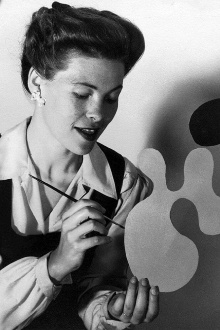
Ray-Bernice Alexandra Kaiser Eames was an American artist and designer who worked in a variety of media. In creative partnership with her husband Charles Eames and the Eames Office, she was responsible for groundbreaking contributions in the fields of architecture, graphic design, textile design, film, and furniture.
Most Popular Ray Eames Trailers
Total trailers found: 56
01 January 1970
The process of manufacturing fiberglass chairs is shown through visuals only, with no narration.
01 January 1972
A parable, photographed in live-action, about the use of eating utensils in India. Doubling as a social commentary, this film also examines the significance and status that people attach to their artifacts.
01 January 1970
Created with imagery taken from the 19th-Century Japanese woodcuts on display in the Smithsonian Institution’s exhibition “The Japanese Expedition 1852-1866 of Commodore Matthew Perry,” the film records the opening of the country to Western trade from a Japanese perspective.
22 March 1961
Symmetry is one of five shorts featured in the film "Mathematical Peep Shows." The collection was made by Charles and Ray Eames for the IBM Mathematica Exhibit which opened in 1961.
01 January 1957
A portrayal of the Mexican Day of the Dead consisting of still shots and narration. Deals with the special objects and events surrounding the annual Mexican celebration of “All Souls Day”.
01 March 1961
The concept of a mathematical function is illustrated as used in science.
01 January 1968
A rare, live-action, and close-up study of the only existing Babbage Difference Engine, a machine designed in the first quarter of the 19th-Century by English inventor and mathematician, Charles Babbage.
01 January 1965
A morality film where Sherlock Holmes solves a case using Boolean logic.
01 December 1969
"Based on the exhibition "Photography and the city", designed by the Eames Office for the Smithsonian Institute".
01 January 1976
A short film of the opening of the last museum exhibition prepared by the Eames. The exhibition was called "The World of Franklin and Jefferson" and was to celebrate the bicentennial of the American Revolution.
01 January 1961
Documentary short
31 December 1972
The Eames design philosophy presented in the form of a series of questions posed by a curator at the Louvre and answered by Charles Eames.
01 January 1973
The life and work of the astronomer Nicolas Copernicus are shown by means of images of his writings and drawings and places he was associated with.
01 January 1973
The lives of Franklin and Jefferson are used as prisms through which to evoke colonial America. With a dynamic timeline and a wealth of images drawn from architecture, science, and politics, the film brings alive the way American history shaped, and was shaped by, these two men.
01 January 1965
This film reveals design proposals for the IBM pavilion at the 1964 New York World's Fair. It incorporates photography and animation to present the concepts, architecture, and overall look of the pavilion and to convey an impression of the exhibition's spirit and content.
01 January 1957
Charles and Ray produced this film for IBM’s pavilion at the 1958 Brussels World’s Fair. The Information Machine was the first completely animated project produced by the Eames Office.
01 January 1972
Based on an existing slide show the Eames Office had made about the exhibition, A Computer Perspective (produced for IBM in 1971).
01 March 1955
hese two churches, Viersehnheiligen and Ottobeuren are rich examples of mid-18th-Century German Baroque, a time when music, literature, architecture and philosophy were unified.
01 January 1969
Various kinds of tops are shown spinning.
01 January 1955
The Eames House and Studio is explored via a series of slides.
01 January 1978
A film record of an exhibition of the late work of Paul Cezanne, organized by The Museum of Modern Art and the Reunion des Musees Nationaux in Paris.
01 January 1960
Photographed through a mirror system to achieve radial kaleidoscopic images, the beginning portion of this film consists of fast-moving kaleidoscopic images of chairs, objects, and materials.
22 March 1961
2ⁿ is a story about the exponential growth of numbers raised to powers. Part of the Mathematica Peep Shows, one of five films made to accompany the Mathematica: A World of Numbers and Beyond exhibition at the California Museum of Science and Industry and the Museum of Science and Industry in Chicago.
01 January 1973
Created as a demonstration of multi-disciplinary thinking, this film was produced in association with UCLA Mathematics professor, Ray Redheffer.
22 January 1960
The Fabulous Fifties, CBS, combines style, humor, and imagination. It was rich in touches of quality showmanship and equally rich in the memories of a decade which it revived.
04 April 1961
The Greek mathematician Eratosthenes estimates the circumference of the earth.
26 March 1961
Short animated film commissioned by IBM - to illustrate Camille Jordan's concept of topology - the fact that a simple closed curve divides a plane into an inside and an outside.
04 June 1977
A scientific film essay, narrated by Phil Morrison. A set of pictures of two picnickers in a park, with the area of each frame one-tenth the size of the one before.
01 January 1967
The film sets forth the objectives of the planned Center, describes its architectural program, and gives a guided tour through a model of the galleries and exhibits.
31 December 1970
An excerpt from the Charles Eliot Norton Lectures, which Charles delivered at Harvard University in 1970-71.
01 January 1970
A live-action film of a rare sea creature. The tiny transparent life form (only 5/8″ high) has only rarely been observed in its natural habitat.
01 January 1973
This film was produced to present the Eames proposal to make an American Revolution Bicentennial celebration.
13 June 1990
In 1957, Charles and Ray designed the Solar Do-Nothing Machine for Alcoa, the Aluminum Company of America.
02 January 1952
A visually elegant study of water on a schoolyard playground.
01 January 1957
This film was made by the Eamses on a weeks notice for a local Los Angeles TV show where jazz musicians improvised to the images live.
01 January 1958
To avoid making travelers walk excessive distances through a large airport, Washington, D.C.'s new airport is to use mobile departure lounges to transport passengers from the terminal directly to the plane.
25 September 2025
But where have the women architects gone? It’s been a few centuries since women have been creating architectural works with passion and talent in a profession dominated by men.
18 November 2011
Interviews with the junior designers swept into the 24-7 world of "The Eamery" are the heart of this complex picture of a husband-and-wife creative team that define the era of Mid-Century Modernism.
25 April 1955
A film by Charles and Ray Eames
01 January 1952
A live action pageant of mechanical toys, animals, puppets, cars, lead soldiers, and dolls—all set in motion.
05 April 1968
From hardware to software, the basics of then-current computing technology is explained.
01 January 1968
A Rough Sketch features a linear view of our universe from the human scale to the sea of galaxies, then directly down to the nucleus of a carbon atom.
01 January 1960
The short film uses a variety of familiar examples that have the feedback principle in common to present a broad view of the phenomena present in control mechanisms and social situations.
01 January 1976
Atlas gives the viewer an overview of the rise and fall of the Roman Empire. Beginning in 500 BC, a time clock at the bottom of the screen marks off the years – eight to a second – as the boundaries on the animated map change, showing both the growth including the conquests of Alexander the Great, as well as the decrease as the power of the Romans declined.
08 August 1957
An interesting look at the world of toy trains, shot from the perspective of the little world itself. Originally created for model train enthusiasts, this short film transcends it's intended audience to delight viewers of all ages and interests!
01 January 1953
Presented without voiceover, various kinds of breads are displayed and broken in a joyous celebration of starch, seed and salt.
01 January 1974
Animated graphic symbols presented in a constant time frame are used to diagram and explain the laws of planetary motion devised by the Sixteenth-century astronomer Johannes Kepler.
01 January 1972
One of a series of three films on mathematics conceived and produced by the Eames Office with Ray Redheffer, professor of Mathematics at UCLA.
01 January 1953
An early attempt to present communications theory, made to encourage the breaking down of barriers of thinking between disciplines and to discourage thinking of communications in a limited way.
01 January 1971
The movie "Clown Face" offers a very rare glimpse into the backstage private world of Circus Clowns. Here, you can look behind the curtain.
01 January 1950
With a cast consisting exclusively of toys, a Japanese windup boy carrying a suitcase has a series of encounters with other windup toys.
01 January 1961
Produced to introduce the functions and design properties of the Eames Contract Storage units. This innovative use of live-action and animation accompanies an Eames script which includes the famous Eames quote “The details are not details, they made the architecture – the gauge of the wire, the selection of the wood, the finish of the castings – connections, the connections, the connections.
01 January 1972
Utilizing surveys and reports on the background of cable television, this film explores its place in the world of television, and its future potential as a communication tool in workplaces, educational institutions, the home, and the community.
01 January 1975
Using live-action footage, animation, and still photography of a scale model, this film presents the Eames unique multimedia concept for making the museum’s resources more accessible via a central information center and guide to the myriad collections and galleries of the Metropolitan Museum of Art.
01 September 1965
Featuring narration by Walter Cronkite.
01 January 1966
The subject of problem solving begins with an explanation of what the Eameses called “the information machine, “a device for presenting information in fragments so that viewers are compelled to see new relationships among events, objects and people.