Satsuo Yamamoto Trailers
Ah! Nomugi Pass — Fresh Green Edition TrailerAuto Town TrailerNomugi Pass Trailer
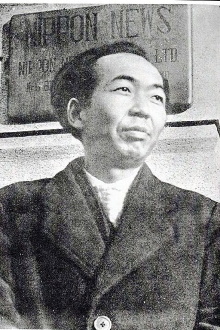
Satsuo Yamamoto (July 15, 1910 - August 11, 1983) was a Japanese film director.
Yamamoto was born in Kagoshima Prefecture on July 15, 1910. He dropped out of Waseda University to join Shochiku, where he worked as an assistant director to Mikio Naruse and others. He followed Naruse when he moved to PCL, and became a director in his own right after the company was reborn as Toho. During WWII he directed several pro-war propaganda films for them despite being a fervent member of the Japanese Communist Party (JCP), and after the war he rallied against the company as a driving force behind the union during the 1948 Toho labour dispute (in which the JCP was heavily involved), after which was ultimately fired.
He subsequently worked on independent films and made numerous intensely rebellious and substantial socially conscious works. From the 1960s onward, he directed a succession of major films including the Toyoko Yamasaki adaptations “The Ivory Tower” and “The Perfect Family”, the “Men and War” trilogy, and “Kotei no inai Hachigatsu”. This body of epic works led to him being dubbed “the Red Cecil B. DeMille”.
Three of his films, Shiroi Kyotō, Fumō Chitai and Ah! Nomugi Toge won the Mainichi Film Award for Best Film.
He died of pancreatic cancer on August 11, 1983 at the age of 73.

Most Popular Satsuo Yamamoto Trailers
Total trailers found: 62
23 September 1958
The humorous tale of Jimbei, a miller, and his wife Osen who live in complete happiness. But Osen's beauty attracts numerous would-be lovers among whom is the local governor, a timid creature, who is dominated by his high-born and beautiful wife, who dresses in a scarlet battle-tunic, a sign of his family's military merit around which he fabricates fantastic tales of his prowess in war.
21 February 1939
A rich bourgeoisie family has little care in the world and knows no other lifestyle. It is only the family's second daughter who has an insecure bone in her body and ponders a day when the good times might end.
24 April 1940
9th directorial work by Yamamoto Satsuo.
04 April 1964
The intense selfishness of a man brings him fame and fortune but not happiness.
11 August 1973
As Japan's war of aggression against China intensifies, beginning with the Nanjing Massacre in December 1937, Kohei, who had secretly married Junko, the second daughter of the Godai family, deploys to the front lines, witnessing the atrocities of the Japanese army firsthand.
10 July 1947
A woman remarries after receiving official notification that her husband has died, but he returns.
03 February 1954
Military doctor Leutenant Hanada deserts during the war in the Philippines with a local girl. The officer in command orders Lieutenant Uji to shoot Hanada.
11 February 1959
A lifetime story of a woman who stubbornly lives in a poor mountain village in post-war Japan.
23 September 1978
Taking the Chilean coup as an example, a group of young officers plan to overthrow the Japanese government on V-J Day.
15 October 1966
The story contrasts the life of two doctors, former classmates and now both assistant professors at Naniwa University Hospital in Osaka.
26 January 1974
Set in the post-World War II climate of the 1960s in Kobe, the movie explores the struggle for power within the powerful Manpyo family.
01 December 1962
Warlord Oda Nobunaga seeks to unite a fractured Japan. A young man trained in the arts of ninjitsu is manipulated by a ninja master into attempting to assassinate the warlord before he completes his task.
05 July 1955
The film consists of three short stories. Tomiko, the heroine of the first story, "The Flower Girl" (dir.
25 January 1968
After the death of a colleague, the workers at a factory form a labor union.
01 May 1965
Gisuke Hayashida is an illegal dentist during the day and a burglar by night. One night during a burglary he witnesses a train derailment.
12 June 1971
As the Japanese military has established the puppet state of Manchukuo and is advancing its invasion of Asia, fighting intensifying battles against anti-Japanese partisans, the Godai zaibatsu becomes involved in large-scale opium smuggling.
19 December 1956
A group of shady politicians want to make money after a typhoon by claiming the schoolhouse has been destroyed and then cashing in on building a new one.
14 August 1976
Tadashi Iki returns to Japan from a Soviet gulag 11 years after being captured during the invasion of Manchuria.
30 June 1979
The story of the silk industry and the young girls who worked as silk spinners in the early 1900s in Japan.
10 December 1952
Just before the end of the war, Japanese soldier Kitani is released from prison, having served his term for theft.
15 June 1968
On the night of the summer Obon festival, Hagiwara Shinzaburo meets a beautiful courtesan named Otsuyu.
15 November 1969
Sentaro is been severely beaten for his defiance of the government and the high taxes during a time of famine.
26 April 1934
Mikio Naruse’s final silent film is a gloriously rich portrait of a waitress, Sugiko, whose life, despite a host of male admirers and even some intrigued movie talent scouts, ends up taking a suffocatingly domestic turn after a wealthy businessman accidentally hits her with his car.
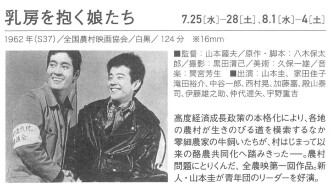
07 October 1962
As Japan's economic growth policies intensify, small-scale farmers embark on a first-ever communal dairy farming initiative in their village.
06 February 1982
In a factory that prioritizes profits amid economic downturns, a female worker criticized for her poor performance commits suicide, prompting her colleagues to strike and demand improved working conditions.
15 May 1965
Murder case and trial.
18 October 1959
Drama which shows the struggle of Fumiko, a female teacher, at work and at home.
03 May 1963
Comedy drama film
14 March 1952
A period film about a peasant revolt in the region near Mount Fuji, occasioned by high officials' depriving the farmers of their water rights.
29 April 1967
Toramatsu is a very enthusiastic policeman. Believing that the police should help others he is dismissed the force when his pistol is stolen while doing one of his good deeds.
15 November 1955
A travelling theater troupe, led by Umagoro Ichikawa, comes to play in a mining town, and manages to sell every seat.
07 October 1943
Set in wartime at the Yawata Steel Works in Tobata, Yawata, and Kokura cities in Fukuoka Prefecture, the film depicts people taking on the evil blast furnaces that prevent increased production.
06 August 1963
[Period covered: 1582-1594]. As the film opens, the warlod Nobunaga Oda rides to Iga Ayanokuni shrine.
12 August 1967
When a local gambling house kidnaps some peasants because they failed to pay their debts, a rival gambling house pays their debts and sets them free.
15 July 1932
The film is about a protest provoked when the university decided to restrict access to sports facilities to athletes, cutting out all other students.
24 June 1954
Based on the novel by proletarian writer Sunao Tokunaga. The story is about a long strike by workers at a large printing house and the strikers' steadfastness, which neither hunger nor violence could break.
14 August 1970
The upstart Godai family conglomerate plans to strengthen ties with the hardliners in the Kwantung Army as they plan military expansion into Manchuria.
08 November 1960
It's a story of the life of a man who advocated the necessity of sex education to children, which was unusual at the time, solely opposed to the amendment of the Peace Preservation Law, and was assassinated by a rightist prior to his opposition speech.
03 February 1961
Satsuo Yamamoto's filmic depiction of the famous 1949 Matsukawa Incident.
09 April 1977
Six months after the liberation of Vietnam, a ship called the Thong Nhat (Unification) arrives at Saigon Port.
26 May 1970
A group of teenagers grow up in Okinawa amid the protests and resistance against the presence of the American base in the island.
11 June 1938
A priest in Hokkaido adopts a blind orphan girl, and as she grows up he finds himself falling in love with her.
04 September 1965
Based on true events surrounding a Korean student who had entered Japan unlawfully and escaped illegal alien internment.
26 February 1950
An attempt is made to suppress a journalist's investigation of collusion between a rural police chief and the local gangster bosses.
26 March 1966
Keizo Tsujiguchi believes his wife Natsue was having an extramarital affair when their child was kidnapped and killed.
06 September 1975
When bribe money from a rigged election funnels into a dam construction project, collusion, lust, greed and even murder are on the ballot.
02 October 1969
Captures the optimistic attitude and entrepreneurial spirit characteristic of the Vietnamese people, who remain positive despite ever-present reminders of the horrors of the Vietnam War.
13 November 1976
A great famine struck all of Japan: the so-called Great Tenpō famine. It was a time when there were frequent uprisings in rural areas due to farmers losing their land as a result of strict tax collection.
30 October 1940
A family comprised of a father, mother and three sisters lives in a posh area. The father is a doctor who has to join the army and work at war.
21 July 1937
The story deas with the experiences of an exceptionally strong-willed, middle class Tokyo "ojōsan" who comes to teach in a middle school in the countryside.
09 October 1938
Adaptation of Nobuko Yoshiya’s story.
29 September 1938
Adaptation of Nobuko Yoshiya's story.