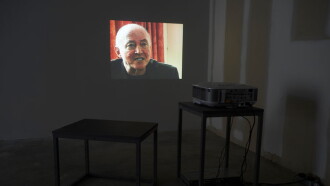
Vito Acconci Trailers
Burden TrailerRevenge of the Mekons TrailerAmerica Is Not Ready for This Trailer
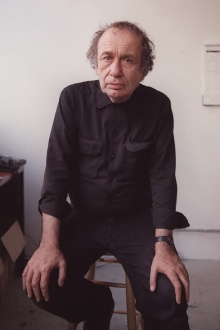
Vito Acconci (January 24, 1940 – April 27, 2017) was an American performance, video and installation artist, whose diverse practice eventually included sculpture, architectural design, and landscape design. His performance and video art was characterized by "existential unease," exhibitionism, discomfort, transgression and provocation, as well as wit and audacity, and often involved crossing boundaries such as public–private, consensual–nonconsensual, and real world–art world. His work is considered to have influenced artists including Laurie Anderson, Karen Finley, Bruce Nauman, and Tracey Emin, among others. Acconci was initially interested in radical poetry, creating 0 to 9 Magazine, but by the late 1960s he began creating Situationist-influenced performances in the street or for small audiences that explored the body and public space. Two of his most famous pieces were Following Piece (1969), in which he selected random passersby on New York City streets and followed them for as long as he was able, and Seedbed (1972), in which he claimed that he masturbated while under a temporary floor at the Sonnabend Gallery, as visitors walked above and heard him speaking.
In the late-1970s, he turned to sculpture, architecture and design, greatly increasing the scale of his work, if not his art world profile. Over the next two decades he developed public artworks and parks, airport rest areas, artificial islands and other architectural projects that frequently embraced participation, change and playfulness. Notable works of this period include: Personal Island, designed for Zwolle, the Netherlands (1994); Walkways Through the Wall at the Wisconsin Center, in Milwaukee, WI (1998); and Murinsel, for Graz, Austria (2003). Retrospectives of Acconci's work have been organized by the Stedelijk Museum in Amsterdam (1978) and the Museum of Contemporary Art, Chicago (1980), and his work is in numerous public collections, including those of the Museum of Modern Art and Whitney Museum of American Art. He has been recognized with fellowships from the National Endowment for the Arts (1976, 1980, 1983, 1993), John Simon Guggenheim Memorial Foundation (1979), and American Academy in Rome (1986).[6] In addition to his art and design work, Acconci taught at many higher learning institutions. Acconci died on April 27, 2017, in Manhattan at age 77.

Most Popular Vito Acconci Trailers
Total trailers found: 75
22 June 1991
Inspired in form by American police TV shows and soap operas, The Golden Boat is a madcap, surreal dash through the streets of New York city, telling the mysterious and often hilarious story of an aged street-person named Austin, a comically compulsive assassin, as he joins up with a young rock critic and philosophy student named Israel Williams.
22 February 1999
"Steven Holl: The Body in Space" explores the career of the innovative, highly renowned American architect.
01 January 1971
In Conversions II, the second in a trilogy of films interrogating the rigidity of gender binarism, the artist attempts to feminize his unquestionably male body by hiding his genitals between his legs.
16 April 2016
A probing portrait of Chris Burden, an artist who took creative expression to the limits and risked his life in the name of art.
01 January 1973
This early document is a videotaped interview ("videoview") of Vito Acconci by Willoughby Sharp during which they discuss Acconci's development as an artist.
01 January 1981
With HOW TO FLY, Bowes abandoned plot entirely, finding other forms of structure. He wanted to show that stories do not have to obsessively organize and explain data, and that television’s hundreds of simultaneous, fragmented narratives – news, fiction, commercials, sports, etc.
23 May 2008
Chelsea on the Rocks celebrates the personalities and artistic voices that have emerged from New York’s legendary Chelsea Hotel.
10 October 2009
Explores some of the most innovative attempts by contemporary artists, filmmakers, architects etc to explore multiple Temporalities and to counter the uniform sense of time promoted by our technology-driven society.
02 January 1970
"Acconci spars with his close-up image in a mirror. He then breaks the mirror, destroying his image.x
01 January 1972
"In another exploration of nonverbal communication, the camera moves back and forth, each time catching one of Acconci's hands in an expressive gesture.
15 July 1970
Acconci's body-based performances are often willfully provocative in their testing of physical limits and controlled actions.
01 January 1973
Super-8mm footage documenting the gallery set-up for Acconci's exhibition AIR-TIME at Sonnabend Gallery in 1973.
01 September 1981
The multiple means of making art after the end of illusionism led these artists to create performances, sculptures, earthworks, tableaux, furniture, shaped canvases, and more, using unusual materials.
01 January 1973
Acconci lies naked on a gurney-like table, rocking back and forth as a tape-loop of his voice describes his anxieties about exposing his body and his artwork.
01 January 1971
A super-8mm document (blown up to 16mm) of Acconci's performance of the same name in which he covered almost the entirety of the gallery space with a tarp (except about a two feet perimeter around the tarp where visitors could awkwardly make their way through) that was maybe two feet off the ground as he crawled underneath for six hours confronting himself.
01 January 1970
A ten minute super-8mm work from 1970 by Vito Acconci.
01 January 1974
In this feature-length silent film, Acconci uses hand-written title cards to present an "interior monologue" about speaking, language, and silence.
01 January 1974
Acconci imitates the sounds of war, gunfire and explosion; he thrusts his face, stomach or penis onto the screen.
01 January 1972
"In this exercise in nonverbal communication, Acconci explores facial expressions, and their psychological resonance, as a mode of performance narrative.
01 January 1971
The final installment of the Conversions trilogy.
01 January 1970
A five minute super-8mm short from Vito Acconci
01 January 1977
A three-part video epic in which avant-garde artist Vito Acconci explores the relationship between the self and national mythology.
01 January 1973
"Visions of a Disappearance is a newly restored performance tape that was recorded in Naples, Italy, in 1973.
01 January 1971
Using extreme close-ups and amplified sound to force the viewer into the space of his body, he experiments with his mouth as a container for saliva, holding it in as long as possible, trying to catch it in his hands.
01 January 1970
A woman kisses Acconci's body, covering him in red lipstick traces. Acconci then rubs his body against another man (Dennis Oppenheim), transferring the stains onto him.
01 January 1972
A super-8mm work documenting Acconci's audio installation piece in the Sonnabend gallery in 1972 of the same name.
01 January 1970
"A view of a brick wall: the artist enters and walks from one side to the other, back and forth, row after row.
10 October 1970
In this performance based tape, Acconci uses his body to explore notions of opening and closure.
01 January 1970
"Acconci caresses his torso, then crushes cockroaches into his stomach and rubs them into his skin."x
01 January 1974
In Face of the Earth, Acconci's face becomes a metaphorical theater for a narrative drama of the mythic American landscape.
22 October 2006
"You’re Going to Die!" is a children’s story exploring one simple idea ad nauseum bonum. This video treatment by Dennis Palazzolo adapts prose by Timothy Furstnau using original footage and clips lifted from famous movies, and features the close-mic’d muttering voiceover of artist Vito Acconci.
01 January 1972
A super-8mm short from Vito Acconci
01 January 1973
Face-Off is an ironic collusion of private and public, of exposure and masking, a tense ritual wherein Acconci divulges and then censors his self-revelations.
21 January 1971
A documentation of a live performance at New York University, Pryings is a graphic exploration of the physical and psychological dynamics of male/female interaction, a study in control, violation and resistance.
01 January 1970
A three and a half minute Super-8mm piece on concentration/contemplation by Vito Acconci.
01 January 1974
The back of Acconci's head is seen in tight close-up. He hums to himself, first lyrically, then aggressively, violently.
01 January 1973
"A long narrow corridor, leading to the camera—at one side, a window—sun streams in, splotches of light and dark, the corridor shimmers.
01 January 1971
Acconci's face is seen in close-up. His eyes trace, in real time, the movement of the hands of an off-screen clock.
11 August 1973
In Theme Song, Acconci uses video as close-up to establish a perversely intimate relation with the viewer, creating a personal space in which to talk directly to (and manipulate) the spectator.
01 January 1972
A super-8mm short by Vito Acconci
01 January 1970
"Super-8 camera held out before him as shield and surrogate, Acconci pushes through a landscape of dense reeds and overgrowth.
01 January 1974
"I walk in a circle around the camera: sometimes I'm on screen, sometimes I'm off, sometimes I change direction, leaving the screen on one side and coming back on the same side.
01 January 1972
"In this now infamous tape, exemplary of his early transgressive performance style, Acconci sits and relates a masturbatory fantasy about a girl rubbing his legs under the table.
01 January 1970
"Unavailable until recently, Corrections is Acconci's first single-channel video. Back to the camera, with only his head and bare shoulders visible, Acconci lights a match and brings it around to the nape of his neck.
01 January 1971
This early performance tape is an example of what Acconci has termed his "quasi-ESP exercises," in which he explores mental concentration and intuition as a means of non-visual and non-verbal perception, interaction and communication.
01 January 1973
"Recording Studio From Air Time is a personal confessional in which video is both a mirror and a mediating device.
01 January 1971
A super-8mm document (blown up to 16mm) of Acconci's performance of the same name where he laid flat on his stomach blindfolded on a wood platform in the middle of an arts event at a Rhode Island university as students watched videos, listened to music, etc and he spun himself in circles until he reached exhaustion at which point he would point at a random student and wish them dead.
01 January 1971
Contacts is one of a series of tapes in which Acconci creates a controlled performance situation to explore the limits of a private space.
01 January 1974
Acconci's open mouth is framed by the camera in an extreme close-up, bringing the viewer uncomfortably close.
01 January 1970
"In Scene Steal, Acconci, fully clothed, tries to shield a nude woman from the camera. In Container, he wraps his nude body around a cat as if to totally enclose it.
01 December 1970
Vito Acconci chokes himself with a white cloth multiple times, his face turns red.
01 January 1971
The screen is empty: the artist stands off-screen — he breathes in and out, his stomach moving into and out of the frame.
01 January 1969
In 'Looking Around Piece', the performer stands before a fixed camera, which records his eye and head movements as he follows a moving object outside the frame.
15 February 2007
For Seven Easy Pieces Marina Abramovic reenacted five seminal performance works by her peers, dating from the 1960's and 70's, and two of her own, interpreting them as one would a musical score.
01 January 1973
Torn over the pressure to perform for his audience, Acconci fantasizes about "a dancing bear" who takes his place, performing in the spotlight, doing what others want, "what I always had to do.
14 November 2013
Documentary about the Mekons.
11 January 1980
An epic meditation on psychoanalysis, the Baader-Meinhof, feminism, and pre-revolutionary Russia.
01 January 1971
A documentation of one of Acconci's most notorious performances, Claim Excerpts is a highly confrontational work, an exercise in self-induced, heightened behavioral states, and an aggressive psychological exploration of the artist/viewer relationship.
01 January 1970
The artist, covered in flour, tries to blow the flour off his skin.
01 January 1970
Standing alone among beach dunes, Acconci begins to kick at the sand below him. Over the course of the film's ten minutes, this repeated action displaces sand at a steady rate: as the artist sinks lower into the hole he creates, the mound of sand before him grows in correspondence.