Most Popular Werner Schroeter Trailers
Total trailers found: 60
25 May 1978
Thirty years of Neapolitan history (from 1942 to 1972) through the ups and downs of the Cavioli and Pagano families.
02 September 2010
When director Daniel Schmid grew up, his parents ran a hotel in the Alps, and this singular setting was to influence his film.
01 September 1971
Film director Jeff and his lead actor are taking their time getting to set. In their absence, the crew lack a purposeful way to spend their time waiting, so they drink heavily.
17 January 1991
An unusual story of a triangular relationship in Vienna. A woman shares an apartment with a man named Malina.
11 June 1971
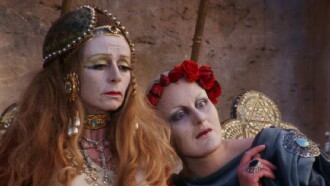
Schroeter's virtuosic staging of the Oscar Wilde tragedy is a complex montage of image and sound, filmed on the grand steps of Baalbeck, the ancient Roman temple in Lebanon, and interweaving Lebanese and German folk songs with the music of Verdi, Wagner, Strauss, Mozart, Bellini, and Donizetti.
18 December 1971
Fusing Shakespeare‘s tragedy with the Verdi opera, Schroeter's Macbeth is a fascinating television experiment shot entirely in a studio with several electronic cameras.
08 October 1969
Feminist short film set in West Berlin. A militant group of homosexuals who campaign for women's liberation.
03 March 1986
A mentally unstable woman and her son move to a sprawling mansion in Portugal to grow roses.
25 November 2011
Elfi Mikesch accompanies Werner Schroeter in staging a tribute to Lautréamont in Berlin.
12 March 1982
Oskar Panizza’s The Council of Love (1895) is a blasphemous play set in 1495, during the first recorded outbreak of syphilis, which Panizza satirically presents as the punishment from Satan for sexually active humans.
20 May 1976
Werner Schroeter's rhapsody of excess leaps from 1949 Cuba to contemporary France to points in between, while its feverishly shifting visual style evokes and parodies everything from kitschy Mexican telenovelas to silent French art films.
11 February 1989
Philippe Garrel’s documentary on France’s second wave of masterful filmmakers. Featuring Jean Eustache, Chantal Akerman, André Téchiné, Leos Carax, Jacques Doillon and Benoit Jacquot.
04 May 1979
Personal diary-style documentary of German Gay rights activist Von Praunheim's sojourn in the US.
01 May 1968
"Of all the female interpreters I know, Maria Callas was the one who, in her expressive power, could let time stand so long until all fear disappeared, including that of death itself, and reached a state similar to what should be called happiness has been.
31 October 1981
A woman experiences psychic disintegration and ends up in a psychiatric hospital.
31 July 2009
Klaus Wyborny's Das letzte Jahr is a take on Ovid's "Fasti" in three parts. Yet, "a character as confused as our protagonist hardly would have been able to write the first three.
30 October 1982
Jesus returns to present-day Bavaria, walks around Munich in a somewhat dazed manner and strikes up an affair with a nun, arguing that they are married anyway.
01 January 1975
With the ascetic grandeur of Carl Th. Dreyer’s The Passion of Joan of Arc, Schroeter evokes the visions of Saint Joan, partly through unused footage of Darling and Caven pantomiming in his 1972 film The Death of Maria Malibran.
07 November 1996
German director Werner Schroeter invited his favourite opera singers to a 13th century abbey near Paris.
10 October 1969
Collage of dramatic scenes, some exaggerated to comic effect, with asynchronous sound from well known classic, operatic, and rock and roll music – with different approaches to love, suffering, and death.
02 March 1972
A series of tableaux illustrating the life and death of a celebrated 19th century German opera singer.
01 February 1980
An impoverished young man from Sicily travels to Wolfsburg, West Germany to find work. He takes a job in the Volkswagen factory after he travels through Northern Italy by train.
03 November 1970
Schroeter’s film is a chronicle of Germany from the Nazi era until the economic boom of the 1950s and 1960s, centering on three women who search for a career as singers and dancers.
01 October 1968
Carla is a different form of homage, in which Carla Aulaulu sings a song by Gitta Linds.
26 November 1968
A love triangle, accompanied by traditional German Christmas songs.
07 March 1969
Werner Schroeter's stunning split-screen short deals with what the director called "archaic, fundamental themes" of love and mourning.
30 January 1969
"The film starts with a shot of a cassette recorder, and it has a juke box in it. There’s always music in it.
25 November 1980
An exhilarating, essayistic documentary about the 1980 festival of experimental theatre in the French city of Nancy.
07 April 2011
Werner Schroeter was one of the most significant proponents of New German Cinema. Schroeter was diagnosed with cancer in 2006.
13 November 2002
After reading a postcard that her mother let go in the wind, a woman learns that she has a twin.
01 January 1987
Schroeter casts his tutored eye on Mnouchkine, the legendary founder of the avant-garde Théâtre du Soleil, with whom he shared an affinity for collage and pastiche, improvisation and distillation, ancient Greek drama, commedia dell’arte, opera, and Asian traditions of theater and dance.
01 December 1968
Aggression, Schroeter’s first 16mm film, is the fictive portrait of a woman who is oppressed by her (unseen) boyfriend.
27 October 1983
One of the most caustic and personal essay films ever made, Werner Schroeter's account of the 1983 Manila Film Festival, presided over by Imelda Marcos, chronicles the legacy of American and Spanish imperialism as it presents a "kaleidoscope of a ravaged country.
12 June 1973
Living together in an isolated house, three women go to murderous lengths to keep strangers out of their private retreat.
07 December 2000
Werner Schroeter's lovely and touching portrait of the great German actress Marianne Hoppe, whose career spanned from the glory days of the Weimar era through the Nazi years to a postwar return to the stage in Shakespeare, Tennessee Williams, and experimental productions by Robert Wilson and Heiner Müller.
07 January 2009
Werner Schroeter directed this dark and surreal tale of a man determined to save a lost lover from a grim fate at the hands of a violent mob.
23 October 2012
Rosa von Praunheim is an icon in the scene: gay activist, loving provocateur and a very special filmmaker from Berlin for decades.
26 November 1968
La morte d’Isotta is a passionate melodrama inspired by Richard Wagner and Comte de Lautréamont, with Schroeter appearing in a principal role.
26 November 1968
One of Schroeter’s first experiments in choreography, as he stages actors in an empty room.
02 December 1985
Documentary on State terrorism during the last military dictatorship in Argentina, made in its aftermath.
01 April 1968
"My camera was silent, and so I started to compose wild sound collages for my films from my records with the help of tape, for example with my favorite Callas arias.
18 April 1980
One of Werner Schroeter's most important and inventive works, this threadbare evocation of Jean Genet's notorious Querelle depicts the erotic adventures of two sailors through the world's seaports in the manner of a cut-rate silent movie.
07 May 1974
Two women, one from Boston and one from Germany, flee their empty lives to seek fulfillment in Mexico.
16 November 1990
Documentary film about a young actor from the GDR who lives in West Germany after moving there. It deals with his close relationship with his mother, his fears, and his sex life.
01 March 1968
Animated stills of Maria Callas and overlaid with a soundtrack of her singing.
07 March 1969
In a dark and spare theatrical space, four characters use gesture, language, and movement to explore themes of desire and mortality.
29 October 2009
A meeting with Werner Schroeter. An sequence originally featured in Wyborny's Das letzte Jahr extended here to its own short film.
16 January 2011
"On the occasion of the premiere of Nel Regno di Napoli in Cannes in 1978, Werner Schroeter gave me an audio interview about this film and about his work in general.
01 January 1968
In the first part of this short film, Schroeter tries to visualize the artist as Lucia in the mad scene of the third act of the Donizetti opera.