Willard Maas Trailers
Orgia TrailerAndy Warhol Screen Tests TrailerBitch Trailer
Willard Maas (b. 24 June 1906 - 2 January 1971) was an American experimental filmmaker and poet. He was the husband of filmmaker Marie Menken. The couple achieved some renown in New York City's modern art world of the 1940s through the 1960s, both for their experimental films and for their salons, which brought together artists, writers, filmmakers and intellectuals.
According to their associate, Andy Warhol, 'Willard and Marie were the last of the great bohemians. They wrote and filmed and drank -- their friends called them 'scholarly drunks' -- and were involved with all the modern poets.
In the 1960s, Maas was a faculty member at Wagner College and an organizer of the New York City Writer's Conference at the college where Edward Albee was a writer in residence. The filmmaker Kenneth Anger indicates that Maas and Menken may have been a significant part of the inspiration for the characters of George and Martha in Edward Albee's 1962 play Who's Afraid of Virginia Woolf? (Scott McDonald - 'A Critical Cinema: Interviews with Independent Filmmakers' (University of California Press - 1988).
Maas died on January 2 1971, four days after Menken had died of alcohol related illness. He was cremated.
The Maas/Menken materials and letters are located at the University of Texas (in Austin). A selection of these items is on deposit/loan (in Trust) at the Anthology Film Archives in New York. The Willard Maas Papers - a collection of approximately 500 letters, manuscripts, page proofs, photographs, drawings, play scripts, and film scripts from the period 1931-1967 - is housed at Brown University.

Most Popular Willard Maas Trailers
Total trailers found: 13
29 December 1961
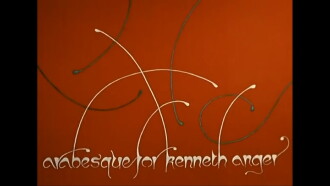
Filmed at the Alhambra in Spain in just one day, according to Marie Menken. Arabesque for Kenneth Anger concentrates on visual details found in Moorish architecture and in ancient Spanish tile.
28 November 1965
The films were made between 1964 and 1966 at Warhol's Factory studio in New York City. Subjects were captured in stark relief by a strong key light, and filmed by Warhol with his stationary 16mm Bolex camera on silent, black and white, 100-foot rolls of film at 24 frames per second.
07 July 1966
"A realism like that of GREED is lifted to a level where it becomes poetry. This is done by stylization and a few well-chosen details.
30 January 1957
A film poem, a re-telling of the Greek myth in modern terms. In the traditional pool the water has become muddy and Narcissus finds that mirrors are more rewarding for the study of his changing reflections.
01 January 1965
“Andy Warhol called Marie Menken and Willard Maas ‘the last of the great bohemians,’ and, in 1965, made Bitch, his real-life parody of Edward Albee’s play Who’s Afraid of Virginia Woolf?, with Willard and Marie sitting on the couch in their living room, drunk and arguing on a Sunday afternoon.
01 January 1966
Andy Warhol's Silver Flotations is a portrait of Warhol's famous installation of floating silver helium-filled balloons at the Leo Castelli Gallery in 1966.
01 January 1943
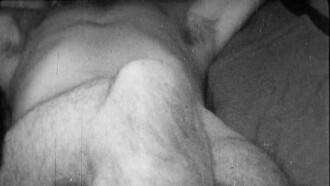
A quotation from Aristophanes, "The desire and pursuit of the whole is called love," precedes views of a man and a woman's bodies, often in extreme close up.
04 August 1967
A fragment of an abandoned, long work concerning St. Teresa of Avila. A sexual orgy symbolizing the decadance of modern society.
21 December 1964
In 1963 Boultenhouse wrote, produced, and directed Dionysius,which he described as a “free treatment of Euripides' The Bacchae.
12 November 1952
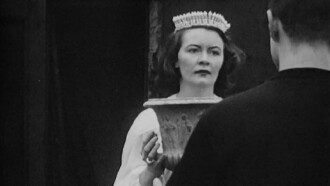
A young male protagonist dreams of a muscleman hero, a black dancer, and a princess who gives him a magic urn.
16 July 1964
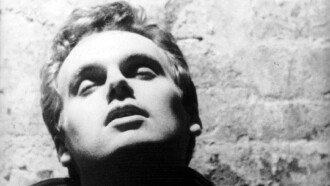
Andy Warhol directs a single 35-minute shot of a man's face to capture his facial expressions as he receives the sexual act depicted in the title.
26 April 1955
This short begins with a couple about to make love, and then does a tour of innocuous objects in the room around them that invariably suggest sexual activity.
01 January 1966
Photography: Willard Maas and John Hawkins. "Looking down instead of around, while walking, finding the magic patterns in the pavements of a city.