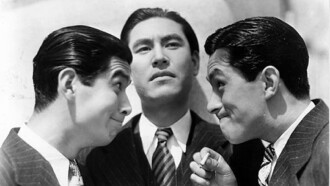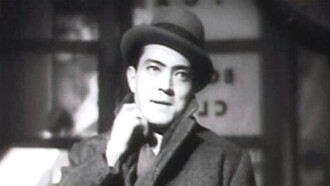
Yasujirō Shimazu Trailers
A Brother and His Sister TrailerThree Youngmen and a Dream Girl TrailerNichijô no tatakai Trailer
Yasujirō Shimazu (島津 保次郎, Shimazu Yasujirō, 3 June 1897 – 18 September 1945) was a Japanese film director and screenwriter, and a pioneer of the shōshimin-eiga (common people drama) genre at the Shōchiku studios in pre-World War II Japan.
Shimazu was born in Tokyo, the second son of merchant Otojirō Shimazu. His father owned a long-established seaweed business named Kōshū-ya directly in front of the main Mitsukoshi department store in Nihonbashi.
Shimazu entered Shōchiku in 1920 after answering an advertisement and began training under Kaoru Osanai. He gave his debut as director in 1921 at Shōchiku's recently established Kamata studio, directing both comedy and melodrama films, often depicting the everyday life of the lower middle classes. Our Neighbor, Miss Yae (1934) and A Brother and His Younger Sister (1939) are regarded as his most exemplary and best films.
By the end of the 1930s, he moved to Tōhō studios, where he made some films in cooperation with the Manchuria Film Association. He died of cancer just after the war ended. Many famous directors, such as Heinosuke Gosho, Shirō Toyoda, Kōzaburō Yoshimura, and Keisuke Kinoshita, started their careers as his assistant.

Most Popular Yasujirō Shimazu Trailers
Total trailers found: 44
01 January 1923
An early Japanese film
17 April 1937
A businessman’s daughter falls in love with one of her father’s employees.
18 July 1937
Three men vying for the same job end up chasing the same girl in this comedy-drama from noted Japanese director Yasujiro Shimazu.
20 March 1940
Twenty-year-old Yoshiko (Setsuko Hara) and her younger sister Asako (Yōko Yaguchi) struggle to accept changes in their home during the preparations of their widowed father's wedding to his chosen bride, Maki Tsuneko (Sadako Sawamura), who's anxious about her conduct as the bride.
15 June 1935
A period piece about the love of a wealthy blind woman, a teacher of koto and shamisen, and her devoted manservant.
01 May 1926
Japanese silent film from 1926. (Obo-chan meaning "Young Master.") Written by Ayame Mizushima, the first female screenwriter in Japan.
03 April 1936
A melodrama about a businessman's relations with the three women in his life.
14 September 1934
The poor novelist Yamamoto is writing his novel, determined and with a headband around his head. With him, the novelist who is always in trouble paying his bills, is the girl Saya who becomes the model for his novel.
13 December 1934
Jyuta, an honest owner of a taxi company, has a younger half-brother who is involved in the yakuza world and doesn’t get along well with his mother.
02 December 1937
Pre-war Asakusa was a riotous district of cabarets, dance-halls and brothels - a striking backdrop for Shimazu's story of innocence and experience.
28 June 1934
Keitaro is a law student and Yaeko is a high school girl. They are neighbors, and their friendship is starting to develop into something more romantic.
22 January 1929
Japanese film from 1929.
09 September 1941
OSHINO, the beautiful daughter of restaurant owners, is in love with SHIRASAGI the painter. But there is another young man, the son of a moneylender family, who is desperately in love with Oshino.
18 January 1940
Part one of two.
25 September 1925
Japanese silent film from 1925.
18 January 1940
Part two of two.
01 April 1939
A young student of traditional dance falls in love with a handsome young man who visits the dance school in order to take photographs.
28 August 1925
Japanese film from 1925.
24 March 1944
Sumida is separated from his wife and daughter when conflict erupts in Harbin. Years later, he finds that his wife passed away and her daughter was adopted by his friends at the Russian opera company.
17 April 1931
The three-hour Ai yo jinrui to tomo ni are / Love, Be with Humanity (1931) starts as a satire of alienation in the world of money, develops into a lumberland epic with a forest fire on Sakhalin Island, turns into a tragedy of King Lear dimensions, and manages to amaze the blasé audience with a happy end in the Wild West.
25 April 1956
1956 Drama by Toshio Sugie
17 April 1931
The three-hour Ai yo jinrui to tomo ni are / Love, Be with Humanity (1931) starts as a satire of alienation in the world of money, develops into a lumberland epic with a forest fire on Sakhalin Island, turns into a tragedy of King Lear dimensions, and manages to amaze the blasé audience with a happy end in the Wild West.
11 December 1931
Japanese silent film directed by Yasujirô Shimazu, originally released as a two-part movie on December 11, 1931.
01 April 1939
A man who works late hours at a deadening job lives together with his wife and his younger sister. The younger sister's a modern girl who's starting to receive romantic attention from one of her co-workers.
29 August 1936
Three couples connected to rival business and theatrical families navigate complicated romances, workplace disputes, and family opposition.
01 April 1938
Shigeo is an aspiring writer living with his girl friend Minako and hoping for success and a better tomorrow every day.
17 November 1928
Japanese silent film from 1928.
19 September 1956
In a household of three the husband is a salaryman who lives with his younger sister and wife in Tokyo.
01 April 1942
Set in Qingdao, China, a Japanese company locates an office there and begins work and cooperation with a local Chinese company for business.
17 October 1934
That Night's Woman
18 March 1932
Japanese film from 1932, adapted from the novel by Kan Kikuchi. The first sound film from director Yasujiro Shimazu.
10 January 1929
Japanese silent film from 1929.
01 August 1930
Japanese silent film from 1930.
14 April 1932
The story of a sailor who begins a love affair with a woman he saves from suicide.
12 August 1943
1943 japanese movie.
16 October 1931
First chapter of Tasujiro Shimazu's ABC Lifeline, released two months before ABC Lifeline: Part 1 and ABC Lifeline: Part 2.
01 January 1939
Fisherman Choon-sam (Yoon Buk-yang) is suffering financially because of a prolonged scarcity of fish.
20 January 1928
Japanese silent film from 1928.