In the background is a row of three-masted sailing ships, at anchor, their sales furled. In the foreground, a simple pier that's more like a yardarm juts out above the water; about 15 boys of six or seven years of age are on the jutting wood, and they jump off into the water below. The water looks to be about three feet deep. They swim back toward the pier. A small motorized boat passes. It's a stationary camera; one take.
Watch the official Boys Diving, Honolulu 1901 trailer in HD below.
A short documentary to celebrate Hammer Films' 89th anniversary. Discover how Hammer has shaped the horror genre, influenced culture, and what the future holds.
This scene is a part of the very first film shot produced by the Manaki Brothers. Despina, the Janaki and Milton Manaki's grandmother, was recorded weaving in one high-angle shot.
Two cats housed in a glass box, one of which had received a small amount of atropine in the preliminary experiment, are exposed to ether vapors with the result that only the animal which had not been pretreated began to salivate (profusely).
This film weaves across sound, image, time, rhythm and place and is made up of a number of layers both sound and visual layered on top of one another, talking to and informing each other.
Bokanowski returns to the complex - and mind-bending - optical array of pinholes, mirrors, prisms, and refractive substrates of his earlier film, La Plage to create the whimsical and playful Au bord du lac.
The subject is two grotesque-looking human beings who are sitting on the deck of a ship. The two weird individuals sit cross-legged and do the bidding of a man in oriental costume.
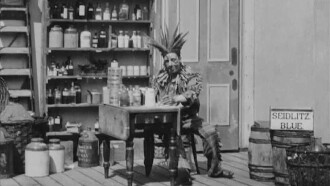
An inventive use of slow-motion filming helps hammer home the gag as an unconvincing 'Indian chief' hopes to dissolve some trapped wind with a popular brand of indigestion powder.