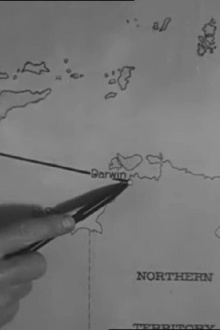
Original archival synopsis: The Japanese bombed Darwin many times during World War II because it was strategically important target number one in their attack on the Australian mainland. Before the war, Darwin was little known except to the crews of pearling luggers and cattlemen. During the war it become an important air base which contributed much to the success of General MacArthur's island-hopping campaign against Japan. Today Darwin is an aerial port of call for all planes travelling either from Europe or the Far East to Australia. The Darwin touchdown is, in fact, for many travellers the first sight of the Australian continent. The film shows Darwin as it is today (1949), much ravaged by Japanese attack during World War II, but already showing signs of building activity and general recovery. The film indicates the general life of the town and also explains the plan which will make Darwin a model city of which Australia will be very proud.
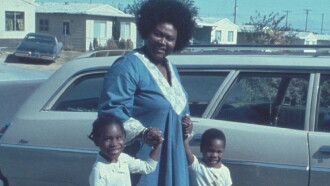
This inspiring documentary chronicles the extraordinary life of Ruby Duncan, an activist who fights the welfare system and becomes a White House advisor.
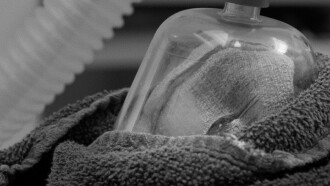
At a wildlife rehabilitation center in the Pacific Northwest, the steady, practiced, and gentle hands of veterinarians nurse dozens of convalescing animals back to health.
A prospective wish is announced at the very beginning: "Imagine a land without ownership". Ownership? Since when? How? Where? With which implications? This is what Marwa Arsanios endeavours to discover in the fourth part of her meticulous ongoing project whose generic title is Who Is Afraid of Ideology? After documenting feminist experiments of community autonomy in Lebanon, Kurdistan and Syria (Who Is Afraid of Ideology? I&II, FID 2019), Marwa Arsanios ventures a hypothesis in the form of speculative fiction, from a remote piece of land in Lebanon, a cut in a stone quarry.
Children of lesbian mothers talk frankly about their mothers' coming out, their own homophobia, and how they feel about being raised by lesbian mothers.
Tut is a 52-year-old fisherman living in Kampot. In spite of the language barrier, he recounts for the first time and without any words his past during the Khmer Rouge regime, demonstrating the torture he experienced in prison the year he turned fifteen.
In recent years, more than 2,500 books have been removed from school districts around the US, labeled as banned, restricted, or challenged, and made unavailable to millions of students.
This Warner Bros. The Sports Parade series short chronicles the attempt by a group of men to navigate the Colorado River through the Grand Canyon to Lake Mead.
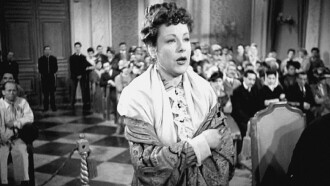
Madrid, late 19th century. A wealthy woman is found murdered in her home and her maid seems to be the main suspect; but her statement further entangles the case.
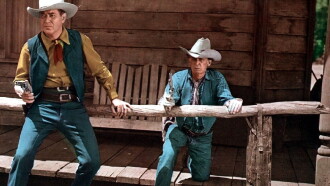
Veteran cowboy star Johnny Mack Brown plays a cattle buyer turned prairie sleuth in this low-budget oater from Monogram, which co-stars perennial old-timer Raymond Hatton as a retired U.
The cattle herds of some Arizona ranchers are being stampeded and stolen, so the Arizona Stockmen's Syndicate sends ace investigator Steve Reynolds in to find out who is responsible.
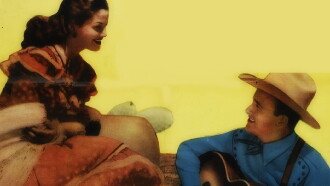
All-American singing cowboy Jimmy Wakely went below the border in this musical Western from the assembly line at Monogram, performing such ditties as Adios Mariquita Linda, Rose of the Rancho, the inevitable La Cucaracha, and his own title tune.
Comments
Have you watched Darwin: Doorway to Australia yet? What did you think about it?