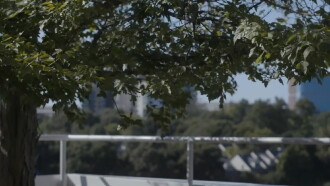
The first embodiment of (a) concept of structural activity in cinema comes in Kren's Bäume im Herbst, where the camera as a subjective observer is constrained within a systematic or structural procedure, incidentally the precursors of the most structuralist aspect of Michael Snow's later work. In this film, perception of material relationships in the world is seen to be no more than a product of the structural activity in the work. Art forms experience.
Sentenced to community service, a privileged and self-consumed young woman encounters a war veteran at a soup kitchen and realizes that she has the potential to support him on his road to wellness, while doing the same for herself.
A controller in a London cab office looks for a driver to pick up a fare from Victoria Station. The driver who answers has never heard of Victoria Station.
After a suicide attempt, a young woman is admitted to a psych ward where she finds reprieve from the real world, only to be discharged without a tangible way to move forward.
Seoul, under a drizzling spring rain; Korea is under the rule of Japan. A gisaeng(Korean geisha) named Jeong-ok (Ju Jeung-nyeo) and Myeong-gyu (Lee Min), the son of a bank president, fall in love.
Two plays by William Saroyan portraying writers stymied, inspired, frustrated, excited, listful, wistful, slothful, awed, unnerved, perhaps corrupted and perplexed by the promise and let-down writing holds for them.
The film tells the story of two twins separated in childhood who reunite when they are older. One of them has grown between outlaws and has become one of them, a murderous bandit who frightens the region.
A small-time thief steals a car and impulsively murders a motorcycle policeman. Wanted by the authorities, he attempts to persuade a girl to run away to Italy with him.