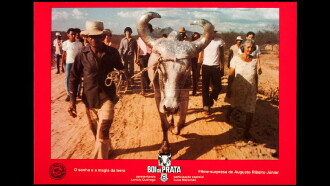
A group of armed soldiers is sent to the Northeast of Brazil in an attempt to stop a famine-struck population from invading and stealing a food deposit in the dry backlands. While the alienation and insanity of people driven to hallucination by their latent hunger is conducted by the predictions of a religious figure, a truck driver observes the situation and remains torn between his friendship with the soldiers and his revolt against the lack of government action in fighting the misery that lingers over the region.
He was the most prolific within the New Portuguese Cinema generation. He would try western spaghetti, esoteric allegory, supernatural, and science-fiction.
Before Cinema Novo revolutionized the Brazilian cinematic scenery, a young craftsman and Bahian filmmaker had already paved the way for the beginning of the journey for some of the biggest and most popular films of Brazilian history.
Born a fully grown black man in a village in the Brazilian jungle, Macunaíma later magically transforms into a white man before making an adventure-filled trip to the city of São Paulo.
A destitute family tries to escape the drought in the backlands of northeastern Brazil. Fabiano (Átila Iório), Sinhá Vitória (Maria Ribeiro), their two children and their dog Baleia wander aimlessly and almost hopelessly through the remote interior, surviving the forces of nature and the cruelty of men.
Rebels on the surface, retrogrades in essence. “The Ridiculists”, a duo composed of the eccentric and explosive, “The Ridiculer”, and his faithful squirer, “The Talker”, roam through the Brazilian capital breaking into homes, committing murders, as they create a legion of blind supporters along the way.
Experimental short-film made by brazilian students about the trópicalia and cinema novo movement. The narrative revolves around the song Géleia Geral from the album Tropicália ou Panis Et Circensis and also around the political, artistical and social time from that period.
Somewhere in Rio Grande do Norte's countryside, Brazil, the wealthy farmer Elói Dantas (Álvaro Guimarães) decides to increase his patrimony even further by exploiting ores.
Popular movie trailers from 1964
These some of the most viewed trailers for movies released in 1964:
Traveling lawman comes to town and schools the residents in collective farming practices. There's also a bad guy with a lot of money who's cut off the water supply to the area's farmers, and the soul of a murder victim that manifests as a flying fireball.
A womanizing reporter for a sleazy tabloid magazine impersonates his hen-pecked neighbor in order to get an expose on renowned psychologist Helen Gurley Brown.
Special agent 007 comes face to face with one of the most notorious villains of all time, and now he must outwit and outgun the powerful tycoon to prevent him from cashing in on a devious scheme to raid Fort Knox -- and obliterate the world's economy.
An outdated fireclay factory is due to close, but its long-time employees can't imagine stopping what has fed them all their lives and what they do best.
Once upon a time there lived in the same village two men bearing the very same name. One of them chanced to possess four horses, the other had only one horse, so, by way of distinguishing them from each other, the proprietor of four horses was called "Great Claus," and he who owned but one horse was known as "Little Claus".
Whips was one of the films mentioned in a half page ad in the April 7, 1966 issue of the Village Voice, advertising The Exploding Plastic Inevitable show at the Dom.
A four-time widow discusses her four marriages, in which all of her husbands became incredibly rich and died prematurely because of their drive to be rich.