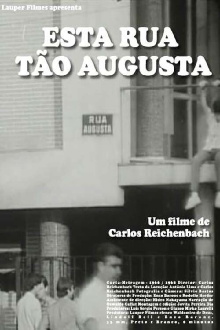
A short documentary that uses irony to approach the most fashionable São Paulo street in the 60s: the Rua Augusta (Augusta St.), with its classic personages and most frequented spots.
Having Cuba as a background, decadent and in crisis, in a black-and-white lacerated by the Caraibic swinging rain, Alex and Edith, a couple in their 30s, live their love story made of small daily gestures, stories from the past, nostalgia, and a deep intimacy.
As daylight breaks between the border cities of El Paso, Texas, and Juarez, Mexico, undocumented migrants and their relatives, divided by a wall, prepare to participate in an activist event.
Underscored by French film legend Delphine Seyrig’s evocative recitation of a Henri Michaux poem, Maureen Fazendeiro’s film is a mysterious, multi-textured portrait of eclipse spectators in Portugal.
Working men and women leave through the main gate of the Lumière factory in Lyon, France. Filmed on 22 March 1895, it is often referred to as the first real motion picture ever made, although Louis Le Prince's 1888 Roundhay Garden Scene pre-dated it by seven years.
Radiating the radical simplicity of a Lumière actuality, THE MAYBERRY PRACTICE CALF shows an African-American cowboy roping a hunk of tire again and again.
This documentary observes the conversations, primping and camaraderie that take place in the women's bathroom of a nightclub over the course of a night.
A film about a young woman's future plans in Munich, Germany. MUNCHEN, RAPHAELA (also known as RAPHAELA RING MUNCHEN) is part of Mike Plante's Lunchfilm series of commissioned shorts (made for the cost of a lunch between Plante and filmmaker Kevin Jerome Everson).
Popular movie trailers from 1968
These some of the most viewed trailers for movies released in 1968:
"In my film I suggest that there is no greater mystery than that of the protagonists. War and Love are simply equated for what they are; the aftermath is inevitable, and a normal human condition, for which like the ancients one can only have pity and understanding.
Forced behind British lines by engine problems, the Red Baron camouflages his plane, swaps uniforms with a dead soldier, and, posing as a Belgian, makes his way to a hospital.
There's nothing like a good, opulent, gaudy musical to lift the spirits, but when it's a 1960's Hong Kong musical orchestrated by a Japanese director and composer, it breaks through the ranks as a classic of campy kitsch.