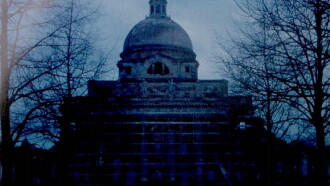
An experimental documentary short about Saint Cross's basilica of Lecce, Apulia. In 1968, Carmelo Bene made a deal with Nexus Film to shoot three documentaries. This is the only one that was actually made. He used the deal money to shoot his first feature Nostra Signora dei Turchi. It is still unsure if Bene actually shot the movie or if he just put his name on it to get the money.
"In my film I suggest that there is no greater mystery than that of the protagonists. War and Love are simply equated for what they are; the aftermath is inevitable, and a normal human condition, for which like the ancients one can only have pity and understanding.
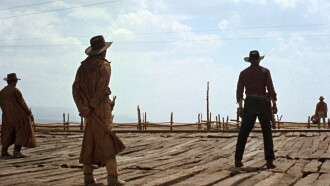
As the railroad builders advance unstoppably through the Arizona desert on their way to the sea, Jill arrives in the small town of Flagstone with the intention of starting a new life.
There's nothing like a good, opulent, gaudy musical to lift the spirits, but when it's a 1960's Hong Kong musical orchestrated by a Japanese director and composer, it breaks through the ranks as a classic of campy kitsch.
The dangers of drinking and driving are illustrated to a teenager returning from a beach party, where after having "one too many beach beers" he runs over a young mother and her child.
Two young boys, play hooky from school in order to explore an ultramodern world's fair. They take in the many marvelous scientific and industrial exhibits, obtain literature, eat food, and generally run amok.
Centring on the legend of the four ancient Chinese heroines, the film was a novelty for audiences at the time, as the singing performance was in Cantonese and used huangmei operatic rhythms—a popular trend in the 1960s, yet it retained traditional flavours by using operatic luogu percussion in the battle scenes.