Carmelo Bene Trailers
La parte maledetta. Viaggio ai confini del teatro - Carmelo Bene TrailerÈ severamente vietata la sosta in palcoscenico ai non autorizzati. Un documentario di meno su Carmelo Bene TrailerRushes di Otello Trailer
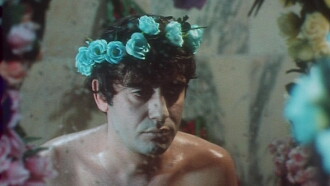
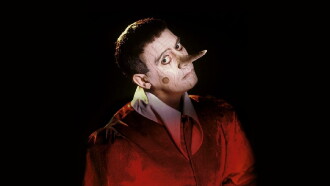
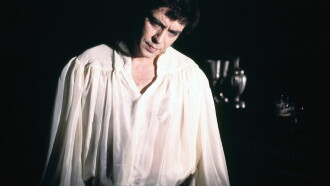
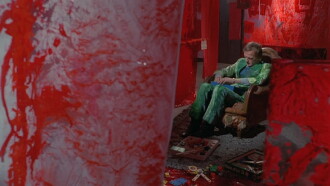
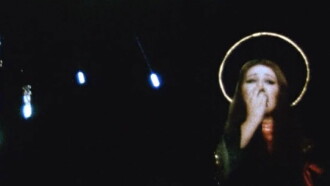
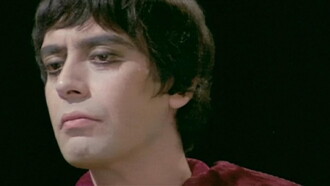
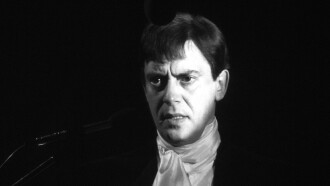
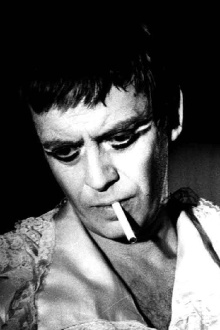
The filmmaking career of Carmelo Bene (1937 - 2002) lasted from 1968 to 1973, six years out of a lengthy time spent in the theater that made Bene one of the most celebrated figures of the Italian avant-garde in the second half of the 20th century.
Bene first made a name for himself with a controversial production of Camus’ Caligula in Rome in 1959. Subsequent productions retained this sense of notoriety, and Bene (like Pasolini) quickly acquired a police record. Bene, however, would come to bemoan the controversy his work created, because it attracted an audience looking for shocks and titillation, while he himself was more concerned with reinventing the vocabulary of the theater: sets, gestures, texts.
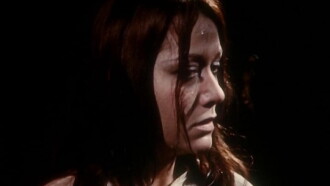
Bene’s turn to cinema expanded that quest to reinvent. His films resist synopsis because, although they are often derived from narrative sources, Bene uses these sources against themselves and as a springboard for his critique of the stultifying traps of representation and interpretation. The films are wildly inventive and visually arresting on several levels: the performance styles of his actors, including eccentric movements, gestures and grimaces; the sets, costumes and makeup; the editing; and the use of the camera, with stable shots regularly punctuated by handheld camera work, extreme close ups and the occasional baroque use of zooms, dollies, cranes, elaborate pans and exaggerated camera angles. They resemble something like the work of Jack Smith crossed with the experimental Pasolini of Teorema and Pigsty.
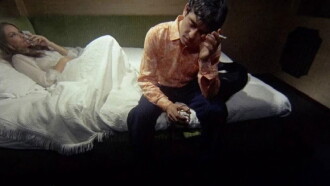
One constant feature of Bene’s work is its satire of heterosexuality. The two sexes keep trying to communicate with each other, but always fail to do so. Bene’s work constantly deflates masculinist pretenses at mastery: his male characters tend to be hapless and often hysterical, while his female characters are alternately predatory and remote, and unknowable in either case. But this satire is merely the most visible form of Bene’s revolt against convention and communication. Over and over again in the films, everyday actions become hopelessly complicated or endlessly interrupted. His characters often end up staring quizzically offscreen or even into mirrors, as if they were no more sure than we are of the meaning of what they see. Indeed, identity and by extension agency seem to get suspended, along with meaning. What is left is glorious spectacle and enigmas for the eyes and ears: endless music; babbling, stuttering text; excessive and exciting images. – David Pendleton

Most Popular Carmelo Bene Trailers
Total trailers found: 44
01 May 1973
Adapted from the ninth chapter of the novel "Controcorrente" (1884) by Joris Karl Huysmans. Its narrative concentrates almost entirely on its principal character and is mostly a catalogue of the tastes and inner life of Jean des Esseintes, an eccentric, reclusive aesthete and antihero who loathes 19th-century bourgeois society and tries to retreat into an ideal artistic world of his own creation.
01 September 2003
Video registration of Carmelo Bene's play 'Lorenzaccio, al di là di de Musset e Benedetto Varchi', performed in Florence in 1986.
01 January 1996
A visit to the Rotoli cemetery in Palermo, while film director Carmelo Bene reads a fragment of Antonio Pizzuto's book "Signorina Rosina".
25 November 1990
A TV movie variation on Shakespeare's Hamlet. The movie is a part of Carmelo Bene's multi-medial project on Hamlet, also including the theatrical movie "Un Amleto di meno", a stage drama and the experimental video "Amleto di Carmelo Bene (Da Shakespeare a Laforgue).
01 January 1968
Hermitage, defined by Bene as "a rehearsal for lenses", beyond any literal rendition - its narrative trace comes from one of his anti-novels, Credito Italiano V.
26 October 1967
Bob is a successful actor, but his career gets doomed by a strange phenomenon: the animal kingdom is taking on him!
01 January 1997
One of the last TV performances by Carmelo Bene, from Publio Papinio Stazio and Henrich Von Kleist, mixing the myth of the amazon Pentesilea with the invulnerability of the greek hero Achilles.
01 January 1980
Realized in 1980 for Rai 2, it recalls the main phases in the life of Giorgio Colli.
05 April 1997
Macbeth, the Thane of Glamis, receives a prophecy from a trio of witches that one day he will become King of Scotland.
01 January 1966
In 1966, Bene presented The Pink and the Black, his successful theatrical adaptation of Matthew Gregory Lewis’ lurid Gothic novel from 1796.
07 September 1967
In pre-war Italy, a young couple have a baby boy. The father, however, is jealous of his son - and the scene moves to antiquity, where the baby is taken into the desert to be killed.
01 August 1996
Actor, poet and playwright Carmelo Bene offers a reading of excerpts from the collection of literary compositions called Canti Orfici by poet Dino Campana.
06 March 1971
A few days after the arrival of the year 1000, bearer of great misfortune according to the Prophets,l
07 December 1981
Riccardo III is a theatre play staged in 1977 and also edited for television and aired in 1981, which Carmelo Bene dedicated to his friend Gilles Deleuze, who wrote a book about it before even seeing it.
01 November 1970
Frankenstein's monster gropes towards the awareness that his mind is a universe; Attila, naked on a white horse, liberates his people from their ignominy; the ultra-caustic Viva bemoans the frustrations of married life and drifts into the elegiac persona of the Bloody Countess Bathory; Louis Waldon is a hip American tourist searching for the (missing) Mona Lisa.
01 December 1998
On the occasion of the bicentenary of the birth, Carmelo Bene returns to the verses of the poet from Recanati.
15 August 2003
A montage dedicated to friends, actors and companions who have passed away over the years: from Francesco Tirone to Paviglianiti, two leading figures in the famous Cinico TV series, from Tommaso Lauria to Carmelo Bene.
31 March 1970
Frank was removed from an investigation into Mac Brown, the owner of a pharmaceutical company, who was suspected of drug trafficking and illegal experiments on teenagers.
01 January 1982
Carmelo Bene reads poems by Dino Campana
12 December 1990
Rome, December 12th - 15th 1990.
18 March 2002
Produced by RAI and filmed in the Turin studios in 1979 but edited years later, in 2001-2002, this is the staging for TV of Carmelo Bene's play of the same name.
11 December 2001
When we believe it is we who say we are said. In the speech, the strong-willed arrogance of all my intentions is hopelessly frustrated and since we are not the learners to argue in voice what whips in our mind, just as you are not, you can say nothing.
01 January 2023
Approximately 15 hours of footage (contained on 28 tapes) for a television adaptation of Carmelo Bene's play "Otello o la deficienza della donna," produced by RAI in 1979 but only edited in 2002.
03 September 1968
To the protagonist, an intellectual so feverish that he seems pathologically unrecoverable, a confused memory resurfaces of a massacre carried out by the Turks in Otranto.
21 April 1978
An experimental video variation on Shakespeare's Hamlet.
01 January 1984
Videotape produced by Ferruccio Marotti for Roma's University theatre students. A presentation of Carmelo Bene's "Performative matrix": not a performance yet, but it's not just text or ideas.
20 October 1972
Salome is the daughter of the second wife of King Herod. The King is infatuated with her and, after she fails to seduce the prophet John The Baptist, she dances for the King in order to ask for his execution.
20 November 1975
In the words of the director, a movie about 'the colonizers in the view of the colonized', the movie presents a series of disconnected happenings throughout Europe and Brazil emphasizing the perception of human life as trance-like experiences and thus offering a view of the human history as a connection of symbolic behavior.
21 November 1973
The Prince of Denmark, Hamlet, is little interested in family affairs and the fate of the kingdom, and not at all attracted by a doll-like Ophelia sucking his finger.
15 November 1969
After a fight in their apartment, the story of a writer and a painter are divided. The writer is dedicated with his partner Manon to provoke continuous accidents in a field in which car carcasses abound.
07 May 1969
Artists and poets meet in a dreamlike space between walks and performances.
01 January 1965
Backstage short documentary on Carmelo Bene’s theatre works Amleto and Pinocchio.
14 May 1970
In this a baroque and claustrophobic take on Mozart’s opera of the same name, Don Giovanni tries to seduce a girl who is manically searching for Christian icons.
01 June 1968
An experimental documentary short about Saint Cross's basilica of Lecce, Apulia. In 1968, Carmelo Bene made a deal with Nexus Film to shoot three documentaries.
10 July 1967
Nico D’Alessandria’s graduation film at the Centro Sperimentale di Cinematografia in Rome features the director himself and is inspired by T.
27 October 1977
Performance shot in 1977, in which emblematic actor Carmelo Bene, in the charming reconstruction of the ruins of a theater on fire accompanied by the disturbing notes of Vittorio Gelmetti, reads four poems of the Twentieth Century russian poets Vladimir Majakovskij, Boris Pasternak, Aleksandr Blok and Sergej Esènin.
09 September 1985
Recording by Rai Milan of Adelchi staged by Carmelo Bene at the Teatro Lirico in Milan in 1984, with the Rai orchestra and choir for the bicentenary of Alessandro Manzoni's birth.
12 September 1983
Drama by Lord George Byron, music by Robert Schumann. Filmed at Teatro Comunale di Bologna, 1979.