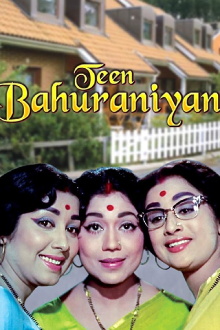
Teen Bahuraniyan (English: Three Daughters-In-Law) is a 1968 family comedy movie. The film is a remake of 1967 Tamil movie Bama Vijayam (Bama's Visit). The film's three lead ladies reprise their roles from the original movie. Teen Bahuraniyan is family story of 3 daughter in laws and their husbands. The movie shows how their relations takes different colour at various situations and how the father Prithviraj Kapoor plays vital role in the family to keep things going.
Nicknamed as "Hitler", Jailer Siddhanth Kumar Sharma is feared and respected at work as well as at home where he lives with his wife, a former lawyer, Sheila; younger brother, Amar; two younger sisters and his son.
Romantic teen caper has a college boxing champion and a career-challenged ventriloquist defying tradition when they compete for favors to win over two rich and beautiful sisters.
A longstanding feud between bitter rivals yields an unexpected friendship in this tale of ambition, violence and love starring Jeetendra and Raj Babbar.
A portrait of alienation is sketched out, focusing on a young art student who passively, but consciously, rejects responsibility for the political storms swirling about her.
"In my film I suggest that there is no greater mystery than that of the protagonists. War and Love are simply equated for what they are; the aftermath is inevitable, and a normal human condition, for which like the ancients one can only have pity and understanding.
A baleful limping man walks through Prague. He is Asmodeus (Juraj Herz), the fiend of lustfulness, entertaining himself by putting together by magic couples of lovers.
Three identical prints of a single 100 foot fixed-camera take are shown from beginning to end-roll light-flare, with a few feet of blackness preceding/bridging/following the rolls.
Documentary by Juan Francisco de Lasa about a pioneer of Spanish cinema. Gelabert attended one of the first sessions of the Lumière's cinématographe in Barcelona.
There's nothing like a good, opulent, gaudy musical to lift the spirits, but when it's a 1960's Hong Kong musical orchestrated by a Japanese director and composer, it breaks through the ranks as a classic of campy kitsch.