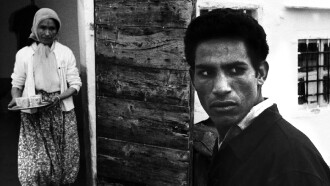
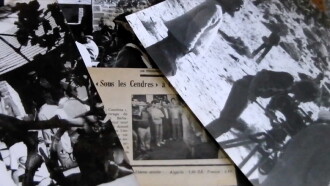
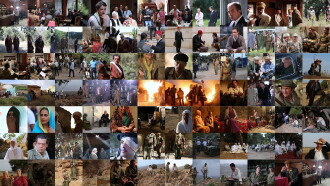
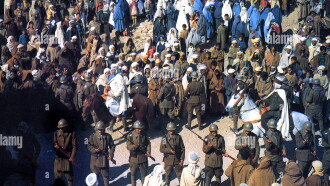
Upon his death, a young African director, Abramo Malonga, bequeathed his first and last unfinished film to his former teacher, the Italian director Fausto Morelli. Morelli, who after seeing the work, is confronted with a confusing, complex and, in part, incomprehensible work. Helped by the young widow of Abramo Malonga and by the notes left by his deceased friend, and again by his personal memories, the Italian director attempts to reconstruct and complete the film. Fausto's work progresses with difficulty, not only because of the problems the film poses for him, but because of the problems that arise in his daily life. After a long crisis, after which he returns to Pisa with his former party companions and abandons himself to love and his own solitude, Fausto takes up the work of his African friend, closing it with a final invention, in which , with a bold metaphor, has refigured the human condition of our time.
South Africa, 1978. Tim Jenkin and Stephen Lee, two white political activists from the African National Congress imprisoned by the apartheid regime, put a plan in motion to escape from the infamous Pretoria Prison.
Paratrooper commander Colonel Mathieu, a former French Resistance fighter during World War II, is sent to Algeria to reinforce efforts to squelch the uprisings of the Algerian War.
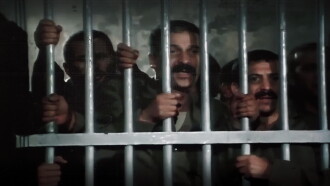
In 1982, Hadj Rahim directed "Serkadji", a fiction film about the men's quarters of the Barberousse military prison in Algiers, where hundreds of FLN fighters were incarcerated and executed during the war of independence.
Madame Rosa lives in a sixth-floor walkup in the Pigalle; she's a retired prostitute, Jewish and an Auschwitz survivor, a foster mom to children of other prostitutes.
The Second World War. French authorities ban political parties and unions. In Algeria, the leaders of political and trade union organizations were arrested and interned in "surveillance" camps with more than 2,000 French and foreigners: communist activists, trade unionists, brigadists, Spanish republicans and other opponents of the Vichy regime.
The feature film “The seven ramparts of the citadel”, a fiction recounting the conflict between an Algerian family expropriated from its land and a bloodthirsty settler; by director Ahmed Rachedi.
A meticulous chronicle of the evolution of the Algerian national movement from 1939 until the outbreak of the revolution on November 1, 1954, the film unequivocally demonstrates that the "Algerian War" is not an accident of history, but a slow process of suffering and warlike revolts, uninterrupted, from the start of colonization in 1830, until this "Red All Saints' Day" of November 1, 1954.
The story of two teenage extraterrestrial refugees from the planet Pluto, who escape to Earth after their planet is destroyed by the US government, as it was deemed “insignificant.
Neena lives a poor lifestyle along with her parents. Her marriage is arranged with a wealthy male, but the marriage could not take place as her parents are unable to provide enough dowry.
As the west rapidly becomes civilized, a pair of outlaws in 1890s Wyoming find themselves pursued by a posse and decide to flee to South America in hopes of evading the law.
A student, tired of a too well-mannered fiancé, loses a virginity she considers very embarrassing in the arms of a forty-year-old man, before finding love with a repentant gigolo.
A simple-minded, yet loving young couple, Rajoo (Sunil Dutt), and his wife Maya, who allow their child to be adopted by Rajoo's sister-in-law/Bhabhi, Shanti (Kamini Kaushal).
The legendary swords-girl Little White Dragon, helps protect a crown prince on his journey to a far off temple where he is to be blessed before becoming a Prince.
AVM Rajan the protagonist lives in a joint family is an easy going guy. Unfortunately AVM Rajan's father loses his eyesight in an accident and family struggles financially to run daily life.
A portrayal of two modern young men and their experiences of love. Jack, a sociology student, is in a relationship with Betty, who is somewhat older than him.
Comments
Have you watched The Damned Of The Earth yet? What did you think about it?