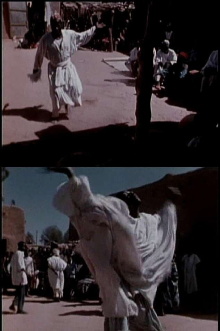
A seven-day initiation ceremony is documented in which two women undergo ritual healing following a diagnosis of spirit possession, presented without narration, intertitles, or explanatory commentary.
How’s the Big Everything? Garba asks Nicole. For them, the “Big Everything” encompasses family, politics, History, daily life, the stars, small things, and time passing like the wind.
Every winter, a small town in Castilla-La Mancha called Luzón transforms into a little hell. Its inhabitants, dressed as devils, venture into the darkness and roam its streets with horns, bells, and smeared with soot.
On Sept. 11, 2001, deep inside a White House bunker, Vice President Dick Cheney was ordering U.S. fighter planes to shoot down any commercial airliner still in the air above America.
A unique 'direct cinema' feature length documentary (no narration or interviews) originally filmed in the Spring of 1970 and concluded during the Summer of 2017 (footage added, restored, and re-edited).
At dawn a nomad caravan descends on Aq Kupruk from the foothills of the Hindu Kush. In their camp, and in commerce with the townspeople, the Maldar reveal the mixture of faith and distrust that has kept nomads and sedentary people separate and interdependent over the centuries.
While no wrestling is actually depicted, Atilogivu: The Story of a Wrestling Match documents gymnastic dancing to drum and flute music of the Ibu people, east of the River Niger.
A collage of daily life in Aq Kupruk builds from the single voice that calls the townspeople to prayer, the brisk exchange of the baazar, communal labor in the fields, and the uninhibited sports and entertainment of rural Afghans.
This documentary started as part of a photography project about the indigenous Ainu population in northern Japan, portraying people from tightly knit communities.
Alternative movies trailers for Horendi
More movie trailers, teasers, and clips from Horendi:
Horendi (1972) Jean Rouch; Documentary on African Dance Ritual
Horendi full hd movie trailer.
Popular movie trailers from 1972
These some of the most viewed trailers for movies released in 1972:
An adventure story for children set in New Zealand and told in eight sequential episodes. 5 of 8: The escaped criminals drive away from Wellington in a stolen car.
A guardian angel agrees to help Willie Mays win the National League Pennant if Mays agrees to take care of Veronica, a lonely, mischievous orphan girl.
After having challenged the German Ottone to single combat for the hand of Leonza, the bishop's niece, the valiant knight Anselmo da Montebello, leaves for Rome where he must deliver a precious relic to the Pope and obtain a sum of twenty-thousand crowns in order to participate in the third crusade in the Holy Land.
The film by Brakhage commonly referred to as "Wecht" does indeed exist. It doesn't have a titlecard at the head, and the leader of the original is labeled "Portrait" in Stan's handwriting, so I'm not sure where the 'Wecht' title comes from.
Young adventurer Gipo owns one fifth of a rock illustrating the location of a rich gold mine. Risking his life more than once and with the help of the beautiful hooker, Lulu Belle, our hero sets out to recover the missing pieces.