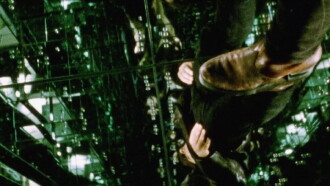
“The Riddle of Lumen” presents an evenly paced sequence of images, which seem to follow an elusive logic. As in “Zorns Lemma” the viewer is called upon to recognize or invent a principle of association linking each shot with its predecessor. However, here the connection is nonverbal. A similarity, or an antithesis, of color, shape, saturation, movement, composition, or depth links one shot to another. A telling negative moment occurs in the film when we see a child studying a didactic reader in which simply represented objects are coupled with their monosyllabic names in alphabetical order. –P. Adams Sitney. Preserved by the Academy Film Archive in 2007.
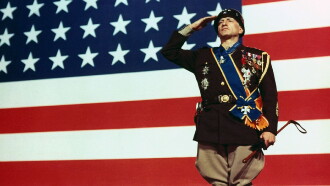
"Patton" tells the tale of General George S. Patton, famous tank commander of World War II. The film begins with Patton's career in North Africa and progresses through the invasion of Germany and the fall of the Third Reich.
The style is relatively unchanged, but the images--press conferences, news events, disasters--convey his vision of the world in a new, direct, political fashion.
Londoner Harry Fabian is a second-rate con man looking for an angle. After years of putting up with Harry's schemes, his girlfriend, Mary, becomes fed up when he taps her for yet another loan.
Using clips from several unidentified films of the preceding decade, featuring many well-known stars of the day, this short demonstrates that an endless variety of music to entertain all tastes can be heard when you go to the movies.
During the years preceeding his death, Sonbert channeled his energy into making Whiplash. His vision and motor skills impaired, he gave his companion, Ascension Serrano, detailed instructions about the assembly of specific shots and the music to be used as a counterpoint to the images.
Sonbert's vivid color palette enhances the ritualistic nature of each action observed. Set against this lush panorama, Sonbert subverts the expectation of classic cinematography with a liberal sprinkling of avant-garde techniques.
This film is an outgrowth of one of Sonbert's film classes at NYU, in which he was given outtakes from a Hollywood film photographed by Hal Mohr to re-edit into a narrative sequence.
"A family of Polish immigrants has a difficult time adjusting to life in the United States. The story centers on the son, named Janek, who has trouble fitting in at school and with his family.
A prohibition-themed gangster thriller, set in the 1930s in the United States. Following a failed heist, Sam's gang takes refuge in a small isolated town where another gang has already settled, together with a mysterious priest.
A group of ruthless Chicago mob enforcers are sent to Kansas City to settle things with the owner of a slaughterhouse who has taken money that is not his to keep.
The film by Brakhage commonly referred to as "Wecht" does indeed exist. It doesn't have a titlecard at the head, and the leader of the original is labeled "Portrait" in Stan's handwriting, so I'm not sure where the 'Wecht' title comes from.
Paul, a former womanizer, marries the head of the medical department's "unattractive" daughter Christine because he thinks attractive women can't be trusted and make poor wives.
An adventure story for children set in New Zealand and told in eight sequential episodes. 5 of 8: The escaped criminals drive away from Wellington in a stolen car.
A frustrated Frankfurt innkeeper is recruited as an agent for the "Gehlen Organization" and after a short training period, during which he is familiarized with sophisticated espionage methods, he takes his first steps as a spy.
Comments
Have you watched The Riddle of Lumen yet? What did you think about it?