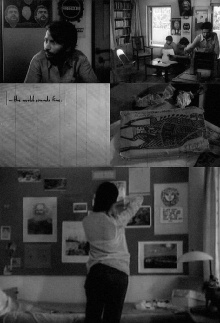
Shama and Ravi are members of a Marxist party. Shama loves classical Indian music, a luxury of a few, and Ravi is in love with quotations and the philosophy of Marx - a need of the masses. Due to a strike, Ravi is compelled to work full-time for the party. Shama decides to give up music reluctantly and joins Ravi.
Sudhir - staying in a city without family roots - symbolizes the need for commitment in all young, sensitive and thinking individuals all over the world.
A man (psychopath), walking around isolated roads at night, encounters a woman who triggers off his childhood memories of torturing and killing a rat, and further leads him to slash another woman - a hooker to death.
In modern society, communication between individuals is becoming more and more difficult. Two persons may be in the same physical environment, yet it seems that a Glass Pane - invisible but strong, and very much there separates these individuals.
The journey of news coming alive, when an athlete featured on the front page falls in love with a tennis starlet featured on the last page of a newspaper.
Maya is a teenager young girl who is working as a housemaid in a rich family. She is required to do all household work and also look after a small child.
The actual Viscount Arnau wants to acquire the power and fame that had their ancestors. For this reason decided to hav many children, preferably males, to revive the Empire.
A couple of musicians are on their way to a show at a country bar. Along the way, they pick up a couple of sexy hitchhiking ladies and decide to pull over for a pitstop.
Portrays the challenges of creating a film about nuclear disaster amid public apathy. It captures behind-the-scenes moments as the crew discusses the gravity of nuclear threats, the importance of preparation, and the emotional impact of a nuclear attack.
A short film that originally played before showings of "Heroes Two" - in which Fu Sheng, Chen Kuan Tai and Chi Kuan-Chun demonstrate different techniques of Hung boxing.
A collage film, a dialogue between mother and the unborn child, the film can be seen as a personal self-analysis by René Paquot, who dreamily delivers his conflicts with maternal, medical and religious authority.