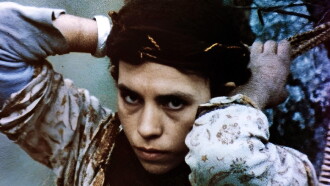
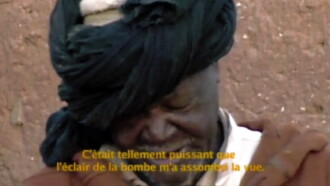
Ali in Wonderland unveils the condition of immigrant workers in Paris in the 1970s. It is a cry of anger against exploitation and racism, uncompromisingly raising the role of the French state, the media, capitalism, and colonization in this system of domination that crushes those who suffer it. In this experimental essay on the condition of Algerian migrants in Giscard's France in the mid-1970s, every aesthetic choice has a precise and legible political motivation and gives body and voice to a figure completely absent from the experimental cinema of the time: that of the immigrant worker. Abouda is one of the children of immigrants seen in the film, and not a simple activist serving a cause, which is why the emotion of her experimental gesture, which she throws in the viewer's face, springs from a ferocity inscribed in her body, from an insatiable anger that inhabits her gaze.
After the defeat of 1940, and faced with the unexpected collapse of French power, all eyes turned to a horizon of both hope and uncertainty: the colonies.
A leading figure in the Palestinian cause and the fight against imperialism, the Lebanese communist activist Georges Ibrahim Abdallah had been languishing in French prisons for thirty-eight years—a unique case in France.
Over the course of a decade Brooks, Alberta, transformed from a socially conservative, primarily white town to one of the most diverse places in Canada as immigrants and refugees flocked to find jobs at the Lakeside Packers slaughterhouse.
The Italian children who grew up in Switzerland between 1950 and 1970 were considered illegal. The law allowed guest workers to work, but not to raise their children here.
The Kabyle people define themselves first and foremost through the spoken word. Every gesture, every moment of their daily lives can give rise to a language of verse, metaphors, and proverbs.
In 1964, Algeria, just two years after the end of the war of independence, found itself catapulted into new contradictions, a still rural territory which responded to the modernity brought by the revolution.
"Gerboise bleue", the first French atomic test carried out on February 13, 1960 in the Algerian Sahara, is the starting point of France's nuclear power.
The image of French prisoners was very often evoked in Algerian cinema and literature, but until today, no Algerian or even European report or documentary had given voice to one of these French prisoners of the war of Algeria.
Natsu, the older of two sisters, has a relationship with Yonosuke, the local kimono trader. Unlike her more conservative sister Oshichi she tries to use sex as a means to climb to a better social position.
Documentary of the U.S. Senator Joseph McCarthy, who rose to prominence in the early 1950s by trumpeting allegations of a vast conspiracy by alleged Communist agents whom he claimed had infiltrated the U.
A married couple, after a life time of work and bringing up a family, retire and awaken to the fast changing world around them, the habitual nature of their relationship, and what they have left.
A petty criminal fakes insanity to serve his sentence in a mental ward rather than prison. He soon finds himself as a leader to the other patients—and an enemy to the cruel, domineering nurse who runs the ward.
Neelapponmaan is a 1975 Indian Malayalam film, directed and produced by Kunchacko. The film stars Prem Nazir, KPAC Lalitha, Adoor Bhasi and Sreelatha Namboothiri in lead roles.
A social drama, it tackles the contradictions prevalent in society. Kumar, a respectable wealthy man to the outside world, in fact leads a life of debauchery.
King Arthur, accompanied by his squire, recruits his Knights of the Round Table, including Sir Bedevere the Wise, Sir Lancelot the Brave, Sir Robin the Not-Quite-So-Brave-As-Sir-Lancelot and Sir Galahad the Pure.