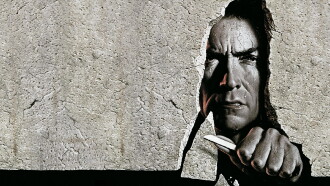
Record of the life and work of Luiz Thomaz Reis, a cameraman who accompanied Rondon's expeditions through the interior of Brazil since 1915. He documented, in photographs, the revolutionary movements of the 1920s, especially that of Catanduva. In the montage, iconographic material, old films and filming made at the National Museum of Cinema were used, where some of his cameras are located.
How are the sex scenes filmed? What tricks are used to fake the desire? How do the interpreters prepare and feel? Spanish actors and directors talk about the most intimate side of acting, about the tricks and work methods when narrating exposed sex.
The relations between Parma and cinema were so strong for almost the whole of the twentieth century that this city became an early laboratory of ideas and theories on cinema and a set chosen by some of the greatest Italian authors and beyond.
Four lives that could not be more different and a single passion that unites them: the unconditional love for their cinemas, somewhere at the end of the world.
This documentary captures the sounds and images of a nearly forgotten era in film history when African American filmmakers and studios created “race movies” exclusively for black audiences.
Germán Cipriano Gómez Valdés Castillo, a young radio announcer from Cuidad Juárez, succeeds in drawing attention to the pachuco movement through his character Tin Tan, laying the groundwork for a new form of binational and mass linguistic expression: Spanglish.
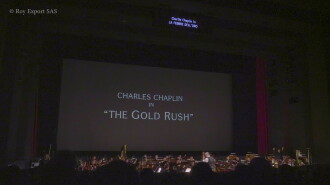
On 18th of December 2017, the Filarmonica Teatro Regio Torino, directed by Timothy Brock, presented "The Gold Rush" by Charles Chaplin, with live performance of the soundtrack.
Using the unfinished film, ANGELITA Y MIGUEL ÁNGEL, by Andrés Caicedo and Carlos Mayolo, as a structuring device, friends of prolific film critic and writer Andrés Caicedo, an unforgettable figure of the group of Cali in the 1970s who left an incredible amount of texts, reflect upon his life, his work, and his suicide at the age of 25, testify to his influence in the cultural life of Colombia, and remember his strong and touching personality.
A remote stone house nestles peacefully on the edge of the Yorkshire moors. In the garden. Faith Armstrong describes the flowers and the late afternoon skies to Jack, her blind husband.
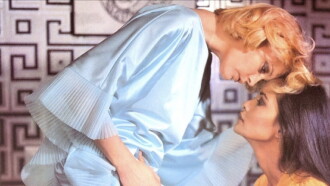
A pair of sexy bisexual nurses live in an apartment building, one floor up from a middle-aged couple and their son Albert, who is busy putting his new science project—a periscope—to good use by spying on the lingerie-wearing lovelies.
An intellectually-challenged man and woman meet, fall in love, and are determined to get married, despite the initial objections of their families and friends.
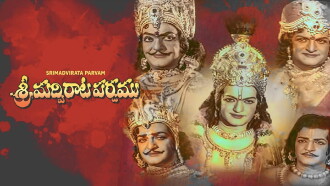
It is an Epic story based on the book Virata Parva of Mahabharatha. After 12 years of Vanavasam, the Pandavas spend their 13th year of exile the Agnaadhavasam in an incognito state with disguised identities at the court of Virata.
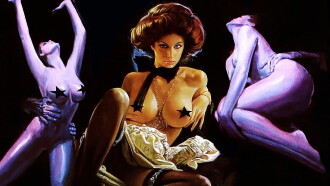
A queen has a stepdaughter named Baby Love, whom she wants to sell as a bride to the highest bidder. Four individuals present themselves to the castle to contribute to a kind of auction, but the girl, route to all sexual experiences while still a virgin, prefers to set out and lose virginity with a young knife thrower who is, incidentally, also the queen's lover.
Comments
Have you watched O Cinegrafista de Rondon yet? What did you think about it?