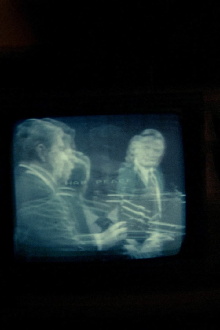
Kurt Kren recorded the last television debate in the Reagan/Mondale election campaign. In the viewfinder, the television filled the entire picture, but the viewfinder did not match the lens entirely so that the television screen in the picture was very little. That was not the plan, but Kren decided to "adopt" the film in the end.
When churlish mobster Albert Spica acquires an upscale French restaurant in London, he dines there nightly, effectively scaring off the clientele with his bad manners.
Welcome to Come, which depicts a somewhat mysterious transformation of the image in the course of a single zoom, was my only film to achieve a small measure of "popularity," with a short write up in Variety and prints purchased by several film teachers who still show it today.
In 1963 and 1964, Andy Warhol captured dancer-choreographers Lucinda Childs, Yvonne Rainer, and Freddy Herko, and Village Voice dance critic Jill Johnston with his Bolex—performing in lofts, on rooftops, and at Judson.
Beginning in 1965 with Black Is, Tambellini launched a series of politically charged experimental films that explore the expressive possibilities of black as a dominant color and idea.
Popular movie trailers from 1984
These some of the most viewed trailers for movies released in 1984:
A former Prohibition-era Jewish gangster returns to the Lower East Side of Manhattan over thirty years later, where he once again must confront the ghosts and regrets of his old life.
After arriving in India, Indiana Jones is asked by a desperate village to find a mystical stone. He agrees – and stumbles upon a secret cult plotting a terrible plan in the catacombs of an ancient palace.
Fast-talking, quick-thinking Detroit street cop Axel Foley has bent more than a few rules and regs in his time, but when his best friend is murdered, he heads to sunny Beverly Hills to work the case like only he can.
Biopic of Saturday Review editor and political journalist Norman Cousins who developed and promoted a self-made health therapy consisting of intake of large quantities of vitamin C and making oneself laugh as much as possible.
A man wanders out of the desert not knowing who he is. His brother finds him, and helps to pull his memory back of the life he led before he walked out on his family and disappeared four years earlier.
Disciplined Italian composer Antonio Salieri becomes consumed by jealousy and resentment towards the hedonistic and remarkably talented young Salzburger composer Wolfgang Amadeus Mozart.