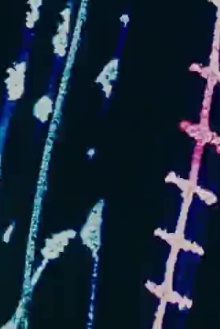
Brazilian animated film, hand-painted on 35mm film. The first version of this 1957 film, a single copy drawn and painted directly onto blank 35mm film, was sent to and lost during the Rio de Janeiro International Film Festival in 1968. Roberto Miller remade the film using other images and the original soundtrack.
An experiment in pure design by film artists Norman McLaren and Evelyn Lambart. Lines, ruled directly on film, move with precision and grace against a background of changing colors, in response to music specially composed for the films.
Len Lye usually timed his films with great care to match their soundtracks, but for All Souls Carnival, he and composer Henry Brant worked separately, preferring to see if the score and visual track would synchronise by chance.
For Kaleidoscope, which was sponsored by Churchman Cigarettes, Lye animated stenciled cigarette shapes and is said to have experimented by cutting out some of the shapes so that the light of the projector hit the screen directly.
An intimate look at cinematographic creation, this visual essay shares with us secrets of the legendary Canadian animator Norman Mclaren and his personal view of filmmaking.
"Leiberg embarks on a search for the interaction between painting and improvised music, tinkering with sound collages sets language and sounds against each other (.
A music video compilation was also released by A&M Records alongside the album. It contained (in order) music videos for "Stay" and "Just Another Day" from Dead Man's Party, "Gratitude" from So-Lo, "Little Girls" from Only a Lad, "Nothing Bad Ever Happens" from Good for Your Soul, and "Private Life" from Nothing to Fear.
A man and a hotel room. One of the best of the series. Writes Kuchar: "Set in central Oklahoma during May, I spend 3 weeks in a motel and get talked at by a small weather-radio that seems to rule my life.