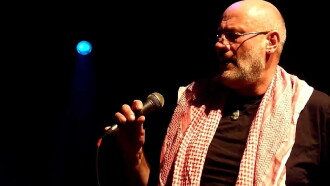
"Freedom" is an acoustic live performance by singer-songwriter Neil Young that was released on video in 1990 in conjunction with his 1989 studio album of the same name. The video includes performances of seven songs that were filmed in Jones Beach, NY on September 5, 1989, and at the Palladium in New York City on September 6, 1989. Six of the songs are performed solo by Young on vocals, guitar, harmonica, and piano. One song, "Too Far Gone," features long-time Young collaborators Ben Keith and Frank "Poncho" Sampedro on Dobro and Mandolin, respectively. Set List: 1. Crime in the City (6:15), 2. This Note's for You (2:39), 3. No More (5:13), 4. Too Far Gone (3:13), 5. After the Gold Rush (4:43), 6. Ohio (3:31), 7. Rockin' in the Free World (4:46).
Here's a little story they're about to tell... Mike Diamond and Adam Horovitz share the story of their band and 40 years of friendship in a live documentary experience directed by friend, collaborator, and their former grandfather, Spike Jonze.
The film is a series of comical musical numbers and skits following Phil Harris around, starting with him performing at the Cocoanut Grove nightclub, which is listened to by Dorothy on the radio whose home-brewing husband Walter hates Harris.
Two artistically inclined childhood friends, a comedian and a folk-rocker respectively, set out on a tour together in hopes of regaining their "mojo" and finding love in the process.
The brothers Gibb perform their greatest hits from the 60's, 70's, 80's and 90's including many songs written for and made hits by other artists but never recorded by the Bee Gees themselves.
The entire Sunday Electric set from the Leamington Convention October 2012, a night that went down as one of the most amazing nights ever in Fish gig history.
Drift by Max Hattler sees the body as a metaphorical landscape. Eerie and sometimes too close for comfort the film manages to transform the familiar and mundane into something poetic and mysterious.
Andreas, who is ten, has been brought up by his grandmother. When she dies, he removes a putto from the crucifix placed upon her, puts it in his mouth and does not speak again.
Yuddy, a Hong Kong playboy known for breaking girls' hearts, tries to find solace and truth after discovering the woman who raised him isn't his mother.
Young people living in Poland in the late 1960s had to face difficult times and make tough choices. Some of them were forced to leave their country for having Jewish origin.
On the fifteenth anniversary of the exorcism that claimed Father Damien Karras' life, Police Lieutenant Kinderman's world is once again shattered when a boy is found decapitated and savagely crucified.
The boisterous good humor of Jurmala, the nickel-mine owner, is, if anything, only barely dented by the raging battles in Finland before, during and after World War Two.
This half-hour BBC documentary offers a revealing look at Svankmajer at work on "Death of Stalinism in Bohemia," and uses excerpts from his earlier films to trace the development of his unique sensibility.
When a beautiful country girl leaves her farm and baby behind to pursue a singing career in Nashville, her naïve dreams of stardom descend into a perverse nightmare.
Dim-witted and stuttering Pidol is the brunt of his townsfolk's ridicule. Not even being reconciled to his dad Andres changes his luck, for under Andres' nose Pidol is tormented by his stepmother Husing and stepdaughter Sunshine.
Three part anthology with stories involving a Phantom of the Opera-style killer haunting a theater, four punks who pick the wrong house to rob and a man on the hunt for Bigfoot.