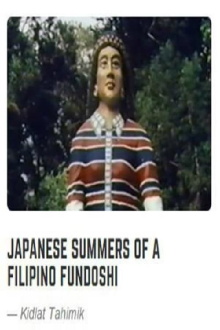
Kidlat Tahimik, a director and performer, sought to recreate relations between the body and filmed image seen through "Asian eyes." This groundbreaking project took the form of a documentary which Mr. Tahimik directed and in which he performed himself in order to show his own thinking about the different views of the body held by the "East" and the "West."
Denys Colomb de Daunant (1922 - 2006) is a writer, poet, photographer and filmmaker known for being the author and co-writer of the film Crin-Blanc (1952) directed by Albert Lamorisse.
In the background is a row of three-masted sailing ships, at anchor, their sales furled. In the foreground, a simple pier that's more like a yardarm juts out above the water; about 15 boys of six or seven years of age are on the jutting wood, and they jump off into the water below.
The film shows a parade down Fifth Avenue, New York. In the foreground many children, both black and white, can be seen following alongside the parade.
They set off, looking for work in far-off places, but disappeared along the way. Inspired by Shiv Kumar Batalvi’s “birha” poetry, the film traces the longing on both sides: on the part of those who are missing, and those that wait for them to return.
BEAUTIFUL FUNERALS is a hand-painted double-step-printed film composed of 1) dense blackness variously punctuated by brilliantly colored jewel/flower-like shapes AND 2) interruptive white sections which are fuzzily dotted with blurred whites and criss-crossed by black "brushstrokes" and hard-edge straight black and white lines.
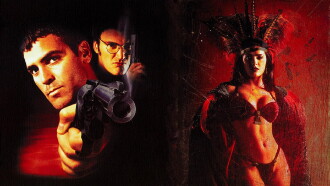
After kidnapping a father and his two kids, the Gecko brothers head south to a seedy Mexican bar to hide out in safety, unaware of its notorious clientele.
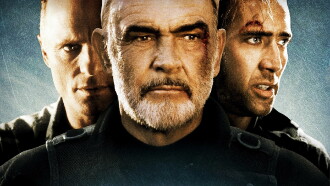
When vengeful General Francis X. Hummel seizes control of Alcatraz Island and threatens to launch missiles loaded with deadly chemical weapons into San Francisco, only a young FBI chemical weapons expert and notorious Federal prisoner have the skills to penetrate the impregnable island fortress and take him down.
When Hydro-Québec announced its intention to proceed with the enormous James Bay II hydroelectric project, the 15,000 Cree who live in the region decided to stand up to the giant utility.
A jaded Lower East Side couple have become bored of straight sex, in a bid to spice things up, they decide to imitate some rough sex scenes as seen on TV.
Comprised of a series of bizarre and unrelated episodes, this absurd Italian comedy earned the inglorious honor of being the film with the most audience walkouts at the 1996 Venice Film Festival.
Comments
Have you watched Japanese Summers of a Filipino Fundoshi yet? What did you think about it?