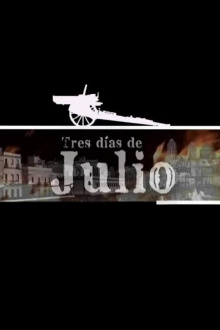
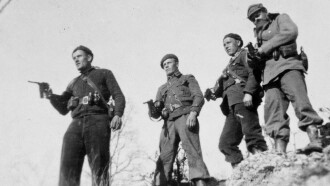
"Tres días de julio" shows what happened in the city of Cádiz in the hours prior to the coup d'état of July 18, 1936, as well as what happened until the moment the Cadiz capital succumbs to the rebels on the morning of Sunday the 19th. The documentary features the participation of historians, relatives of victims of reprisals, and even some direct testimonies of people who lived those tragic days in their youth. The city and province of Cádiz are described as a fundamental piece in the coup because, when it failed in the main cities of the country, they began to play a fundamental role in the strategy followed by the rebels in the immediate Civil War.
Obsessively referring to the traumas and wounds that the Spanish civil war (1936-39) and Franco's dictatorship (1939-75) caused in their day no longer serves to explain the impassable abyss of incomprehension and hatred that the abject policies and radical positions adopted by both the right and the left in recent decades have opened up before the citizens of a country that is barely known beyond hackneyed cultural clichés.
The Spanish journalist Manuel Chaves Nogales (1897-1944) was always there where the news broke out: in the fratricidal Spain of 1936, in Bolshevik Russia, in Fascist Italy, in Nazi Germany, in occupied Paris or in the bombed London of World War II; because his job was to walk, see and tell stories, and thus fight against tyrants, at a time when it was necessary to take sides in order not to be left alone; but he, a man of integrity to the bitter end, never did so.
A particular reading of the hard years of famine, repression and censorship after the massacre of the Spanish Civil War (1936-39), through popular culture: songs, newspapers and magazines, movies and newsreels.
Eight foreign characters recall their exploits and fears in Malaga, a paradise city that starts a revolution on July 18th 1936, as the military coup is stopped by popular rebellion, until February 9th 1937, when Mussolini troops take Malaga and put it under the rule of Franco.
In 1948 Pablo Picasso met the hairdresser Eugenio Arias. Both were linked by the fate of emigration. If Picasso initially only had his hair cut by Arias, a deep friendship soon developed.
In july 1936, the civil war began in Spain, and it would last three years. Since then, it has constantly been a subject for fascination and controversy.
In July 1936, the Spanish people resist the offensive by Franco’s army, backed by Italian and German fascists, aimed at conquering the country's major cities.
While cleaning the apartment of Lucía, her deceased grandmother, Anna finds a notebook where she discovers the story of a secretly kept love, lived during the turbulent years of the Second Republic and the Spanish Civil War.
This documentary features the story of Jules Paivio, the last living Canadian volunteer of the infamous Mackenzie-Papineau Battallion of the “International Brigades”.
Popular movie trailers from 2016
These some of the most viewed trailers for movies released in 2016:
16-year-old Cassie Sullivan tries to survive in a world devastated by the waves of an alien invasion that has already decimated the population and knocked mankind back to the Stone Age.
Lou Clark, a directionless 26-year-old from the English countryside, takes a job at the local castle as a caregiver and companion to a wealthy young banker, Will Traynor.
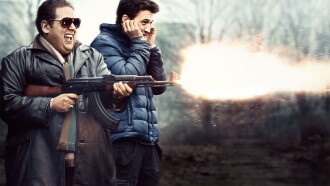
Based on the true story of two young men, David Packouz and Efraim Diveroli, who won a $300 million contract from the Pentagon to arm America's allies in Afghanistan.
The untold story of Katherine G. Johnson, Dorothy Vaughan and Mary Jackson – brilliant African-American women working at NASA and serving as the brains behind one of the greatest operations in history – the launch of astronaut John Glenn into orbit.
1966, United States of America: Kennedy is unable to prevent the Cuban Missile crisis in 1962, creating a nuclear winter throughout the country that seems to have no end.