Danièle Huillet Trailers
S et H TrailerUne Vie Risquée TrailerHommage à Jean-Marie Straub Trailer
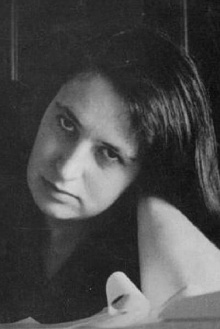
Danièle Huillet was born on May 1, 1936 in Paris, France. She was a director and editor, known for Sicily! (1999), Class Relations (1984) and The Chronicle of Anna Magdalena Bach (1968). She was married to Jean-Marie Straub. She died on October 9, 2006 in Cholet, Maine-et-Loire, France.
Most Popular Danièle Huillet Trailers
Total trailers found: 59
05 September 2001
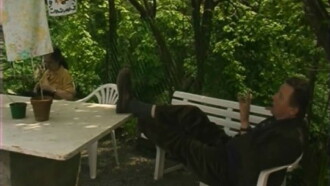
Six unused scenes from Where Does Your Hidden Smile Lie? One of the more priceless of the “bagatelles” in this collection features a lounging Jean-Marie Straub who gives a non-stop disquisition on liberty and filmmaking while Danièle Huillet busies herself with laundry, and their dog Melchior frisks in and out of frame.
03 February 1968
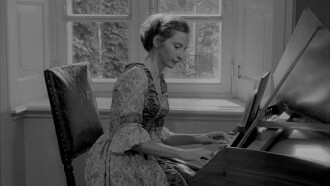
The life and music of Johann Sebastian Bach as presented by his wife, Anna.
10 September 1972
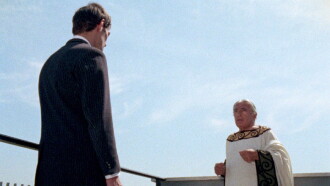
Set in contemporary Rome, the film shows through a series of encounters with “ancient” Romans, how the economic and political manipulation by ancient Roman society led to Caesar’s dictatorship.
20 December 1978
Cinématon is a 156-hour long experimental film by French director Gérard Courant. It was the longest film ever released until 2011.
08 June 1988
Forgotten Straub-Huillet film that shows outtakes from "Der Tod des Empedokles".
01 February 1963
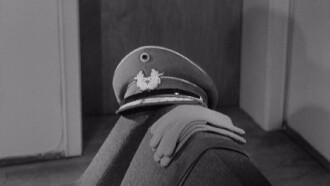
A satirical attack on West Germany's re-armament and revival of militaristic tradition in the Adenauer era.
21 February 1984
A young man, recently arrived in New York from Europe, becomes swept up in a series of events that are beyond his knowledge or control.
01 June 2001
Former Straub/Huillet assistant Jean-Charles Fitoussi films them at work during the shooting of 1999's Sicilia!.
01 November 2001
An alternate look at a part of Sicilia, perhaps left out for its more straightforward didactic quality.
15 January 2003
Undaunted by a commission to make a film about his mentors and aesthetic exemplars, the filmmaking team of Jean-Marie Straub and Danièle Huillet, Costa records with great sensitivity and insight the exacting process by which the two re-edit their film Sicilia!, discussing and arguing over each cut and its effect.
13 November 1982
The child Ernesto doesn't want to go to school any more because, as he says, all he is taught there is things he doesn't know.
07 November 1979
Two segments. The first one arranges six stories from Cesare Pavese’s «Dialoghi con Leucò», taken from classical mythology.
08 January 2018
Short film commissioned by the Cinemathèque Suisse to celebrate Jean-Marie Straub’s 85th birthday.
30 September 2001
A group of men and women have been brought together after World War II, when Italy regained its national and territorial unity.
01 January 1995
My films are like that: in a room, but looking out onto an open sky. [...] I can’t really say it except to repeat that Bresson note, ‘that without a thing changing, everything is different.
02 September 1992
A fearless Antigone, refusing to allow the dishonored body of her murdered brother Polynices to be devoured by vultures and dogs, defies the Thebian tyrant Creon by burying him.
13 October 2006
Inspired by Rossellini's Europa '51 Straub-Huillet made a film consisting of two pans of a street corner in Paris.
04 July 1965
A story about the continuity and collapse of history, the power of suppression, and the terror of reconciliation; loyalty, treason and revenge.
23 April 2003
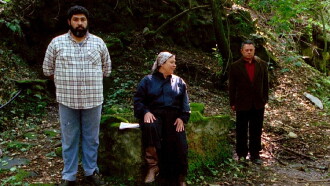
In Italy, immediately subsequent to the war, a group of people who lost all they possessed during the conflict, settle in a village in ruins.
01 January 2003
Recently discovered and shown only twice before, Incantati is an alternate ending to Danièle Huillet and Jean-Marie Straub’s 2003 film Umiliati — fragment as mini-manifesto.
01 January 2020
Discuss, discuss, but we must not forget the laundry!
Snatches of dialogue, of thoughts that mingle happily with the faces that also mingle with each other.
02 February 1992
Documentary about the shooting of Straub's Antigone.
08 January 2018
Short film commissioned by the Cinemathèque Suisse to celebrate Jean-Marie Straub's 85th birthday.
01 January 1993
Blank's TV documentary on Straub-Huillet.
17 July 1984
Reel 35 of Gérard Courant’s on-going Cinematon series.
01 January 2005
A film by Laura Vitali about the last work of the couple Jean-Marie Straub and Danièle Huillet in Buti (Italy) in May 2005, namely the staging of the last five "Dialogues with Leucò" by Cesare Pavese.
01 October 2015
"Jean-Marie Straub and Danièle Huillet" is the overlay of two Cinematons by Gérard Courant with Jean-Marie Straub and Danièle Huillet: "Jean-Marie Straub, Cinématon number 342" and "Danièle Huillet, Cinematon number 343," filmed on May 27, 1984.
03 April 1968
John cheats on Jane with Ann. He claims Jane doesn't care about love, and is wrong: in the end Jane shoots John.
01 January 1967
A short TV documentary about the making of Straub-Huillet's Chronicle of Anna Magdalena Bach.
16 November 1978
This is a recording of a movie discussion. This discussion, shown live in German television on November 16th 1978, is framed by two screenings of Huillet/Straub's movie »Toute révolution est un coup de dés«.
13 January 1971
Straub-Huillet’s first color film, adapts a lesser-known Corneille tragedy from 1664, which in turn was based on an episode of imperial court intrigue chronicled in Tacitus’s Histories.
19 May 1999
A man returns to visit his native Sicily after living in New York for a long time. He learns about the Sicilian way of life from stylized conversations with an orange picker, his fellow train passengers, his mother, and a knife-sharpener.
09 May 1975
A familiar Biblical tale transformed into a cinematic opera of seemingly endless possibility. In expressive, melodic tones, the fraternal pair debate God’s true message and intent for His creations, a conflict that leads their followers towards chaos and sin.
01 January 1983
A behind the scenes film of Class Relations.
10 October 1968
Three sequences are linked together in this short film by Straub; the first sequence is a long tracking shot from a car of prostitutes plying their trade on the night-time streets of Germany; the second is a staged play, cut down to 10 minutes by Straub and photographed in a single take; the final sequence covers the marriage of James and Lilith, and Lilith’s subsequent execution of her pimp, played by Rainer Werner Fassbinder.
17 February 1982
Inspired by a letter by Friedrich Engels and a 1974 account of two militant Marxist writers who had been imprisoned by the Nasser regime, Straub-Huillet filmed this film in France and Egypt during 1980.
28 December 1985
"D. W. Griffith’s 1909 short film A Corner in Wheat, a Biblical tale of avarice, divine retribution, and the prolonged suffering of the masses, is the prelude to this political film essay.
14 October 1987
Film adaptation by Straub and Huillet of Hölderlin’s 1798 tragedy on the symbolic death of Empedocles, the legislator in Ancient Greece.
04 April 1990
A landmark work of symbolistic imagery. The words that the filmmakers speak offscreen are imaginary conversation with Cézanne quoted from a critique by Joachim Gasquet.
11 July 2001
The original television version of 'Where Does Your Hidden Smile Lie?'
17 April 2004
A visit to the Louvre in Paris commentated by an actor reading Cézanne.
10 August 1994
About the history of the French region of Lorraine, called Lothringen in German.
07 December 1977
A tribute to Mallarmé that not only asserts the continuing relevance of his work but also confronts its literary ambiguities with political and cinematic ambiguities of its own.
01 January 2002
"At the end of filming Umiliati, Straub and Huillet gave thanks to the cast and crew in a graceful way: by inviting Dolando Bernardini to sing several stanzas from Torquato Tasso’s 16th-century epic poem Jerusalem Delivered.
09 April 1973
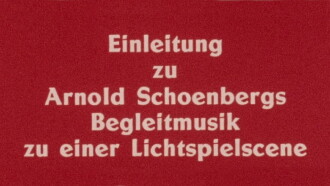
This is a small, intense film based on Schoenberg’s opus of the same name with the subtitle “danger, fear, catastrophe”.
15 August 2014
Jean-Marie Straub pushes this musicality of blocks to a paroxysmal extreme, mixing blocks of time (40 years separate the various extracts that are going to be used, and what is to be filmed), blocks of text (Malraux, Fortini, Vittorini, Hölderlin) and blocks of language (French, Italian, German), and from this ruckus emerges the history of the world, yes, History with a capital H, and from the same movement, the political hope of its being overtaken.
30 November 1977
The film is a sort of presentation of Franco Fortini's book 'I Cani del Sinai'. Fortini, an Italian Jew, reads excerpts from the book about his alienation from Judaism and from the social relations around him, the rise of Fascism in Italy, the anti-Arab attitude of European culture.
01 January 1984
Filmmaker Manfred Blank (director of the excellent Pharos of Chaos) interviews Danièle Huillet and Jean-Marie Straub at some length about their then-current production, Klassenverhältnisse (Class Relations), in which he, himself, performed as an actor.
19 May 2008
The film is a commemoration of the lost livelihood of the earth, the lost lives of the War and to the work of two of the cinema’s greatest artists.
22 May 2007
A hommage to Jean-Marie Straub's and Danièle Huillet's film Quei loro incontri (2005), and to their access to cinema itself.
24 March 2003
Excerpts from the novel Donna di Messina (1949 and 1964, 1967) by Elio Vittorini (1908-1966).
11 August 2010
In the summer of 1986, Danièle Huillet and Jean-Marie Straub were working in the park of an old Sicilian mansion and in a clearing at the foot of Mount Etna shooting Der Tod des Empedokles.
13 November 1983
This film is at once a self-portrait and an homage to Jean-Marie Straub, Farocki's role model and former teacher at the Film Academy.
21 January 2009
In his meetings with various different people, Jean-Luc Godard develops his thinking about history, politics, the cinema, images and time, and this will lead to his exhibition as an artist at the Pompidou Centre.
01 May 1989
A companion piece to the earlier film ‘The Death of Empedocles’, 'Black Sin' is an adaptation of the third version of Friedrich Hölderlin’s play ‘Der Tod des Empedokles’.
04 June 1971
A group of men, women and Kristl with his camera debate how to resist authority in all its forms. All cinematic professionalism is avoided as Kristl explores how to live and make films politically.
07 September 2006
These Encounters Of Theirs divides 10 non-professional actors into couples, then has them take turns in declaiming the Dialogues With Leuco, Cesare Pavese's abstract, philosophical work.
29 September 1997
Based on a rarely performed Schoenberg opera from 1929, From Today Until Tomorrow explores one night in a marriage.
01 March 1991
Documentary about Huillet/Straub's Empedocles.