Jean Painlevé Trailers
Cinéastes de notre temps : Jean Vigo TrailerJean Painlevé Through His Films TrailerPigeons in the Square Trailer
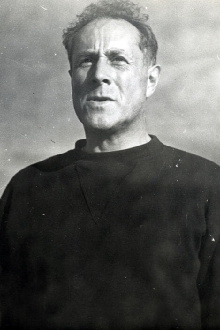
Jean Painlevé was a French photographer and filmmaker who specialized in underwater fauna.

Cinéastes de notre temps : Jean Vigo TrailerJean Painlevé Through His Films TrailerPigeons in the Square Trailer
Jean Painlevé was a French photographer and filmmaker who specialized in underwater fauna.

Total trailers found: 37

01 January 1955
Alexander Calder created and performed one of the most important and beloved works, his miniature circus (1926-1931).
14 December 1928
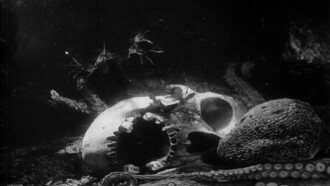
An octopus slithers over objects on land—a doll, a skull—then oozes along the shore into the sea.
01 January 1929
In close-ups and extreme close-ups, we watch two small species of marine crustaceans, the slender long-legged stenorhynchus and the clumsy, short-legged hyas.

31 December 1945
After a look at some strange creatures, the narrator and camera take us to the Chaco forest, on the borders of Paraguay, Argentina, and Brazil, where a vampire bat lives, desmodus rotondus, attacking wildlife and domesticated creatures, killing small ones by draining all their blood and killing large ones by leaving a parasite in their bloodstream.
01 August 1947
In a freshwater pond, it's "eat or be eaten." A dragonfly larva eats a midge; a water beetle larva eats a damselfly larva.
01 January 1925
An educational film, a movie through a microscope, in two parts. Within minutes after the egg drops in the water, fertilization occurs and contractions start.
01 January 1964
After a comic introduction, we look closely at a shrimp. Eyes on stilts, color patterns, pinchered walking feet, a rostrum.
31 December 1930
Jean Painlevé is interested here, with the help of Eli Lotar, in crabs and shrimps. He is particularly interested in detailing their anatomy and observing their mating and fighting behavior.
01 January 1968
The one-celled long and slender diatom, up close: discovered in 1703 with the invention of the microscope.
01 January 1954
Underwater photography, magnified close-ups, and film through microscope present the sea urchin, a complex creature.
01 January 1982
An enthusiastic grandfather sits with children in a Parisian park talking about pigeons. First. their physical appearance—eye, wings and tail, and color—and their varieties.
01 January 1989
This documentary about the life and work of filmmaker Jean Painlevé was originally presented in eight parts on French television.
01 January 1929
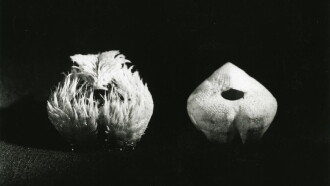
A close-up look at sand urchins and rock urchins. At the seashore, a man digs up a sand urchin. We look closely.
31 December 1936
Perrault's fairy tale presented in claymation with choral voices. Bluebeard goes courting, all six of his wives having died.
31 December 1936
The film begins with methodical descriptions of one-dimensional, two-dimensional, and three-dimensional space.
05 October 1946
A series of 5 choreographed sketches starring Jacqueline Clédon and Michèle Nadal.
01 January 1972
In mud flats along the coast of Brittany we watch acera, small ball-shaped mollusks that are about two inches in diameter.
21 March 2007
The mesmerizing, utterly unclassifiable science films of Jean Painlevé (1902-89) have to be seen to be believed: delightful, surrealist-influenced dream works that are also serious science.
25 May 1937
We begin on planet Earth, with a demonstration of measuring distances using triangulation. Then, an imaginary voyage begins from earth to the moon, on to Mars, Saturn, the closest star (besides the sun), and beyond to the edge of our universe.
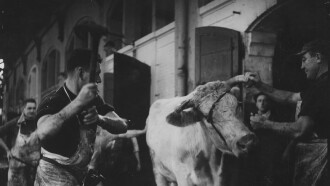
01 January 1949
An early example of ultra-realism, this movie contrasts the quiet, bucolic life in the outskirts of Paris with the harsh, gory conditions inside the nearby slaughterhouses.
25 May 1937
Jean Painlevé short film examining proportion and its effects on organisms.
31 December 1928
Titles in French and English help us know what we're seeing. In all waters, daphnia abound. They are crustaceans about 2 ml long, with one eye that turns in all directions.
01 January 1960
At a marine biology station, a clump of algae reveals polyps, stomachs with limbs, limbs with buds, buds with poison cells.
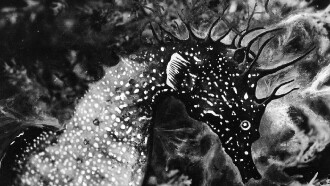
10 August 1935
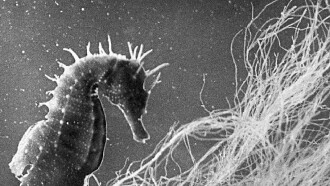
Examines the sea horse, the only fish that swims upright. We watch it use its prehensile tail to wrap around plants and other sea horses.
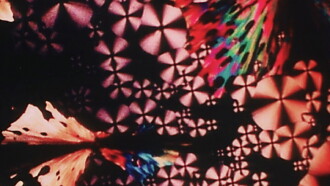
31 December 1978
Title cards introduce images we watch without narration; they are displays of shape and color. François de Roubaix's electronic music accompanies these images, photographed under a polarizing microscope.
01 January 1956
Two kinds of starfish, the brittle and the feather. The brittle star moves its arms alone, without the aid of suckers.
01 February 1929
Painlevé’s first film on animal behavior, focusing on the Hermit Crab. On this film we see the Hermit Crab trying to find shelter.
25 May 1937
Jean Painlevé short film examining population explosion and decline.
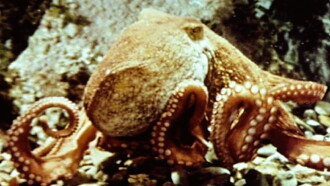
01 January 1967
An octopus slithers into a narrow crack near the shore; we see its eye up close. It feeds on a crab. In spring it's time to mate.
31 December 1930
Jean Painleve short about an experimental canine surgery.
01 January 1937
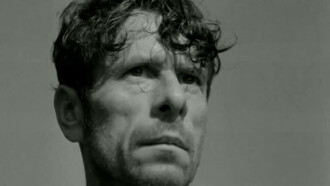
When a wanderer arrives in a village in the East Flanders countryside, strange events begin to unfold.
06 November 1927
Mathusalem (or Methuselah) is a 1922 play by Ivan Goll, considered a precursor of the theater of the absurd.

19 April 2001
The Sounds of the Sounds of Science is a score written by Yo La Tengo for filmmaker Jean Painlevé. It contains 78 minutes of instrumental music to accompany his eight short documentary-style films shot underwater.

