Joyce Wieland Trailers
Portrait of Snow TrailerArtist on Fire: Joyce Wieland TrailerHome Movies 1971-81 Trailer
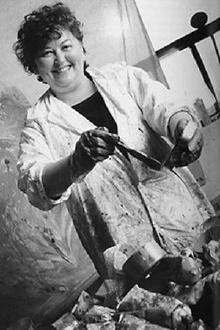
Joyce Wieland (1931-1998) was an experimental filmmaker and artist, whose work challenged and bridged boundaries among avant garde film factions of her time. Her works introduced a kind of manual manipulation of the filmstrip that inscribed an explicitly female craft tradition into her films, while also playing with the facticity of photographed images. Wieland's output was small, but received considerable attention in comparison to other female avant garde filmmakers of her time. As both a gallery artist and a filmmaker, Wieland was able to crossover between those realms and garner attention and support in both.
In 1963 Wieland and Snow moved to New York where they lived for ten years. She attracted critical recognition of her work but eventually moved back to Toronto. Wieland later divorced Snow and kept a low profile until her death in 1998 from Alzheimer's disease. She was made an Officer of the Order of Canada in 1982.

Most Popular Joyce Wieland Trailers
Total trailers found: 35
01 January 1968
The rising moon is the main theme in this short movie of three people and an animal going about their nocturnal rituals.
01 January 1985
Home movies shot on Super 8mm by W+B Hein over 10 years.
01 January 1967
"The whole film are non-art portraits of people in which they do what they want with this hat – and therefore, act or stand in front of my camera.
01 April 1970
Zorns Lemma is a 1970 American structural film by Hollis Frampton. It is named after Zorn's lemma (also known as the Kuratowski–Zorn lemma), a proposition of set theory formulated by mathematician Max Zorn in 1935.
29 December 1967
In a Lower Manhattan industrial loft, a camera very slowly zooms into a photograph on a wall while various people occasionally enter and exit.
01 January 1964
Filmed in Joyce Wieland and Michael Snow’s loft in New York, the film covers a day of friends visiting, writing and drawing from noon of one day to dawn the next day.
01 January 1967
A day at the Beach, at the Sea, at the Sky and at the Sailboats.
01 January 1984
Joyce Wieland: “Hollis and I came back to Toronto on holiday in the summer of '67. We were staying at a friend's house.
20 April 1969
You see nothing but a white, crystal white plate, and water dripping into the plate, and you hear the sound of the water dripping.
21 May 1969
A camera moves back and forth at an increasing pace. Back and forth, back and forth...
02 January 1969
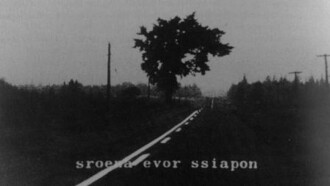
The film consists primarily of degraded footage of landscapes shot from vehicles moving across the country; meanwhile, 537 computer-generated permutations of the film’s title appear like subtitles—the letters are scrambled over and over again, undermining the meaning of Pierre Trudeau's infamous motto.
31 December 1966
In this "fourteen-part drill for the camera," Frampton created a portrait gallery of his art-world friends engaging in a variety of ordinary activities.
17 July 1964
A cutout of a woman's silhouette is displayed in many locations while a free jazz soundtrack is heard.
05 November 1974
Various unrelated vignettes, often juxtaposing sound and image.
01 January 1964
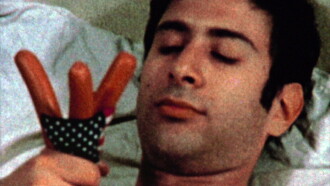
Patriotism, Part One depicts an army of phallic, bun-clad wieners marching on a vulnerable sleeping white male body, naked save for a sheet.
31 December 1964
In a way a portrait of Dave Shackman with the American flag. The ending is a stop-motion animation of a set table with food moving and swirling and finally gathering together in a ball.
01 January 1973
About a strike in which women are involved, but told in a very different way.
01 January 1963
One of Joyce Wieland's earliest works, shot in 8mm and finally blown-up to 16mm, “Larry’s Recent Behaviour” has been described by Simon Field as an "irreverent and wilfully juvenile examination" of a nasty habit that Larry has recently acquired.
31 December 1965
"I decided to make a film at my kitchen table, there is nothing like knowing my table. The high art of the housewife.
23 December 2016
A serendipitous encounter with a younger artist gives legendary Canadian art icon Michael Snow the opportunity to reflect on his life and career.
01 January 1968
The movie takes a rather negative look at things despite the fact that it was shot in reversal film. It depicts the turbulent relationships of disturbed individuals existing on various levels of an apartment house.
01 January 1985
Mother Superior commits murder to save a soul from eternal damnation. Motel Capri was original material improvised as we went along.
12 September 1987
Considered one of Canada's most important women artists of the second half of the 20th century, Joyce Wieland's art embodies the essence of her homeland, feminism, and ecology.
02 August 1967
Experimental short in which a camera pans quickly in a small apartment space; Disembodied voices speak of audience engagement.
01 January 1967
The film 1933 made between 1967 and 1968 offers a street scene shot in New York City in the late 1960s from a loft window on the second floor.
01 January 1972
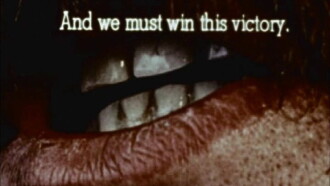
We do not actually see Pierre Vallieres, we see only his lips, his teeth, as he talks in French. English subtitles translate what he says.
28 July 1976
A young woman marries a wealthy man she isn't in love with, but finds romance instead with the couples' painter friend.
18 May 1986
"The film [Birds at Sunrise] was originally photographed in 1972. Birds from my window were filmed during the winter, through to the spring, with the early morning light.
30 January 1967
First shown on January 30, 1967, FOR LIFE AGAINST THE WAR was an open-call, collective statement from American independent filmmakers disparate in style and sensibility but united by their opposition to the Vietnam War.
01 January 1966
Ken Jacobs’s most elusive and mysterious film is at once an allegory of movie-making, a demonstration of 8mm versatility, and a celebration of a now vanished neighborhood beneath the Brooklyn Bridge.
01 January 1967
Hand Tinting, a five-minute silent study of young girls dancing, swimming, and observing one another by Joyce Wieland, […] has a quality that is reminiscent of cognitive dilemmas in some of her other films but that has few counterparts in avant-garde cinema of the sixties.
01 January 1967
A cat eats its methodical way through a polymorphous fish.
01 January 1965
Constructed from found and stock footage, Barbara’s Blindness is a meditation on vision and adversity, drawing humour and pathos from a moralising educational film.
01 January 1969
An unreleased diary film shot during the Fairleigh-Dickinson Artist Seminar simultaneous to the production of Back and Forth by Michael Snow.
29 November 1968
“This film is against the corporate military industrial structure of global village.”