Lillian Schwartz Trailers
Raymond Roussel: The Day of Glory TrailerThe Artist and the Computer Trailer
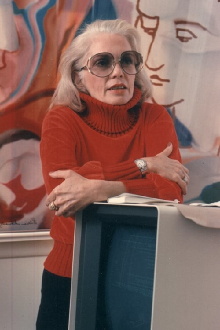
Lillian Schwartz is a pioneer in the field of computer animation. In the early 1970s, she became the official artist in residence at AT&T Bell Laboratories, IBM's Thomas J. Watson Research Laboratory and at Lucent Technologies Bell Labs Innovations where she would experiment with early computer graphics programs to create short works of film art. After studying traditional free-hand drawing while a nursing student at the University of Cincinnati, Schwartz became interested in incorporating technology into her artwork. Along with computer scientist Ken Knowlton, she helped create the image-generating programming language EXPLOR, with which she created many of her works in the mid to late '70s. In addition to her animation, Schwartz has also done research in the field of using computers to analyse the working methods of traditional artists such as Picasso, Matisse and Da Vinci by amassing large databases of their colour palettes and structures within their art. (from: http://www.undergroundfilmjournal.com/tag/lillian-schwartz/)

Most Popular Lillian Schwartz Trailers
Total trailers found: 66
01 January 1977
A single bird in flight is transformed, enhanced and interpreted so as to present a unique visual experience.
01 January 2013
This animation can be watched in 2D or using Chromadepth Glasses in 3D.
01 January 1975
A swift moving assortment of moving images. Filmed from a color TV monitor that was computer controlled.
01 January 2013
This animation can be watched in 2D or using Chromadepth Glasses in 3D.
31 March 1972
“Apotheosis, which is developed from images made in the radiation treatment of human cancer, is the most beautiful and the most subtly textured work in computer animation I have seen.
01 January 2013
This animation can be watched in 2D or using Chromadepth Glasses in 3D.
01 January 1975
Beginning with footage of sea birds in flight, the film image is then optically scanned and transformed by the computer.
01 January 1972
A colorful collage, with a subtle ecology theme, made largely from footage from trial runs of programs used for many of the other films.
01 January 2013
This animation can be watched in 2D or using Chromadepth Glasses in 3D.
01 January 1977
The artist uses the computer to accent and control a mime’s disciplined choreography. Studies in facial distortions with lens distortions.
09 October 2012
This animation can be watched in 2D or using Chromadepth Glasses in 3D.
01 January 2013
This animation can be watched in 2D or using Chromadepth Glasses in 3D.
01 January 1976
Music “Quartet in F” by Maurice Ravel, performed by Max Mathews. Subtly colored images combining microphotography and computer generated images with unique editing sequences that propel the viewer into a spiral-like endless vortex.
01 January 1972
“Lines and rectangles are the geometric shapes basic to ENIGMA, a computer graphics film full of subliminal and persistent image effects.
01 January 2013
This animation can be watched in 2D or using Chromadepth Glasses in 3D.
01 January 1986
Schwartz reordered and combined angular contours, broken planes, and distorted proportions in her own pictorial structures in an homage to Picasso's style.
01 January 1974
This tape combines live-images filmed in the Yucatan with output from the Paik video-synthesizer ribboned with computer-generated images.
01 January 2014
This animation can be watched in 2D or using Chromadepth Glasses in 3D.
01 January 1979
Music performed by The New York Philharmonic Orchestra and conducted by Pierre Boulez. Schwartz manipulates by computer, in real-time the images of the Maestro to realize a unity between his music and the picture.
01 January 1984
A short Emmy award-winning animation promoting New York's newly renovated Museum of Modern Art.
01 February 1972
A ballet of squares and octagons in many forms, exhibiting a variety of geometric and sometimes sensuous interactions.
01 January 1977
The movements of a dancers body are recorded, studied, reshaped, to understand the anatomical ranges of joints.
01 January 1977
Music by Albert E. Miller. Experimental work with dancer and musicians to combine and present an unusual choreography of performers and music as a unified force.
01 January 1977
Abstract images of frame-by-frame animation with subtle growing effects of crystals are enhanced by polarized colors.
01 January 2013
This animation can be watched in 2D or using Chromadepth Glasses in 3D.
01 January 1975
Escher-like images stepping through the frames to the music of a jazz group. Delightful–shows a depth in the imagery not accomplished by computer before.
22 June 1970
Pixillation features computer generated abstract animations set to Moog-synthesized sound.
09 March 1971
Blasting off into cosmic visual abstraction, pioneering computer artist Lillian Schwartz’s UFOs is a kinetic tour-de-force whose innovative pixel pigmentation showcased advanced stereoscopic technology as art.
20 April 2017
A tortuous journey, in the company of the Spanish painter Salvador Dalí, around the figure of the enigmatic and visionary French poet Raymond Roussel (1877-1933).
01 January 1997
A number of telephones from the very first invention by Alexander Graham Bell to the present-day cellular and voice phones are morphed in an inventive choreographic video.
01 January 1976
Music “Canzoni per sonar a quattro” by Giovanni Gabrieli, performed by Elizabeth Cohen, Max Mathews, and Gerard Schwarz.
01 January 1978
This film is strongly rooted in its underlying mathematical structure which forms the basis for the images.
01 January 1978
Pablo Neruda’s life unfolds and becomes the basis for the symbolic representation of his poem “Barcarola”, intermixing live action, still footage, computer images, dance and poetry.
01 January 1976
Picture-processed photos from the artist-filmmaker’s family. Faces are abstracted in a divisionistic manner.
01 January 1974
Computer-simulated disk galaxies that are superimposed and twirl through space in beautiful colors at different speeds.
01 January 1978
An illusion of 3 dimensions is achieved by a blending of mathematics and physics to carry the spectator through a new range of audio and visual dynamics.
01 January 1974
Changing parameters on mathematical equations.
01 January 1974
“Schwartz’ METAMORPHOSIS is a complex study of evolving lines, planes, and circles, all moving at different speeds, and resulting in subtle color changes.
01 January 1972
A playful concoction of computer produced images, a few hand-animated scenes and shots of lab equipment.
01 January 1976
Computer generated images used as counterpoint to music “Fantasia & In Nomine” by John Ward, performed by Elizabeth Cohen, Max Mathews, and Gerard Schwarz.
01 March 1972
“The changing dots, ectoplasmic shapes and electronic music of L. Schwartz’s ‘Mutations’ which has been shot with the aid of computers and lasers, makes for an eye-catching view of the potentials of the new techniques.
01 January 2013
This animation can be watched in 2D or using Chromadepth Glasses in 3D.
01 January 1973
Mathematical functions are the basis for a science film on contour plots and an art film. Both are shown simultaneously at a two screen production for an IEEE conference in NYC.
01 January 1994
A 4 minute film based on flowing changing images from liquid-like faces to flashing abstract imagery.
01 January 1977
Slow disintegration and aging of artists head, revealing underlying bone structure. Created using old picture-phone technology.
27 October 1971
Regulars gather at The Blue Jay, a gay bar in Manhattan's Greenwich Village, to celebrate Christmas Eve 1971 with people they consider family.
01 January 1982
A dance by bodies of shifting colors.
02 October 1976
Pioneering artist Lillian Schwartz demonstrates the human input -- integrity, artistic sensibilities, and aesthetics -- that goes into producing early computer art.
01 January 1976
Musicians and dancer perform in real-time while Schwartz plays a computer-keyboard to create special effects on a computer-controlled video-visual communication system.
01 January 2015
Digital Animation | 02"50
01 January 2013
This animation can be watched in 2D or using Chromadepth Glasses in 3D.
01 January 2014
This animation can be watched in 2D or using Chromadepth Glasses in 3D.
01 December 1990
Created in 1990 at AT&T's Bell Labs in a program called Sculpt, one of the very first real-time texture mapping programs.
01 January 1977
Music by Albert E. Miller. Combination of musicians and dancers in free form movements captured by computer-controlled-video which permits distortions and variations of the imagery.
01 January 2005
Drawing on rare performances, interviews, animations, and experimental film, this documentary surveys the formative years of electronic music from 1948 to 1980.
31 December 1972
Extended editing techniques based on Land’s experiments affect the viewer’s sensory perceptions.
01 January 2013
This animation can be watched in 2D or using Chromadepth Glasses in 3D.
31 December 1971
Study in motion based on Muybridge’s photographs of man running.
01 January 1977
Music by Albert E. Miller. Combination of musicians and dancers in free form movements captured by computer-controlled-video which permits distortions and variations of the imagery.
01 January 2013
This animation can be watched in 2D or using Chromadepth Glasses in 3D.