Miklós Jancsó Trailers
Negative history of Hungarian cinema TrailerA Kádár-korszak demokratikus ellenzéke TrailerEd's Eaten Elevenses Trailer
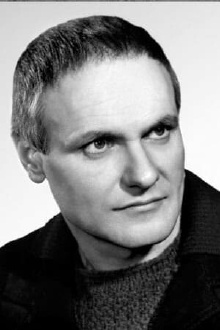
Miklós Jancsó (27 September 1921 – 31 January 2014) was a Hungarian film director and screenwriter. Jancsó achieved international prominence from the mid-1960s onwards, with works including The Round Up (Szegénylegények, 1965), The Red and the White (Csillagosok, katonák, 1967) and Red Psalm (Még kér a nép, 1971). Jancsó's films are characterized by visual stylization, elegantly choreographed shots, long takes, historical periods, rural settings, and a lack of psychoanalyzing. A frequent theme of his films is the abuse of power. His works are often allegorical commentaries on Hungary under Communism and the Soviet occupation, although some critics prefer to stress the universal dimensions of Jancsó's explorations. Towards the end of the 1960s and especially into the 1970s, Jancsó's work became increasingly stylized and overtly symbolic.
He received five nominations for the Best Director Award at the Cannes Film Festival. winning for Red Psalm in 1972. In 1973 he was awarded the prestigious Kossuth Prize in Hungary. He received awards for his life work in 1979 and 1990, at Cannes and Venice respectively.

Most Popular Miklós Jancsó Trailers
Total trailers found: 67
02 February 2012
Anthology film made as an act of protest against Hungarian government of Viktor Orban.
01 May 2004
A collective film made by ten prominent Hungarian filmmakers to express what each of them wishes to bring with them of their own culture and personal experience with Hungary's accession to the European Union.
11 February 2010
Concerning the Mátyás era in Hungarian history, during the reign of Matthias Corvinus (1443–1490), the film focuses on three eras of the king's life: the young Mátyás fights for the throne, the older Mátyás as king, and the fate of the royal crown and the royal heir after his death.
17 December 1986
In a drama in which even Gad has a role as well as Michael York, it is certain that serious issues are at stake.
01 January 1969
Inspired by Giovanni Boccaccio's 14th-century collection of novellas known as The Decameron, this innovative film combines short works from seven directors who set out to interpret Boccaccio's masterwork for the modern age.
01 January 1994
The second film in Miklós Jancsó's documentary series Message of Stones.
03 November 1967
In 1919, Hungarian Communists aid the Bolsheviks' defeat of Czarists, the Whites. Near the Volga, a monastery and a field hospital are held by one side and then the other.
01 January 1986
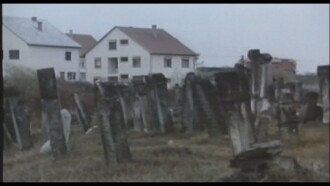
Two rabbis show the ruins of an abandoned synagogue to a group of primary school-age Jewish children, and stand by as the children dip bread in honey, drink wine, pray, and sing.
11 October 1979
Zsadányi flees from the authorities with his goddaughter, Bankós Mari, and they escape into the forest.
12 June 1968
Set during a turbulent era of disquiet, fear, persecution and terror, which permeates every corner of post-WWI Hungarian society.
01 January 2010
Reconstructions of unrealized Hungarian films in cooperation with the greatest Hungarian film directors.
01 January 1954
A celebration of the culture and the ancient traditions in Badacsony.
09 March 1972
Set in the 1890s on the Hungarian plains, a group of farm workers go on strike in which they face harsh reprisals and the reality of revolt, oppression, morality and violence.
06 January 1966
After the failure of the Kossuth's revolution of 1848, people suspected of supporting the revolution are sent to prison camps.
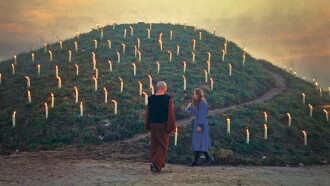
22 April 1971
Allegory of the suppression of the 1919 revolution and the advent of fascism in Hungary; in the countryside, a unit of the revolutionary army spares the life of father Vargha, a fanatical priest.
06 May 1976
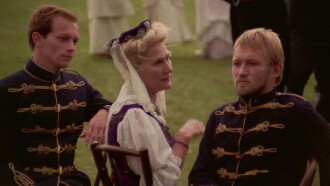
The setting is a Central European kingdom, near the turn of the century. Bored by his very proper wife, the youthful heir to the throne spends his time in amorous dalliances at a sprawling country estate.
04 October 1979
The movie portrays a peasant revolt in Hungary in the early twentieth century.
14 January 1965
In the aftermath of World War II, a Hungarian teenager, captured by Soviet troops, forms an unlikely bond with a Russian soldier in a remote prison camp.
15 September 1987
Zoltai is a Hungarian professor who returns home after a visit to the United States. Following a television interview, he commits suicide and leaves a note for his longtime friend Dr.
01 January 1958
The movie addresses the anti-fascist theme taken from a moral perspective. The movie tells the story of a group of teenagers who were drafted to the front in the last weeks of World War II and found refuge on a small island.
06 February 1969
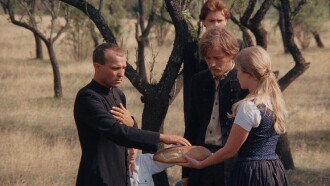
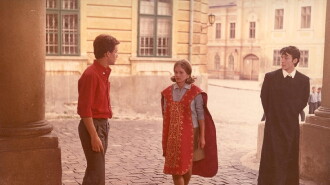
In post-WWII Hungary, a group of Communist college students arrive at a Catholic seminary hoping to engage in peaceful debate with its students.
12 December 1974
It has been fifteen years since the death of her father, Agamemnon, and Elektra still burns with hatred for Aegisztosz, who conspired with Elektra's mother to kill him.
26 October 1981
A historical drama set in the 1400s, a young man sent to Italy but is forced back after his father's mysterious death.
01 January 2002
A making-of documentary shot on the set of Miklós Jancsó's 2003 film "Wake Up, Mate, Don’t You Sleep".
01 January 1994
The Third film in Miklós Jancsó's documentary series Message of Stones.
01 January 1980
János Kovácsi's film is an ironic portrayal of a day in the life of a beautiful German woman in her prime who arrives at Lake Balaton to take charge of her inheritance, a small house with a garden full of childhood memories.
01 January 1994
The first film in Miklós Jancsó's documentary series Message of Stones.
01 September 1977
A documentary about director Luca Ronconi. He is asked about his life and his choice to devote himself to theater and in particular, at that precise moment in his career, to undertake the production of Pier Paolo Pasolini's Calderon as part of the Prato theater workshop.
12 October 1989
A focus on the tormented lives of intellectuals who failed to protest recent troubles in their homeland.
15 March 1962
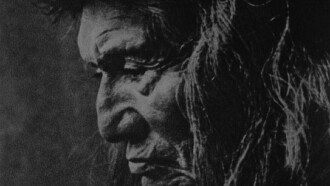
Still photographs and narration give an overview of the history of the American Indian.
01 January 1984
The film the was made of OMEGA band's November 1982 concert in the Budapest Sportstadium.
26 January 2009
A documentary about the Democratic Opposition of socialist Hungary.
02 May 1996
Miklós Jancsó makes fun of his reputation for creating exceptional visuals in "A nagy agyhalál AKA The Great Brain Death.
04 December 1969
Croatian anarchists collaborate with Hungarians to make a bid for the life of King Alexander of Yugoslavia.
30 December 1970
A journalist preparing a story on extremist youth falls in love with a young radical who fears being killed by his companions when he is unable to commit a political assassination.
12 May 1972
The narrative concerns the barbaric exploits of Attila The Hun and yet none of the characters ever leave the remote seaside stretch of land on which the film is set or do much of anything – with the ensuing moralizing interrupted only by the occasional (and equally obscure) music-infused rites.
06 June 1974
In this costume epic, the last days of Julius Caesar are chronicled.
18 March 1991
From the film-shooting in the Buda Castle Marci and his friend go to a well-paying job. The scene is a big castle in the middle of a huge park.
31 December 1950
One of the earliest works of the outstanding Hungarian director Miklós Jancso was filmed by him in collaboration with Dezho Koza and Gyula Meszáros as a documentary short film dedicated to the propaganda of building socialism in Hungary.
28 February 1963
A young doctor undergoes a spiritual crisis when he returns to his rural home.
01 January 1963
A man, a woman, an afternoon, a city, and an unspoken, hopeful desire to find love by way of the personal ads.
01 January 1978
An exploration of a decaying synagogue.
01 January 1998
A mix of documentary and essay about Hősök tere (Heroes' Square) in Budapest.
01 January 1965
Two old men enter an abandoned synagogue, look at the decay around them, and pray.
28 January 1999
In the Kerepesi Street cemetery, three grave diggers contemplate the fate of the world, then they step out of this role and in a sequence of episodes they play the typical figures of contemporary Hungarian reality, the fat cat, the swashbuckler, the victim, underworld chieftains, and present little absurd dramas of love, marriage, friendship, public order and legal safety.
11 October 2001
A girl is on the skids because of love. A short tempered and passionate young man falls in love with the girl.
12 October 2006
Jancsó’s farce, similar to the previous ones, is about our time and about death. Pepe marries into a family of mafiosi, with the father-in-law rolling in money.
26 February 2004
By the notes of Fiáth Pompeiusz, the one-time friend of Kapa and Pepe, Professor Szirtes has solved the secret of the time machine, and he realizes the invention relying on "special" H2O.
06 February 2003
This time, Kapa and Pepe are first of all prisoners of war – and convicts taken to forced labor service, Jews, Hungarian soldiers, German soldiers.
30 May 1992
When Hungary's newest prime minister is shot and killed at a reception, the resulting investigation is necessarily swift and comprehensive.
31 March 1960
The film consists of 3 novellas. 1. On the eve of the Soviet advance into Hungary, workers at a military plant risk everything to strike in defiance, displaying unwavering courage and solidarity.