Mohamed Bouamari Trailers
WHEN CINEMA SPEAKS... TrailerLe Passeur immobile TrailerThe Citadel Trailer
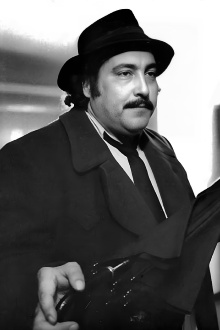
Born in Guidjel, near Sétif in Algeria in 1941, Mohamed Bouamari (محمد بوعمري) is an Algerian actor and director.
Self-taught, in 1961 he received a scholarship from the UNEF to study film set careers in France. Returning to Algiers in 1965, he became an assistant to the filmmaker Mohamed Lakhdar-Hamina on "Le Vent des Aurès" in 1966, then to Costa Gavras on "Z" in 1969 and to Jean-Louis Bertucelli on "Remparts d'Argile" in 1969). Bouamari made his first feature film as director in 1972, with "Le Charbonnier", a film which was selected in several international festivals, including La Semaine de la Critique in Cannes, and which attracted attention.
In the wake of this first work which ranks him among the progressive filmmakers bringing to the screen the effects of the Algerian agrarian revolution, he then directed "L'Héritage" (1974), and continued the vein that would remain his own, that of a committed filmmaker, in search of a revolutionary national aesthetic, whose favorite themes are the war of independence, the denunciation of contemporary feudalism and the cause of the condition of Algerian women and his own wife, Fettouma Ousliha, will play the heroine of his films. The rest of his work, from “Premier Pas” (1974) to “Refus” (1982), will bear witness to these commitments. Mohamed Bouamari last appeared on screen in 2005, in Djamila Sahraoui's film, "Barakat".
He died of a heart attack on Friday December 1, 2006 in Algiers, at the age of 65 while he was finishing his fiction film "The Sheep".

Most Popular Mohamed Bouamari Trailers
Total trailers found: 15
02 January 1973
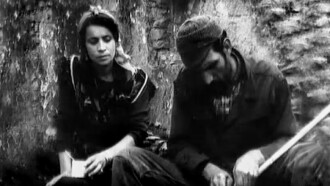
Film describes the miserable existence of a charcoal-burner who is barely able to feed his family. His search for work in town ends in failure and he is forced to return to his village.
08 November 1981
Reel 13 of Gérard Courant's on-going Cinematon series.
02 January 1963
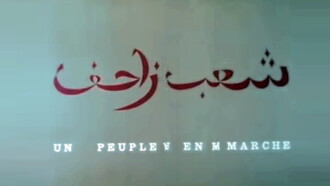
Collectively directed by the members of the Centre audiovisuel d'Alger at Ben Aknoun, the film traces, in two parts, Algeria's recent history, from colonial repression to the birth of the National Liberation Army, and the country's postwar reconstruction, framed in sympathy with the socialist project of Ahmed Ben Bella's government.
14 December 2021
Le Passeur immobile, which covers the year 1987, is a Booklet filmed stuck between The Days and the Nights (1986) and The Artifice and the Fake (1988).
01 January 1969
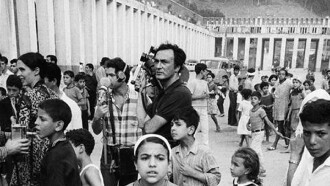
Festival panafricain d'Alger is a documentary by William Klein of the music and dance festival held 40 years ago in the streets and in venues all across Algiers.
11 November 1970
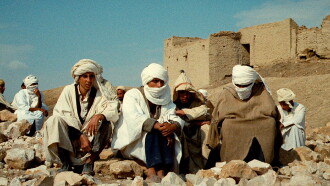
In a village on the edge of the Sahara, Rima, a 19-year-old orphan, dreams of learning, of discovering, of living free while the men of the salt mine go on strike.
08 June 1967
The transformations of the daily life of the Algerian people during the destructive French occupation, then during the war of liberation.
05 June 1982
A stubborn director who wants to rediscover the Algiers of his childhood comes up against the “Hol�
02 January 1971
The film traces the story of a patrol of the Algerian National Liberation Army (ALN), whose mission is to transport a prisoner French soldier to the Tunisian border.
01 January 1965
Algerian youth of the 1960s, straddling traditional South Mediterranean and Western culture and the desire for emancipation of younger generations to find true love.
02 January 1988
El Kalaa, a village in southern Oran. Although already married, old Sidi planned to marry another. He sets his sights on the beautiful Aïssa, with whom Kaddour, his adopted son, is in love.
02 January 1982
In 1971, the Algerian government nationalized hydrocarbons. The consequences of this decision on the community of Algerians in France are numerous.
02 January 1980
A modern couple seeks to find marital happiness in a context where Algerian society is taking the “first step” towards female emancipation.
01 January 1975
A harrowing picture of the heritage of colonialism, focusing on a man driven mad by torture but saved by his wife, who restores his sanity and leads the progressive forces to rebuild the village.
13 May 2026
Zineb Sedira pays tribute to the history of African Cinema and the filmmakers who had inspired her.