Robert Beavers Trailers
Making films out of light and memory TrailerA Visit With Robert TrailerCape Cod Trailer
Robert Beavers is an American experimental filmmaker best known for My Hand Outstretched to the Winged Distance and Sightless Measure, an epic cycle comprising 18 of his films (many later re-edited) made since 1967.
Beavers’s use of shaped mattes to obscure aspects of the image and gelatine filters that produce varieties of coloured light are hallmarks of some of his films, many of which observe hand- and craftwork (including his own filmmaking). Born in Brookline, Massachusetts, Beavers attended Deerfield Academy before meeting the filmmaker Gregory J. Markopoulos in 1966. They moved to Europe in 1967 and removed their films from distribution; Beavers did not show his films in the United States again until 1996. Beavers made films in Greece, Belgium, Switzerland, Germany, and Italy. His early Plan of Brussels and Winged Dialogue (1967-68/2000) are multilayered psychic explorations; From the Notebook of…(1971/1998) is set in Florence and inspired by Leonardo’s notebooks. Ruskin (1975/1997) is shot at the various sites of the titular artist/critic’s work in London, the Alps and Venice. Beavers’s only film to use intertitles, the dialogic Sotiros (1976-78/1996) marks the end of his use of filters and mattes. Wingseed(1985), The Hedge Theater (1986-90/2002), The Stoas (1991-97), and The Ground (1993-2001) dwell in pastoral environments in Italy and Greece. Beavers has produced three films outside the Hand Outstretched cycle: Pitcher of Colored Light (2007), The Suppliant (2012) (both shot in the U.S.) and Listening to the Space in My Room (2013). He lives with the German filmmaker Ute Aurand in Berlin and in Massachusetts.

Most Popular Robert Beavers Trailers
Total trailers found: 45
01 January 2014
“Call them spontaneous or occasional films. I did not know if I would show this publicly when I filmed.
25 January 1983
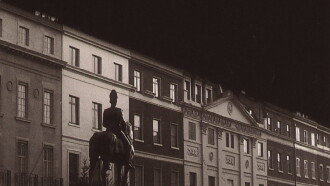
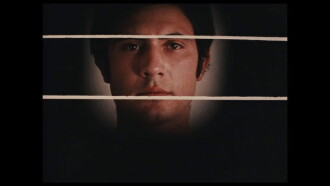
“The details of the young actor’s face – his eyes, eyebrows, earlobe, chin, etc. – are set opposite the old buildings in the market quarter of Athens, where every street is named after a classic ancient Greek playwrite.
29 December 1967
Portrait studies of Mrs. Hodges, Gail Beavers (the filmmaker’s sister) and Gregory J. Markopoulos.
01 June 2008
Filmed in Switzerland and released as part of a triptych with A Walk, Zuoz features the filmmaker Robert Beavers skating on ice.
01 January 1978
The second film in Robert Beavers' Sotiros trilogy
25 March 2016
“Last August, several filmmakers joined me to repair the splices in Markopoulos’s Eniaios. I interrupted our work for a moment; the generosity of James, Silvia, Nina, Alexandre and Julia prompted me to film them.
01 January 1969
The view from a window overlooking a busy city street overlays varying geometric shapes moving against a brightly coloured background.
13 December 1971
Filmed on Hydra, the work studies a young man’s face across shifting light and landscape, framed through customized masks and filters.
30 December 1967
Filmed in Italy (Rome), on Agfa-Gaevert reversal film. Beavers destroyed the camera original.
05 May 2007
Filmed in his mother’s house and garden, Beavers traces shifting shadows across seasons, capturing a blend of solitude and peace.
06 October 1969
The film is seen as though upon and through the structure of its spiritual partitions. One might say that there are three elements or levels to the images: narrative, descriptive or analytic, and abstract.
01 January 1968
Filmed in a Brussels hotel room, Beavers alternates between his work desk and lying nude on the bed, while rapid cuts and superimpositions conjure a rush of street scenes and fleeting encounters.
07 November 1985
A meditation on landscape and desire, the film juxtaposes arid terrain, wild grasses, and herds of goats with the naked figure of a torso in shifting light.
03 October 2010
Filmed in 2003 while staying in a Brooklyn Heights apartment, the work centers on a small Greek statue revealed in shifting morning and afternoon light.
11 October 1997
Named for the colonnades of the ancient Lyceum, the film juxtaposes industrial arcades in golden morning light with lush images of streams and wooded glens.
10 September 2013
A portrait of a recently vacated home, the film evokes both memory and the lingering presence of past inhabitants.
30 May 1974
Beavers traces John Ruskin’s legacy from London to the Alps and especially Venice, where the camera lingers on stone and water in dialogue with Ruskin’s writings.
11 February 1972
Shot in Florence, the film draws on Leonardo da Vinci’s notebooks and Paul Valéry’s essay on da Vinci’s creative process to explore parallels between Renaissance space and the moving image.
06 August 1997
Jonas Mekas assembles 160 portraits, appearances, and fleeting sketches of underground and independent filmmakers captured between 1955 and 1996.
01 January 1970
In Palinode a disk-shaped matte continually shifting in and out of focus alternately blocks part of the image or contains it.
09 September 2003
Filmed when Beavers was 18–19, this self-portrait depicts him and Gregory J. Markopoulos in their Swiss apartment.
13 May 2017
Late afternoon quiet and a silent figure seated on a bench in Nafplion; the historic figures of Kolokotronis and Kapodistrias; plus the old factories and machinery, warehouses and train lines that are part of a Piraeus, now disappearing.
01 January 1972
Beavers intercuts scenes of traffic in Bern with details from the 15th-century altarpiece The Martyrdom of St.
14 September 1973
Shot in Florence and the Alps, the film contemplates traditional European labor—ice vaults, bookbinding, cooking—while largely omitting human protagonists.
09 September 2024
“I walked into Bernice Hodges’s garden when I was seven years old and asked her to read to me. She was in her mid-seventies.
01 January 1999
Scenes from the life and work at Anthology Film Archives. Much of the footage in this video was shot by Auguste Varkalis.
05 February 2000
Distilled in 1996 from an earlier 50-minute trilogy, this film was shot in Greece and Austria and structured around two recurring intertitles, “He said” and “he said.
09 September 2026
Documentary about Robert Beavers's works.
01 January 1967
The story of Jacob wrestling the angel at the stream called Jabbok.
01 January 1978
The final entry in Robert Beavers' Sotiros trilogy
01 January 1977
The first film in Robert Beavers' Sotiros trilogy
30 January 2001
Interweaving stonework and filmmaking, Beavers evokes memory through hammer strokes and chisel sounds that shape both image and rhythm.
10 September 2022
Beavers revisits locations in Berlin first filmed in Diminished Frame (1970), alongside sites in Massachusetts, to reflect on how lived places shape vision and memory.
06 April 1971
“There is a balance between a sense of the past seen in the views of West Berlin, filmed in black & white, and a sense of the present in which I filmed myself showing how the colour is created by placing filters in the camera’s aperture.
04 March 1980
Shot in Rome and Salzburg’s natural theatre, the film uses cutting and sewing as metaphors for love, separation, and the craft of montage.
07 October 2005
My Hand Outstretched to the Winged Distance and Sightless Measure is a film cycle by American avant-garde filmmaker Robert Beavers.
01 January 1967
A romantic and lyric study of a young friend and readings he encouraged, especially Mallarmé.
30 December 1967
An early exploration of intimacy and perception, the film portrays the body’s beauty and sexuality as animated by the soul.
01 December 2010
Short film shot in Rapallo, 1987.
17 November 2002
Filmed in Rome in the 1980s, the work draws on Borromini’s Baroque architecture and Il Sassetta’s St.
29 March 2018
Conceived as a gift for Cécile Staehelin after the death of her husband Dieter, the film reflects on music as both memory and philosophy.
23 April 1967
Structured in nine tableaux each a study of a simple action or situation involving a lone, naked figure, the blind Eros, searching for fulfilment, for self.
01 January 2006
Short video by Tom Chomont, features Robert Beavers and his mother during the filming of Pitcher of Colored Light.
06 April 2024
In Spring 2013 I was artist in residence at Dartmouth College in New England. This was a vital time for me developing films and projects with artists Toshiya Tsunoda, Christian Wolff and Larry Polanski.