Structured in nine tableaux each a study of a simple action or situation involving a lone, naked figure, the blind Eros, searching for fulfilment, for self. The objects he touches - books, paintings - can be seen as icons of the creative spirit; there is also a motor cycle and film equipment. In succeeding scenes he appears to try on identities offered by institutional doctrines of religion and social traditions of (overt) masculinity. Much of the film was constructed in-camera with a small amount of editing afterwards. An innovation was the use of in-camera fade-outs as phrase markers, not as terminal points, within a single set-up or shot.
In post-9/11 New York City, an eclectic group of citizens find their lives entangled, personally, romantically, and sexually, at Shortbus, an underground Brooklyn salon infamous for its blend of art, music, politics, and carnality.
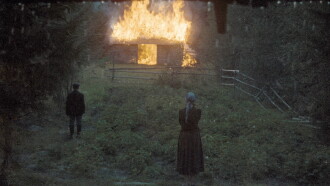
A dying man in his forties recalls his childhood, his mother, the war and personal moments that tell of and juxtapose pivotal moments in Soviet history with daily life.
A successful mod photographer in London whose world is bounded by fashion, pop music, marijuana, and easy sex, feels his life is boring and despairing.
In the 1970s, a young transgender woman called “Kitten” leaves her small Irish town for London in search of love, acceptance, and her long-lost mother.
Three lonely young denizens of Taipei unknowingly share an apartment: May, a real estate agent who uses it for her sexual affairs; Ah-jung, her current lover; and Hsiao-kang, who's stolen the key and uses the apartment as a retreat.
Adi, a gay teenager, is spending the summer in his home village in the Danube Delta. One night he is brutally attacked on the street, the next day his world is turned upside-down.
A jewel thief crosses paths with a woman carrying a briefcase that the Americans, the Russians and the Chinese all want desperately, so he goes on the run with her figuring that what's inside the case has to be way more valuable than anything he could steal on his own.
"Desire Caught by the Tail" - Described as surrealistic, absurd, and weird. The narrative is nonlinear and the meaning nearly impossible to decipher, the work has been praised despite, and sometimes for, its lack of message.
The Fiend with the Electronic Brain was a re-release of Al Adamson's Psycho A Go-Go featuring new footage starring John Carradine that re-imagined the original film's story with a sci-fi plot.
When petty criminal Luke Jackson is sentenced to two years in a Florida prison farm, he doesn't play by the rules of either the sadistic warden or the yard's resident heavy, Dragline, who ends up admiring the new guy's unbreakable will.