Gregory J. Markopoulos Trailers
Due film-maker in giardino - Robert Beavers & Gregory J. Markopoulos TrailerMy Hand Outstretched to the Winged Distance and Sightless Measure TrailerEarly Monthly Segments Trailer
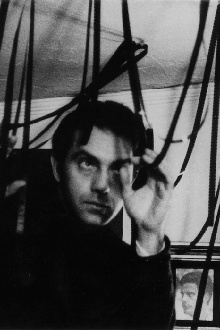
Gregory J. Markopoulos (March 12, 1928 - November 12, 1992) was an American experimental filmmaker. Born in Toledo, Ohio to Greek immigrant parents, Markopoulos began making 8 mm films at an early age. He attended USC Film School in the late 1940s, and went on to become a co-founder — with Jonas Mekas, Shirley Clarke, Stan Brakhage and others — of the New American Cinema movement. He was as well a contributor to Film Culture magazine, and an instructor at the Art Institute of Chicago.
In 1967, he and his partner Robert Beavers left the United States for permanent residence in Europe. Once ensconced in self-imposed exile, Markopoulos withdrew his films from circulation, refused any interviews, and insisted that a chapter about him be removed from the second edition of Visionary Film, P. Adams Sitney's seminal study of American avant-garde cinema. While he continued to make films, his work went largely unseen for almost 30 years.

Most Popular Gregory J. Markopoulos Trailers
Total trailers found: 61
01 January 1968
"In my film I suggest that there is no greater mystery than that of the protagonists. War and Love are simply equated for what they are; the aftermath is inevitable, and a normal human condition, for which like the ancients one can only have pity and understanding.
01 January 1964
Preserved by the Museum of Modern Art, New York.
29 December 1967
Portrait studies of Mrs. Hodges, Gail Beavers (the filmmaker’s sister) and Gregory J. Markopoulos.
01 January 1973
Edited but unprinted. Filmed in the apartment of Alban Berg, Vienna
01 January 1970
Filmed in London. Preserved in Oesterreichishces Filmmuseum, Vienna.
11 October 1997
An 80-hour film being printed and shown in cycles every four years at a remote location in Greece.
07 May 1966
Temenos Archive, Zurich
01 January 1970
Filmed in Mistra, Greece. Preserved in Anthology Film Archives, New York.
19 December 1969
Includes 'portraits' of Marianne Faithfull, Thelonious Monk and 28 others, some known, some less so.
25 June 1949
Based on Plato's dialogue Charmides.
01 January 1968
Die Schachtel (The Box), 1968. 35mm film transfer to videotape, black-and-white, sound; 29 minutes.
01 January 1971
Edited but not printed. Filmed in Zurich. Original reversal film deposted in Temenos Archive, Zurich.
01 January 1971
Filmed in the gardens of the villa La Pietra, Fiesole, Italy.
Preserved in Oesterreichisches Filmmuseum, Vienna.
14 November 1973
Dedicated to Nigel Gosling. Voice-over with Hans Richter reading a Dada text. Filmed in Locarno.
Oea
04 September 1965
Shot in thirty-two hours at the abandoned Baybridge Theater in Brooklyn, in cinemascope and Eastman color.
01 January 1972
The Damnation of Damien, edited in 1968, printed in 1972.
Preserved by Anthology Film Archives, New York.
29 May 1948
Psyche 1947, made while a student at USC, shows Markopoulos’ developing style and his sensuous use of colour and composition.
01 January 1969
Portrait of novelist Alberto Moravia filmed in Rome.
31 December 1950
Jackdaw does not exist in this form; footage may have been incorporated into Flowers of Asphalt.
01 January 1976
Prosopographia, 1976. 16mm film, color, sound; 5 minutes (unfinished).
11 February 1972
Shot in Florence, the film draws on Leonardo da Vinci’s notebooks and Paul Valéry’s essay on da Vinci’s creative process to explore parallels between Renaissance space and the moving image.
06 August 1997
Jonas Mekas assembles 160 portraits, appearances, and fleeting sketches of underground and independent filmmakers captured between 1955 and 1996.
25 June 1961
Originally edited in two versions. Version I, 70 minutes; version II, 90 minutes. (The only known existing version is not Markopoulos’s edit and contains additional titles, music and voice-over added later than 1961.
09 September 2003
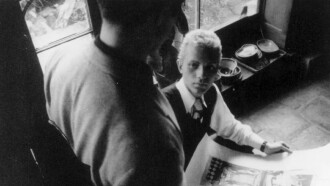
Filmed when Beavers was 18–19, this self-portrait depicts him and Gregory J. Markopoulos in their Swiss apartment.
01 March 1968
Also known as Walden, Jonas Mekas’s first diary film is a six-reel chronicle of his life in 1960s New York, interweaving moments with family, friends, lovers, and artistic idols.
01 January 1972
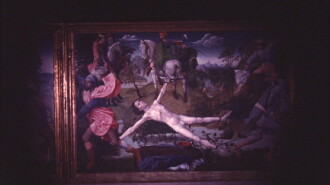
Beavers intercuts scenes of traffic in Bern with details from the 15th-century altarpiece The Martyrdom of St.
31 December 1969
Set to music by Beethoven, this lyrical portrait moves from a chilled and misty exterior to the crystalline interior of the Swiss chateau that King Ludwig II built for Wagner.
24 October 1947
A young man desperately seeks the fleeting image of a female companion, and though he never quite catches her, he discovers far more through surreal explorations of his own sexuality.
15 June 1963
A reworking of the myth of Hippolytus, in which a chaste youth rejects the incestuous advances of his mother and is saved from death by a caring physician.
30 December 1967
Prometheus, on an Odyssean journey, crosses the Brooklyn Bridge in search of the characters of his imagination.
03 September 1966
In March and April of 1966, Markopoulos created this filmic portrait of writers and artists from his New York circle, including Parker Tyler, W.
25 January 1967
The young hero seems the essence of maleness, yet he's troubled by vaguely feminine objects. Soon his masculine and feminine selves are intercut, as each of his identities appears to look and gesture at the other.
31 December 1950
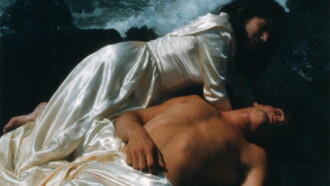
Swain is inspired by Nathaniel Hawthorne’s Fanshawe, features a dreamlike narrative of a young man’s ritualized rejection of heterosexuality, as a mysterious woman in white gossamer pursues him through a ruined landscape.
05 February 2000
Distilled in 1996 from an earlier 50-minute trilogy, this film was shot in Greece and Austria and structured around two recurring intertitles, “He said” and “he said.
01 January 1975
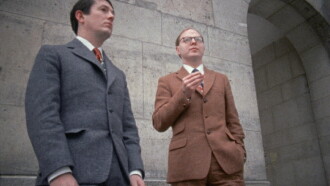
A portrait of the British artists, two living sculptures, filmed in Paris on the occasion of their exhibition at the Sonnabend Gallery.
23 November 1966
This portrait of the filmmaker's apartment, painted in the color of the title, was made a few months before his departure from New York.
01 January 1969
Woman sitting in a chair.
01 January 1970
Edited but unprinted. Filmed in Paris.
Original reversal film in Temenos Archive, Zurich.
21 December 1964
In 1963 Boultenhouse wrote, produced, and directed Dionysius,which he described as a “free treatment of Euripides' The Bacchae.
17 January 1967
Markopoulos’ first attempt at making a 35mm feature film, clearly inspired by the cinema of Jean Cocteau, was left unfinished and the materials were lost for many years.
01 January 1969
Dedicated to Dieter Meier. voice-over by Gregory Markopoulos, reading an excerpt in English translation of Paul Valéry’s L’Homme et la nuit (Man and the Night).
25 January 1967
The life of painter, dancer and poet Mark Turbyfill, seen in his 70th year, is evoked through Markopoulos’ unique form of cinematic portraiture.
01 January 1953
The dreamlike Eldora describes love’s fragmenting effects on the consciousness of an adolescent girl.
01 January 1940
Miser Ebenezer Scrooge is awakened on Christmas Eve by spirits who reveal to him his own miserable existence, what opportunities he wasted in his youth, his current cruelties, and the dire fate that awaits him if he does not change his ways.
07 October 2005
My Hand Outstretched to the Winged Distance and Sightless Measure is a film cycle by American avant-garde filmmaker Robert Beavers.
01 January 1971
Edited but unprinted. Filmed in Paris. Original reversal film in Temenos Archive, Zurich.
30 December 1967
An early exploration of intimacy and perception, the film portrays the body’s beauty and sexuality as animated by the soul.
01 December 2010
Short film shot in Rapallo, 1987.
02 June 1967
The first film made by Markopoulos after moving to Europe, Bliss was shot over the course of two days using only available light to create a lyrical study of the interior of the Church of St.
01 January 1971
An experimental short film by Greek-American filmmaker Gregory J. Markopoulos. The film was shot in Florence and is a silent 16 mm film that has not been publicly screened and is housed in the Temenos Archive in Zurich.
01 January 1970
Based upon the theme of Faust, with the characters portrayed serving as representatives of the crises of their time.
08 August 1968
Gammelion 1968, filmed at Il Castello Roccasinibalda in Rieti, Italy, is a major work in Markopoulos’s oeuvre, marking the transition into his late period and anticipating his epic final film, Eniaios 1947–91.
20 June 1949
Markopoulos called Lysis “a study in stream-of-consciousness poetry of a lost, wandering, homosexual soul” and felt that the film foreshadowed The Illiac Passion.
17 November 2002
Filmed in Rome in the 1980s, the work draws on Borromini’s Baroque architecture and Il Sassetta’s St.
01 January 1951
Suggested music to be played during film : “Concerto Grosso” by Ludwig van Beethoven. With John Markopoulos, Maria Markopoulos, Andrew Markopoulos, Elaine Markopoulos and others.
07 December 1964
In 1964 Film Culture magazine chose Andy Warhol for its annual Independent Film award. The plan was to show some of Andy's films and have Andy come on stage and hand him the award.
30 September 1968
(A)lter (A)ction, 1968. Videotape, black-and-white, sound; 65 minutes (director's edit: 57 minute television version).
31 December 1949
Things spin: amusement park rides, a phonograph record. A man wakes, shaves, and takes a phone call. Another man, in a kimono, walks in the woods, stops, and opens a small decorative box on the forest floor.
23 April 1967
Structured in nine tableaux each a study of a simple action or situation involving a lone, naked figure, the blind Eros, searching for fulfilment, for self.
10 May 1967
A performative variation on "Twice a Man” side by side, one running forward, the other backward. The sound is maintained only on the projector playing the film forward.