Tony Cokes Trailers
Tales from the Planet Kolkata Trailer
Tony Cokes works in video and multi-media installation. Juxtaposing re-edited broadcast and archival footage with quotations in the form of texts and voiceovers, Cokes’s experimental documentaries explore the ideological implications of media representation and rhetoric. His work foregrounds theoretical questions of racial and sexual difference, enunciation, and history.
Most Popular Tony Cokes Trailers
Total trailers found: 15
07 June 2012
Evil.35: Carlin/Owners (2012), uses text from comedian George Carlin set to music by the post-punk band Gang of Four.
26 February 1990
In this meditation on contemporary race relations, two black men discuss in voiceover certain “casual” events in life and cinema that are unnoticed or discounted by whites—gestures, hesitations, stares, off-the-cuff remarks, jokes—details of an ideology of repressed racism.
01 January 2001
Taking its name from The Notwist’s 1998 album (and no doubt also riffing on the informal term for a psychoanalyst), the ‘Shrink’ videos depict text overlaid on found footage of a pre-9/11, Rudolph Giuliani-era New York skyline.
01 January 1995
No Sell Out employs desktop video to position images of Malcolm X in tension with commercial culture. It is a result of a series of loaded questions we ask ourselves, and now wish to impose on viewers. Mr. X is the serialized signifier that sparks problematic readings and profits in rap music, “political art,” and fashionable sportswear. Is X the sign of a meaningful difference, or just another hip style thang?
01 January 2010
"Evil.11 (The Katrina Debacle) is a text animated essay about the Bush Administration's response to the 2005 Hurricane Katrina disaster.
26 February 1999
"Ad Vice consists of a succession of colored projection surfaces with segments of text from the worlds of advertising, sport and popular culture.
01 January 2009
Writes Cokes, "Evil.12 is a 12-minute video animation with sound. The text is excerpted from Brian Massumi's essay 'Fear (The Spectrum Said),' which discusses the Bush Administration's terror alert color-coding system as a method to modulate public affect via media representation.
19 January 1992
Writes Cokes: "In 1984 I conceived of the idea of producing a documentary that framed its own devices.
01 January 2002
The third part of Cokes's Shrink! trilogy in which he "shrinks" criticism.
24 April 2021
A personal film about a city that may only exist in a film or on TV; a film about various dreams about Calcutta.
26 February 1988
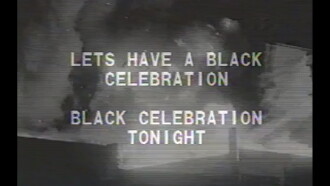
This engaged reading of the urban black riots of the 1960s references Guy Debord’s Situationist text, “The Decline and Fall of the Spectacle-Commodity Economy,” Internationale Situationniste #10 (March 1966).
01 January 2002
The second part in Cokes's Shrink! trilogy in which he "shrinks" criticism.
09 December 2006
Evil.5: Grin and Bear (No Responsibility Mix) continues Cokes’s investigation of the uses of appropriated text and pop music as a form of political critique.
01 January 2011
Video work on the Civil Rights Movement borrowing its core text from “Notes from Selma: On Non-Visibility” by the Alabama collective Our Literal Speed, mixing this text with lyrics and soundtracking by singer and songwriter Morrissey.
06 May 2004
Evil.9 combines an Internet-circulated hip-hop music video by the Canadian-German artist Mocky with an Associated Press text outlining the effect of the U.