Kathryn Osterman, the well-known vaudeville comedienne, in a complete exposition of the methods of "making-up" the face for the stage. She shows the penciling of the eye-brows, blackening the eye lashes, rouging the lips, applying the grease paint and so forth. The work is done in a very dainty and interesting way. Only the head and shoulders of the subject are shown; the figure thus being very large. (AMB Picture Catalogue, 1902)
Watch the official The Art of 'Making Up' 1900 trailer in HD below.
Watch Full Movies Online
Sorry, we can't find the movie trailer you're looking for.
Either a trailer for this movie has not been released yet, or it
was removed following a request from the copyright holder.
On the left of the screen, a small group of men lift the top off of what appears to be a turbine with a crane and continue to check the machine, tightening various parts with wrenches.
On 4 September Frederick Albert Cook (1865-1940) arrived in Copenhagen on the ship 'Hans Egede'. He received a hero's welcome as the first man to set foot on the North Pole.
This scene is a part of the very first film shot produced by the Manaki Brothers. Despina, the Janaki and Milton Manaki's grandmother, was recorded weaving in one high-angle shot.
In the background is a row of three-masted sailing ships, at anchor, their sales furled. In the foreground, a simple pier that's more like a yardarm juts out above the water; about 15 boys of six or seven years of age are on the jutting wood, and they jump off into the water below.
The film shows a parade down Fifth Avenue, New York. In the foreground many children, both black and white, can be seen following alongside the parade.
In this meditation on contemporary race relations, two black men discuss in voiceover certain “casual” events in life and cinema that are unnoticed or discounted by whites—gestures, hesitations, stares, off-the-cuff remarks, jokes—details of an ideology of repressed racism.
Popular movie trailers from 1900
These some of the most viewed trailers for movies released in 1900:
This shows the heart of one of the tremendous drifts in the east end of Galveston. Hundreds of dead bodies are concealed in these immense masses, and at the time the picture was taken the odor given out could be detected for miles.
The film is a panorama shot-scene lasting just under a minute. The panorama film, as coined by Lumière, is a moving-camera shot--usually accomplished by placing the camera on a moving transport, such as a boat or train.
During the terrific storm all of the light craft along the dock front was lifted out of the water and washed up into the streets, many of them being carried for miles inland.
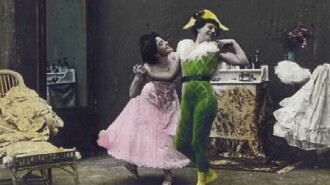
"Les Fredaines de Pierrette" is the collective name of four short films of 20 meters each ("Arrivée de Pierrette et de Pierrot", "Arrivée d'Arlequin", "Suite de la danse", and "Départ d'Arlequin et de Pierrette"), attributed to Alice Guy (although not confirmed in any primary source), in which Columbine resists Pierrette's courting in favor of Harlequin.
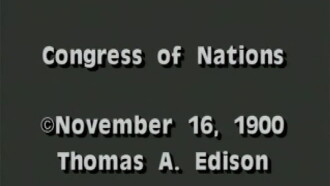
A magician steps upon the stage carrying a hoop covered with white paper. Then in quick succession the flags of Germany, Russia, Ireland, England and China are brought forth, and from each a soldier is produced corresponding with the flag of each nation.
"Nothing new, but an old thing done over again and done well. Some one has attempted to describe a kiss as "something made of nothing," but this is not one of that kind, but one of those old fashioned "home made" kind that sets the whole audience into merriment and motion, and has always proven a popular subject.
Four men each hold a large slice of watermelon, and have a race to see who can finish eating first. All four move quickly, but one man seems to be pulling ahead of the others.