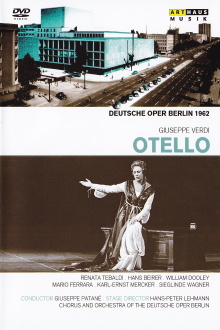
"Glorious portrait of Renata Tebaldi"01 February 1962Music150 mins
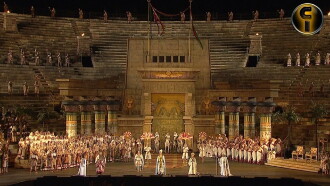
Desdemona in Verdi's Otello was a career role for soprano Renata Tebaldi, from her first operatic performance outside of Italy to her final appearance on the opera stage. Between those landmarks she performed the role nearly 100 times all over the world and made studio audio recordings that became reference recordings for the role. This 1962 production with the Deutsche Oper Berlin and Giuseppe Patane was planned as a media event from the outset and blessedly captures a consummate artist in a signature role at the peak of her gifts.
Who loves whom in Così fan tutte, Mozart’s and Da Ponte’s cruelly comic reflection on desire, fidelity and betrayal? Or have the confusions to which the main characters subject one another ensured that in spite of the heartfelt love duets and superficially fleetfooted comedy nothing will work any longer and that a sense of emotional erosion has replaced true feelings? Così fan tutte is a timeless work full of questions that affect us all.
Disciplined Italian composer Antonio Salieri becomes consumed by jealousy and resentment towards the hedonistic and remarkably talented young Salzburger composer Wolfgang Amadeus Mozart.
The director, Roland Schwab, has created his version of Hell. The set is like a high iron walled hanger and the stage is continually occupied with people who look like fugitives from Mad Max and who interact with Mefistofele.
Officers Ferrando and Guglielmo are certain that their lovers Dorabella and Fiordiligi are faithful to them, but the cynical Don Alfonso challenges them to a bet that the women will be unfaithful given the chance.
The grand scale and magnificent acoustics of the Roman arena in Verona are ideally suited to the pageantry of Verdi's Egyptian opera, presented here in a staging that is true to the original 1913 production, framed by obelisks and sphinxes and filled with chorus and dancers.
This live version of Puccini s superbly dramatic opera was recorded in Rome in the exact locations and at the precise times of day as Puccini had written into his score.
An anthology of four abbreviated operas: "William Tell" by Rossini, "The Marriage of Figaro" by Mozart, "Don Pasquale" by Donizetti, and "Carmen" by Bizet.
All the throbbing eroticism—and ultimate heartbreak—of Puccini’s youthful score is unleashed by James Levine and his top-flight cast.
Alternative movies trailers for Verdi Otello
More movie trailers, teasers, and clips from Verdi Otello:
Verdi. OTELLO. Miranda Ferraro Chiara Taddei Fitch. Caracas. Junio 6 1973
Verdi. OTELLO Teatro Municipal de Caracas Junio 06 1973 Director - Michelangelo Veltri -ELENCO- Otello - Pier Miranda Ferraro Desdémona - Maria Chiara ...
Verdi: Otello: Esultate! (Act One)
Provided to YouTube by The Orchard Enterprises Verdi: Otello: Esultate! · Herbert von Karajan · Jon Vickers · Mirella Freni · Peter Glossop · Ryland Davies ...
Verdi: Otello / Act 2 - "Era la notte... Sì pel ciel marmoreo giuro"
Provided to YouTube by Universal Music Group Verdi: Otello / Act 2 - "Era la Sì pel ciel marmoreo giuro" · Leo Nucci · Luciano Pavarotti · Chicago ...
Verdi: Otello. Trapani 2019 (estratti)
Ecco la nostra recensione con tutti i dettagli sullo spettacolo:
Popular movie trailers from 1962
These some of the most viewed trailers for movies released in 1962:
Agent 007 battles mysterious Dr. No, a scientific genius bent on destroying the U.S. space program. As the countdown to disaster begins, Bond must go to Jamaica, where he encounters beautiful Honey Ryder, to confront a megalomaniacal villain in his massive island headquarters.
The evil scientist Dr. Caronte plots to revive the brains of three dead scientists and use them to obtain the formula for the super-powerful neutron bomb.
When a worker digging up a rose bed in the garden of a rich, influential factory owner uncovers a skeleton, suspicion spreads: Is the man who is so respected in the town possibly a murderer?
Comments
Have you watched Verdi Otello yet? What did you think about it?