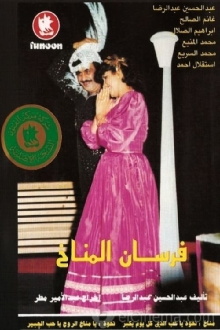
The first Gulf economic play centered on an issue that affected members of Kuwaiti society, which sparked widespread controversy between Kuwaiti society and the Gulf community in general, and the issue was the "Al Manakh Market" crisis in 1982, which ended in losses exceeding $ 22 billion. Where the story tells about the second oil boom of the Gulf states at the end of the seventies and the beginning of the eighties of the twentieth century AD where the price of oil increased continuously until the Gulf countries recorded large financial surpluses, so the money poured into the stock market significantly until it opened a stock trading office in a semi-parallel office and was named a market "Al Manakh" in which money flowed greatly from almost all segments of Kuwaiti society and even foreign residents and some individuals from the Gulf states and increased frantic speculation and increased buying and selling for the future until it reached astronomical numbers.
A group of American soldiers stationed in Iraq at the end of the Gulf War find a map they believe will take them to a huge cache of stolen Kuwaiti gold hidden near their base, and they embark on a secret mission that's destined to change everything.
An adaptation directed by Claude Whatham for the BBC's Theatre 625 slot. Essentially a recording of John Barton's acclaimed Royal Shakespeare Company production starring Catherine Lacey (the Countess), Ian Richardson (Bertram), Lynn Farleigh (Helen), Clive Swift (Parolles) and Sebastian Shaw (the King), it was broadcast on 3 June 1968.
The theatrical events revolve around a comic frame about Adel (Youssef Shaaban), the handsome young man who works at the airport as an air monitor, who is linked to the engagement of Mona (Mervat Amin), the beautiful air hostess, but he loves the air hostesses ’rhythm in his love.
Abd al-Tajtali Sulayt, a compulsory teacher from the village, goes to Locanda al-Firdaws after he was greeted by Atiyah al-Shalashlamouni and his wife Shafiqa, along with his four daughters, who treat them firmly and strongly, while Samiha was a neighbor of Atiyah who was constantly fighting with her husband Masoud because of her jealousy over him, and she thinks that he is in a relationship with another.
The novelist Sami Al-Bagouri finds himself in trouble when he is caught between his jealous wife Zahra and the ghost of his late wife Fekria who discovers that he took another wife.
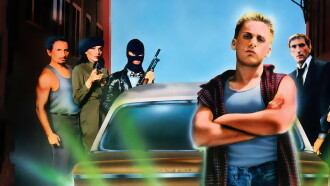
A down and out young punk gets a job working with a seasoned repo man, but what awaits him in his new career is a series of outlandish adventures revolving around aliens, the CIA, and a most wanted '64 Chevy.
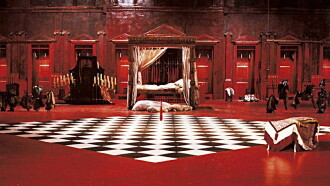
In 17th-century Tuscany, a church play is performed for the benefit of young aristocrat Cosimo. In the play, a grotesque old woman gives birth to a beautiful baby boy.
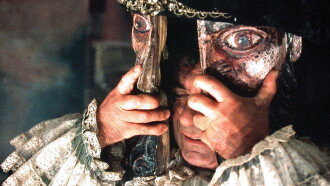
A very free adaptation of Marlowe's "Doctor Faustus", Goethe's "Faust" and various other treatments of the old legend of the man who sold his soul to the devil.
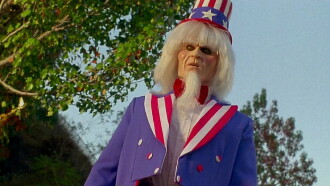
The film is inspired by the Mário de Sá-Carneiro short story, where the narration is made by Professor Antena's assistant who walks by his side when he is run over in a perhaps enigmatic way.
In 1921 the Kwakiut'l people of Alert Bay, British Columbia, held their last secret potlatch. In 1980 at Alert Bay, the U'mista Cultural Centre (U'mista means "something of great value that has come back") opened its doors to receive and house the cultural treasures which were seized decades earlier and only then returned to the people.
This official entry to the first Metro Manila Film Festival in 1983 directed by Lino Brocka and starred Carmi Martin, Phillip Salvador, Dennis Roldan, Vic Diaz, and Tony Santos, Sr centers on the story of Gigi, a burlesque dancer who is the main attraction of show.
A woman was raped in her school years and broke up with her lover because of it. Later, when she became a high school music teacher, she had forbidden liaisons with her colleagues and students at her apartment.
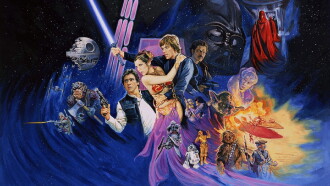
Luke Skywalker leads a mission to rescue his friend Han Solo from the clutches of Jabba the Hutt, the Emperor prepares to crush the Rebellion with a more powerful Death Star, and the Rebel fleet mounts a massive attack on the space station.
Comments
Have you watched Al-Manakh Knights yet? What did you think about it?