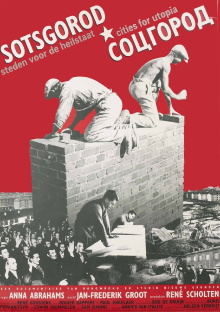
A 1996 Dutch documentary film about the Western European architects who were invited by the Soviet Union to construct “Socialist cities” in Siberia during the late 1920s and early 30s. The film draws on interviews of some of the last survivors of this time, including Jan Rutgers (of the Kuzbass Autonomous Industrial Colony), Margarete Schütte-Lihotzky (of the Ernst May group), and Philipp Tolziner (of the “Bauhaus Brigade”), and on letters, articles, and lectures written by those who have already died, including Hans Schmidt, Mart Stam, Johannes van Loghem, and Ernst May. It also follows the daily lives of contemporary residents of Magnitogorsk, Orsk, Novokuznetsk, and Kemerovo.
A look at contemporary Paris through the lens of theories and ideologies of the past two centuries, with a particular focus on the utopian socialist ideas of Charles Fourier.
The documentary tells the story of Sydney Opera House architect Jørn Utzon's unique gift, brought to the world with the unending support of Lis, the love of his life.
A man with a perspective like no other on the planet. The leading structural engineer of the World Trade Center oversees its construction, haunted by its fall ever since.
Big Time gets up close with Danish architectural prodigy Bjarke Ingels over a period of six years while he is struggling to complete his largest projects yet, the Manhattan skyscraper W57 and Two World Trade Center.
Art historian and filmmaker Sundaram Tagore travels in the footsteps of Louis Kahn to discover how the famed American architect built a daringly modern and monumental parliamentary complex in war-torn Bangladesh.
The Finnish architect Alvar Aalto (1898–1976) is one of the great figures of modern architecture, ranked alongside Gropius, Le Corbusier and Mies van der Rohe.
In 1959 Hiroshi Teshigahara shot the following 16 mm footage of he and his father’s first trip to Barcelona and the outlying Catalonian countryside, including a visit to the home of Salvador Dali in Port Lligat.
One billion people on our planet—one in six—live in shantytowns, slums or squats. Slums: Cities of Tomorrow challenges conventional thinking to propose that slums are in fact the solution, not the problem, to urban overcrowding caused by the massive migration of people to cities.
A jaded Lower East Side couple have become bored of straight sex, in a bid to spice things up, they decide to imitate some rough sex scenes as seen on TV.
A doctor and his wife move to a new city where they plan to start a new life. However, trouble strikes in the form of a police inspector who gets completely obsessed with the doctor's wife.
Director Mohsen Makhmalbaf claims to have never seen a movie before making his first film. Doubtful as it sounds, this boast matches perfectly with the controversial artist's personae.
When Ethan Hunt, the leader of a crack espionage team whose perilous operation has gone awry with no explanation, discovers that a mole has penetrated the CIA, he's surprised to learn that he's the prime suspect.
Filmmaker Ernesto Rimoch looks at the potent combination of love and ambition in this film about a couple who's so happy their daughter is marrying into a rich clan that they throw the best wedding ever, even if they can't afford it.
With their freedom on the line, the Looney Tunes seek the help of NBA superstar Michael Jordan to win a basketball game against a team of moronic aliens.
Jerry Maguire used to be a typical sports agent: willing to do just about anything he could to get the biggest possible contracts for his clients, plus a nice commission for himself.
Comments
Have you watched Sotsgorod: Cities for Utopia yet? What did you think about it?