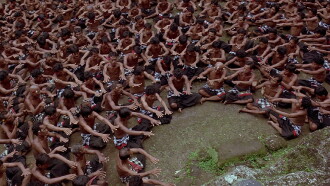
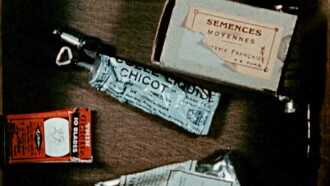
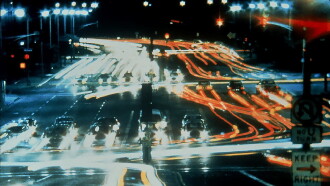
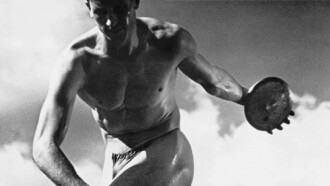
The pictures are burning. A house is in flames for exactly one minute. Cinema under attack: An anonymous fragment from the early days of film is turned into a reflection on reproduction and reality as well as on destruction which takes place on two levels through Gustav Deutsch’s reworking of the material.
Featuring a commentary by Noël Burch (in nonsense French), Recreation's rapid-fire montage of single-frame images of incredible density and intensity has been compared to contemporary Beat poetry.
Filmed over nearly five years in twenty-five countries on five continents, and shot on seventy-millimetre film, Samsara transports us to the varied worlds of sacred grounds, disaster zones, industrial complexes, and natural wonders.
Shot under extreme conditions and inspired by Mayan creation theory, the film contemplates the illusion of reality and the possibility of capturing for the camera something which is not there.
Starting with a long and lyrical overture, evoking the origins of the Olympic Games in ancient Greece, Riefenstahl covers twenty-one athletic events in the first half of this two-part love letter to the human body and spirit, culminating with the marathon, where Jesse Owens became the first track and field athlete to win four gold medals in a single Olympics.
A documentary shot by filmmakers all over the world that serves as a time capsule to show future generations what it was like to be alive on the 24th of July, 2010.
A woman narrates the thoughts of a world traveler, meditations on time and memory expressed in words and images from places as far-flung as Japan, Guinea-Bissau, Iceland, and San Francisco.
Part two of Leni Riefenstahl's monumental examination of the 1938 Olympic Games, the cameras leave the main stadium and venture into the many halls and fields deployed for such sports as fencing, polo, cycling, and the modern pentathlon, which was won by American Glenn Morris.
Carefully picked scenes of nature and civilization are viewed at high speed using time-lapse cinematography in an effort to demonstrate the history of various regions.
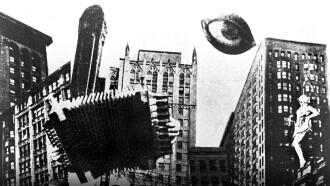
A day in the city of Berlin, which experienced an industrial boom in the 1920s, and still provides an insight into the living and working conditions at that time.
Popular movie trailers from 1999
These some of the most viewed trailers for movies released in 1999:
A rare book dealer finds himself at the heart of a string of paranormal events when he is hired to find the last two copies of a text, The Nine Gates of the Kingdom of Shadows, capable of summoning the Devil.
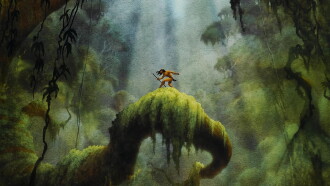
Tarzan was a small orphan who was raised by an ape named Kala since he was a child. He believed that this was his family, but on an expedition Jane Porter is rescued by Tarzan.
To promote the release of his album Garth Brooks in... The Life of Chris Gaines, Garth Brooks appeared as Chris Gaines in a television "mockumentary," a version of VH1's seminal cable classic Behind the Music, featuring a totally made-up tale that just may be the greatest rock n' roll documentary ever made.
In Mystery, Alaska, life revolves around the legendary Saturday hockey game at the local pond. But everything changes when the hometown team unexpectedly gets booked in an exhibition match against the New York Rangers.
In the small town of Rockwell, Maine in October 1957, a giant metal machine befriends a nine-year-old boy and ultimately finds its humanity by unselfishly saving people from their own fears and prejudices.
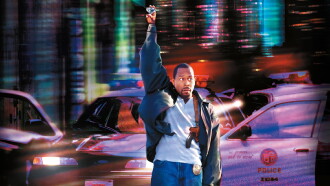
Miles Logan is a jewel thief who just hit the big time by stealing a huge diamond. However, after two years in jail, he comes to find out that he hid the diamond in a police building that was being built at the time of the robbery.
Comments
Have you watched Tradition Is the Handing on of Fire and Not the Worship of Ashes yet? What did you think about it?