Jean Rouch Trailers
Outlaw TrailerL’Enigma di Jean Rouch a Torino - Cronaca di un film raté TrailerMy Conversations on Film Trailer
Jean Rouch (French: [ʁuʃ]; 31 May 1917, Paris – 18 February 2004, Niger) was a French filmmaker and anthropologist.
He is considered to be one of the founders of cinéma-vérité in France, which shared the aesthetics of the direct cinema. Rouch's practice as a filmmaker for over sixty years in Africa, was characterized by the idea of shared anthropology. Influenced by his discovery of surrealism in his early twenties, many of his films blur the line between fiction and documentary, creating a new style of ethnofiction. He was also hailed by the French New Wave as one of theirs. His seminal film Me a Black (Moi, un noir) pioneered the technique of jump cut popularized by Jean-Luc Godard. Godard said of Rouch in the Cahiers du Cinéma (Notebooks on Cinema) n°94 April 1959, "In charge of research for the Musée de l'Homme (French, "Museum of Man") Is there a better definition for a filmmaker?" Along his career, Rouch was no stranger to controversy.

Most Popular Jean Rouch Trailers
Total trailers found: 127
10 October 1986
An artist is invited to Turin and is asked to do a painting inspired by the city and the work of Giorgio De Chirico.
01 January 1972
A seven-day initiation ceremony is documented in which two women undergo ritual healing following a diagnosis of spirit possession, presented without narration, intertitles, or explanatory commentary.
01 January 2011
This portrait of the French film theorist and avant-garde director Jean Epstein (1897-1953) concentrates on the period when he filmed in Brittany, the spot where he became inspired by the sea.
13 October 2013
This distinctly personal journey into the artistic possibilities of independent film is not to be missed.
18 June 1992
An intimate window into one of the great movements in film history that brought about an evolution in the art of cinema.
05 September 1990
Collaborative experimental project on which three director made different films about the Swedish icebreaker "Frej".
22 February 1973
The film narrates a utopian abandonment, consensual and festive of the market economy and high productivity.
24 August 1955
The subject of the film was the Hauka movement. The Hauka movement consisted of mimicry and dancing to become possessed by French Colonial administrators.
22 February 1997
Two parts magical drama and one part straight documentary, this outing from famed ethnographic filmmaker Jean Rouch is set somewhere in Nigeria near a small village.
19 May 1965
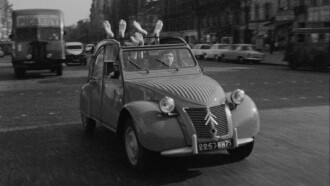
Six vignettes set in different sections of Paris, by six directors. St. Germain des Pres (Douchet), Gare du Nord (Rouch), Rue St.
20 October 1961
Paris, summer 1960. Anthropologist and filmmaker Jean Rouch and sociologist and film critic Edgar Morin wander through the crowded streets asking passersby how they cope with life's misfortunes.
25 June 1979
In 1972, the Dogon of the Bandiagara cliff in Mali celebrated the funeral of Anaï Dolo, head of the Bongo Masks Society, who died at the age of 122.
22 August 1970
An African travels to Paris to learn about the construction of tall buildings, but is soon taken up with the oddities of French life.
01 January 1947
Rouch’s earliest surviving film, which depicts the Sorko of Niger on a hippopotamus hunt. - MoMA
01 January 1974
Every five years, the mask society of the Dogons of Sanga, Mali, organizes a great Dama, a ceremony to end the period of mourning and drive away "the dangerous thing".
20 December 1978
Cinématon is a 156-hour long experimental film by French director Gérard Courant. It was the longest film ever released until 2011.
01 January 1996
In Sangha, through the window of her house, Germaine greets Djamgouno, her main informant. He then translates for her a conversation she has with a half-blind old man.
18 April 1961
Jean Rouch gives a group of black and white teenagers a "what if" question: what if they socialised with each other? The teenagers then improvise their own characters and situations.
03 May 1963
Candid interviews of ordinary people on the meaning of happiness, an often amorphous and inarticulable notion that evokes more basic and fundamentally egalitarian ideals of self-betterment, prosperity, tolerance, economic opportunity, and freedom.
01 January 1995
Malian filmmaker and New York University professor, Manthia Diawara critiques visual anthropology through the work of Jean Rouch.
07 November 1962
An avant-garde political satire that takes place in a mythical country in South America. The dictator has been replaced by a look-alike revolutionary, and the dictator's wife has been replaced by a robot.
18 March 2010
Belgian filmmaker Eric Pauwels' meditation on dream, travel and film.
31 December 1998
Inspired by the life of the french-born photographer and ethnographer, Pierre Verger, the movie follows his journey between Bahia, Brazil and Benin, Oriental Africa, showing places and people he met and his life study project: the Candomblé culture.
27 August 1964
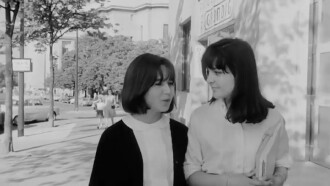
Filmed in Paris in 1964, this documentary short follows two fifteen-year-old girls from the city’s 16th arrondissement as they move through leisure, conversation, and social encounters.
01 January 1974
In February 1974, Pam Sambo Zima, the oldest of the priests of possession in Niamey, Niger, died at the age of seventy-plus years.
01 January 1966
The young goat herders from the cliff of Bandiagara practice on the stone drums of their ancestors. An ethnomusicological film experiment describing the subtle plays of the right and left hand of Dogon drummers.
01 January 1989
A Film by Jean Rouch and Tam-Sir Doueb.
01 January 1994
In front of Jean Rouch's camera, Germaine Dieterlen recalls her ethnographic itinerary, at the Musée de l'Homme, in Mali and in the Paris of the 1930s.
01 January 1977
Germaine Dierterlen talks about Dogon mythology at a conference on the Bandiagara cliffs. The Songo canopy is a sacred site in Bandiagara.
15 December 1987
First part of the collaborative project "Brise-Glace" showing the diverse travels on the icebreaker "Frej".
09 July 1980
Three pioneers of documentary filmmaking – Joris Ivens, Henri Storck, and the man behind the camera, Jean Rouch – recall the early days of the documentary genre and speak about their creative methods and sources of inspiration.
01 December 1967
Beginning of the sextenary festival of the Sigui among the Dogon of the Bandiagara cliff in Mali. This first ceremony takes place at the village of Yougo Dogorou.
10 March 1962
An aimless young woman is sent home from school with nothing to do. Drifting through the streets of Paris, she comes across a variety of people.
01 January 1951
Dogon funerary rites in the village of Ireli at the foot of the Bandiagara cliffs, Mali.
22 February 1958
Funeral rituals for the traditional leader Moro Naba of the Mossi at Ougadougou, Upper Volta (now Burkina Faso).
01 January 1992
When the male nurse Damouré Zika talks about AIDS with his two friends Lam and Tallou, under the admiring eye of his own wife Lobo, who is a nurse's aide, it is because he believes that AIDS is a "disease of love that can only be conquered by love.
25 February 1993
"Their land drought-stricken, three Nigerien farmers (and their donkey) travel to Holland to investigate the possibility of importing windmill technology for use on the plains of Niger.
01 January 1975
A portrait of Zomo, the second of Damouré Zika’s many children. Employed at the zoo of the National Museum of Niger in Niamey, he offers us a tour, showing us the animals he takes care of.
01 December 1970
The fourth year of the Sigui ceremonies, celebrated every sixty years by the Dogons of the Bandiagara cliffs, Mali, takes place in the village of Amani.
01 January 1968
On the Niger River, the island of Ayorou is home to a “singing stone,” an imposing boulder rock covered with cupules.
01 January 1973
In Mali, women's funeral rite takes place in the village of Bongo, in Dogon country.
01 January 1987
Not much film stock, an inspired camera, a meditation on time, period songs: using contemporary images, shot at a time when the broken city was starting to heal its wounds, Jean Rouch recalls his impressions in Berlin immediately after the war.
01 January 1983
A fortuitous meeting, late one afternoon, in the garden of the Tuileries, of one or two cameras, a tape recorder, and three cameramen/directors, Raymond Depardon, Jean Rouch, and Philippe Costantini.
01 January 1977
A Nigerian traditionalist who draws his inspiration from bird warbling to compose music to accompany his verse chronicles.
01 December 1973
The seventh year of the Sigui ceremonies, celebrated every sixty years by the Dogons of the Bandiagara cliffs, Mali.
01 January 1970
A short film about two mothers from Niger and how they care for their children.
01 December 1968
The second year of the Sigui ceremonies, celebrated every sixty years by the Dogons of the Bandiagara cliffs, Mali, takes place in the village of Tyogou.
01 January 2003
This short film was shot in 2002 during Bilan du Film Ethnographic for the purpose of introducing Jean Rouch to the audience at 2003 Taiwan International Ethnographic film festival.
01 January 1990
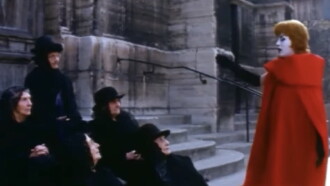
On the occasion of the bicentenary of the French Revolution, a group of Haitians in Paris undertake a voodoo ritual in front of Les Invalides, to reconcile the spirits of Napoleon Bonaparte and Toussaint L’Overture, the Haitian revolutionary who died as a prisoner of the French Emperor.
01 January 1992
A male diva sings in a countertenor voice while massacring chickens brought to him by his butler, Jean Rouch, until a slave provides proof of his love for the chicken, which he has tucked under his arm.
01 January 1967
In the village of Simiri, Niger, fisherman Daouda is also a priest of the cult of Dongo, the god of Thunder for the Songhay people.
01 December 1972
The sixth year of the Sigui ceremonies, celebrated every sixty years by the Dogons of the Bandiagara cliffs, Mali.
01 January 1973
Scene of possession during a ceremony to appeal for rain in Niger.
01 January 1987
Mariama and Damouré, two cousins, are in Venice looking for a relic—or fetish—lost a long time ago, as in one of Gentile Bellini’s famous paintings.
01 January 1958
Sakpata is one of the main deities of the "Vodoun" pantheon in Benin (Dahomey at the time of filming, in 1958).
01 January 1972
A film about a lion.
04 October 1978
Jean Rouch filmed this loving and humorous portrait of anthropologist and filmmaker Margaret Mead in September 1977 while he was a guest of the first Margaret Mead Film Festival.