Katerina Thomadaki Trailers
XYXX Mosaic Identity TrailerQuasar TrailerHôtel Artemis Trailer
Katerina Thomadaki, born in Athens, Greece, has studied literature and philosophy at the University of Athens, theater theory at the University Paris III, Sorbonne, philosophy of art at the University Paris I, Sorbonne, computer graphics at the National School of Decorative Arts, Paris. She teaches media art at the University Paris I, Sorbonne.
Most Popular Katerina Thomadaki Trailers
Total trailers found: 41
06 June 2000
Portrait of Katerina in a hotel room by the sea. Her sunglasses reflect her body and Maria’ s camera in the mirror, thus revealing, albeit in a fragment, the relational principle of their cinema and of their double self-portraits.
19 November 2004
The macrocosm present in QUASAR is a non colonized outer space. A non science-fictionalized outer space.
19 May 1992
This filmic portrait is born of a double movement: the meeting of Lena Vandrey with our cinematographic universe, our meeting with her pictorial world, her space and her collection of processional figures and articulated dolls.
01 January 1985
In "Falling. Desert. Syn" there is the body of repetition—not of tautology but of smooth resurrection; a body dying and being resurrected in a dance without suffering.
20 December 1978
Cinématon is a 156-hour long experimental film by French director Gérard Courant. It was the longest film ever released until 2011.
30 August 1977
All of history, that of Christ or any other, permeates the world, leaves its mark, modifying and informing history, and all that the human reproduces and creates.
11 March 1981
Primarily a trilogy and a complementary work, or an experimental tetralogical cycle by Maria Klonaris and Katerina Thomadaki, consisting of 4 films: Unheimlich I: Secret Dialogue, Unheimlich II: Astarti, Kha Uebertragung - Les embaumées, and Unheimlich III: Les Mères.
11 May 1978
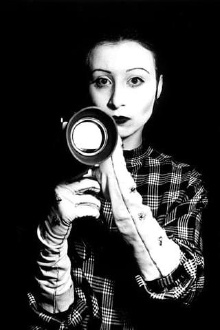
Portrait of Greek filmmaker Katerina Thomadaki, shot in Paris (France) on March 16, 1978 at 11:00 AM.
01 January 1979
After the semantic body (Double Labyrinth) and the libidinal body (L'enfant qui a pissé des paillettes, Soma) we are dealing here with another theme: that of the painful body or, more precisely, the memory of the body in relation to pain lived.
01 January 2001
"Pulsar" belongs to "The Angel Cycle" ("Le Cycle de l´Ange"). In this cycle of works we create bonds between the human body and astronomical bodies.
01 January 1994
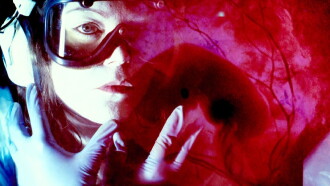
“Personal Statement” stages photographical treatments of the original medical document. The images unfold vertically while feminine hands (Katerina Thomadaki) try to stroke this mutant body.
01 January 2012
In 1976, Maria Klonaris and Katerina Thomadaki direct with the Collectif 010 in La Cartoucherie in Vincennes a 48-hour action, Torture, which is recorded on tape by Jean Roualdès.
20 July 1983
An echoing, nocturnal, elliptical text. Female voices speak it. Fragments of music punctuate and suspend the images.
01 January 1992
The child points to the Secret. For what do we see? A blindfolded Renaissance figure of the In Between (in between the sexes, in between the worlds).
01 January 2013
Video of the installation "XYXX Mosaic Identity" (Offenes Kulturhaus - Linz, 1994).
26 November 2016
SMOKING is a brief portrait of Maria Klonaris composed of seven shots. Katerina Thomadaki completed it in 2016, two years after Maria Klonaris' passing, from rushes shot in 1975 at the time of the filming of DOUBLE LABYRINTHE.
30 September 1980
Astarti, the Greek name for Ishtar, is an archetype of a deep, nocturnal feminine that emerges from subterranean darkness.
11 May 1978
Reel 1 of Gérard Courant's on-going Cinematon series.
30 August 1977
The female universe through four female characters: a child, a prostitute who never appears, me and the other, the other and me.
01 January 1984
A single-screen version of the Portraits / Mirrors multi-projection. Featuring portraits of: Aloual, Gaël Badaud, Raphaël Bassan, Yann Beauvais, Jean-Michel Bouhours, Gérard Courant, Berndt Deprez, Bertrand Gadenne, Mythia Kolésar, Christian Lebrat, Stéphane Marti, Pascal Martin, Michel Nedjar, Dominique Noguez, Vivian Ostrovsky, Bernard Roué, Martine Rousset, Alain Sayag, Unglee, and Catherine Zbinden.
01 January 1979
The film revolves around three notions: Kha = the etheric double according to ancient Egyptians. Perpetual specter in all respects resembling the physical body of a dead person.
04 July 1976
With this film-manifesto, the two artists invent what they called the Cinéma corporel (Cinema of the Body), they present themselves as a "double auteur femme" and they lay the foundations of the radical critical and esthetical positions of their work to come.
01 January 1970
Flash Passion is one of the very first films that the two artists made in Athens when they took up the super-8 camera and extended their theatre practice towards cinema.
01 January 1985
This film is made from the soundtrack of the multimedia installation/environment Mystère I: Sleeping Hermaphrodite that we created for the XII Biennale de Paris in 1982.
04 July 1976
Portrait of Katerina Logotheton, grandmother of the filmmaker, two years before her death on 3 July 1973.
01 January 2007
Angel Scan. "Trip" – but without substances – except the substances created by the brain when energy awakes as a creative conscience, accompanied by an intense experience of "light" and "darkness".
01 January 1994
“Requiem pour le XXè siècle” is a manifesto against war. It is an elegy. The photograph is connected with images that are part of our collective memory: extracts from newsreels of World War II that have been reworked and transformed through various optical and electronic processes.
21 January 1982
Trance dances and out of body projection. In front of the camera, Parvaneh Navaï becomes a mediator who enters in contact with and immerses into the energies of Nature, while her own energy radiates and echos in the forest ("selva").
11 March 1981
Portrait of the filmmaker’s mother in her garden. Part of the Portrait Series by Maria Klonaris & Katerina Thomadaki, the film was initially presented as an interlude during the multi-projection performance of Unheimlich III: Les Mères at Centre Pompidou in 1981.
11 March 1981
After five years of intense work on identity, an alchemical quest for the depths, after nine films and films / actions where the actresses' gestures resounded against a black background which eliminated the environment to reveal the inside, taken outside: encounter of the inside with the outside.
06 October 1982
Professor Anatole Lacoste is having a meeting with one of the agents of doctor Brain at a Jackson Pollock exhibition at Centre Pompidou.