Rogério Sganzerla Trailers
Identidade TrailerThe Long Voyage of the Yellow Bus TrailerThe Good Cinema Trailer
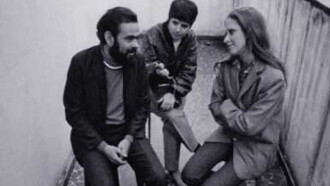
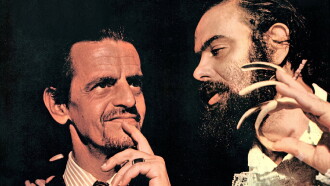
Rogério Sganzerla (1946 — 2004) was a Brazilian filmmaker and one of the main names of the Cinema de Invenção (or Cinema Marginal) underground movement.
Influenced by Orson Welles, Jean-Luc Godard, and José Mojica Marins, Sganzerla often used clichés from film noir and pornochanchadas. Irony, narrative subversion and collage were trademarks of his film aesthetics.
Sganzerla was born in Joaçaba, in the state of Santa Catarina, but moved with his family to São Paulo at a very young age, living there for most of his life. During the 1960s he wrote for the newspaper "O Estado de S. Paulo" ("The State of S. Paulo") as film critic, quickly being recognised as a young talent.
In 1967, Sganzerla directed his first short film, "Documentário" ("Documentary"), winning an award at the JB-Mesbla 16mm Festival. "Documentário" was quickly followed up by his first feature-length film in 1968, "O Bandido da Luz Vermelha" ("The Red Light Bandit"), which became a landmark for the movement known as Cinema de Invenção or Cinema Marginal and is still Sganzerla's most well-known film.
In 1970, he founded the "Bel-Air Filmes" production company along with fellow Cinema de Invenção filmmaker Júlio Bressane. Headed by Sganzerla, the company produced his films "Copacabana Mon Amour", "Carnaval na Lama" and "Sem Essa, Aranha" and Bressane's "A Família do Barulho", "Barão Olavo, o Horrível" and "Cuidado, Madame", all shot in Brazil during four months of 1970 and edited abroad, in England, when both Sganzerla and Bressane were banished from their home country by the then rulling military dictatorship. While in exile, both Sganzerla and Bressane continued to shoot new films.
Sganzerla's personal obsessions, such as director Orson Welles (and his infamous visit to Brazil) and musicians Noel Rosa and Jimi Hendrix, appear in many of his films, going as far as being the main subject in some of them. In 1985, Sganzerla directed the docufiction "Nem Tudo É Verdade" ("It's Not All True") about Orson Welles' arrival in Brazil to film his unfinished documentary "It's All True".
Sganzerla died in 2004, of a brain tumor, shortly after finishing his last film "O Signo do Caos" ("The Sign of Chaos").

Most Popular Rogério Sganzerla Trailers
Total trailers found: 62
01 January 2003
Helena Ignez's first film as a director is a homage to American architect and contemporary artist Vito Acconti, who made an urban intervention over a bridge in São Paulo, transforming that space for it to be used as shelter by nearby homeless people.
01 January 1981
Documentary about power and class relations in the sociocultural context of Bahia, considering the history of oil extraction in the state.
27 September 2018
A film in which dream and reality intertwine, A Moça do Calendário tells the story of inácio, 40, married, without a permanent job.
05 December 1981
João Gilberto receives Caetano Veloso, Gilberto Gil and Maria Bethânia during the recording of his album Brasil.
01 January 2003
Documentary about the trajectory of Antônio Polo Galante, known as "The King of Boca". The film maps work and forms of production in Boca do Lixo, popular area in Luz neighborhood located downtown São Paulo, where usually night clubs and sexual services establishments were located.
10 August 1970
Segment "Prólogo": interviews and scenes with some of the most important filmmakers of the "Boca do Lixo" of São Paulo.
22 September 1978
A film portrait of Jose Mojica Marins.
04 October 2009
Between February an May of 1970, Julio Bresane and Rogerio Sganzerla made 7 films for their company Belair that were forbidden by the Brazilian censorship that reveal today images of an unique freedom.
01 July 1978
An unusual look at 1978 Brasilia Film Festival and the politics that make certain films fashionable or not.
01 January 2001
A short film made with unused footage from The Red Light Bandit and Carnaval na Lama.
01 April 2026
During a screening of Oedipus Rex in a run-down movie theater in downtown Rio, three peculiar characters—a frustrated projectionist, his intern, and a wandering poet—decide to interrupt the film to discuss the death of cinema.
21 February 1992
Loosely based on an Oswald de Andrade screenplay, "Perigo Negro" is a segment of anthology film "Oswr
22 March 1970
Rogério Sganzerla’s lost film. The only existing copy was lost in 1992 and the negatives are lost.
21 February 1992
Collective film with five segments around the works and life of brazilian writer Oswald de Andrade.
02 December 1968
Born and raised in the misery of Brazilian slums, Jorge becomes a luxury house burglar in São Paulo and gets nicknamed "The Red Light Bandit" by the sensationalist press.
24 October 1969
Ângela Carne e Osso (Angela Meat and Bone), a young nymphomaniac, lives surrounded by delinquents, and exerts intense allure on them, dominating them all with her erotic power.
17 September 2003
Documentary about Brazilian filmmaker Glauber Rocha, one of the most important names in the Cinema Novo, with interviews with some of his friends and colleagues.
21 October 2005
Compilation of early Ivan Cardoso's films in Super 8, including "Nosferato no Brasil (Nosferato in B"
01 January 1981
Homage to the great Brazilian samba songwriter Noel Rosa (1910-1937).
01 January 1966
Two young men decide to go to the cinema. However, since their tastes are very strict, they end up in a quarrel.
01 January 1970
Two maids decide to rebel against the society that oppresses them and start murdering their own mistresses.
01 January 1992
A documentary chronicling the life and works of Brazilian poet, songwriter, journalist and avant-garde filmmaker Torquato Neto, from his beginnings to his suicide at the age of 28.
05 May 1970
A dysfunctional family, composed of a prostitute and two gay men, one strong and the other fragile and stupid, lives a routine life in Rio de Janeiro.
08 May 1970
Bressane’s first color film, shot in the home of the artist Elyseu Visconti. Part of it is missing sound and final editing because the director was forced to leave Brazil.
01 January 1970
Daily scenes of a grotesque family living in the metaphorical island of Babaloo.
18 March 2021
An authentically marginal cinema created in Catholic university in Brazil. One of the most intriguing and imaginative moments in modern cinema in the voice of some of its select conspirators—with Carlos Reichenbach at the lead—, and through the most razing flow of images that can possibly be conceived.
30 January 2023
For this behemoth, Bressane took his opera omnia and edited it in an order that first adheres to historical chronology but soon starts to move backwards and forward.
07 May 1969
The short film traces a historical overview of comic book production, focusing here on the Brazilian market.
09 April 1970
Spider, a banker, lives with three women. A tycoon that is a caricature of Brazil's bourgeoisie, his trajectory is the starting point for an essay on the mental underdevelopment of Brazilian elites, in which black humor sets the tone for sharp criticism.
24 May 2012
A documentary on prolific underground Brazilian filmmaker Rogério Sganzerla.
01 September 2020
Ivan Cardoso is the inventor of the terrir, a subgenre that mixes comedy, Brazilian chanchadas and classic American horror.
24 June 1977
Man tries to decipher a manuscript about an ancient civilization and gets involved in strange situations.
10 May 2005
A short documentary on Belair, an independent Brazilian film company that lasted for only five months in 1970.
01 January 1983
Register a popular celebration related to a battle fought in the city of Irani, starting point of Contestado War at Santa Catarina State, Brazil in 1912.
17 October 1993
A documentary about Orson Welles's unfinished three-part film about South America.
01 January 2014
A documentary on the restoration of Rogério Sganzerla's 1970 film "Copacabana, Mon Amour".
13 February 1970
Sônia and her homosexual brother are both believed by their mother to be possessed by the devil. She works as a prostitute in the streets of Copacabana and he’s a servant who falls madly in love with his employer.
13 January 1975
A millionaire lives in a sinister cottage where strange events unfold. A damned creature, he transforms himself in a werewolf and leads a following whose adepts spread horror and despair in the neighboring city, becoming themselves a clan of assassins.
25 October 2017
A rescue of the history of Ipanema beach in the 1970s, when the construction of a pier changed the landscape and created fertile soil for a generation of artists and sportsmen.
01 January 1990
Orson Welles acted in Brazilian culture and music by deeply researching Brazil's historical geology, consciously completing a legendary cultural mission.
13 May 2012
Jorge, bastard child of the infamous Red Light Bandit, decides himself to pursuit a life of crime after meeting with his father, who has been incarcerated for the last 30 years.
22 October 2020
In 1965, a year after the military coup in Brazil, an oasis of freedom opened in the country's capital.
02 January 1986
A documentary based on the book Umbanda no Brasil by the scholar Mata e Silva, who is interviewed by the director.
22 August 1986
Orson Welles goes to Brazil to shoot his documentary It's All True.
04 June 1991
In this short film, Ivan Cardoso records Brazilian film director Rogério Sganzerla sending a message to Brazil.
06 June 2019
Helena Ignez is one of the main female figures of Brazilian cinema. She developed a new style of acting.
13 May 1969
Edson is having an affair with actress Maria do Rosário, who dreams of being a movie director. So he tries to get some easy money for her film, but is arrested and meets a police torturer instead.
05 January 1990
The life of samba composer Noel Rosa.
18 March 1966
A group of middle-class friends driving around São Paulo choose one of the women as a bait to attract a victim, object of their alienation and moral aggressiveness.
28 June 1966
On screen, a bride gets ready for her wedding day. Off screen, middle-class young women from Rio de Janeiro share their experiences and impressions concerning virginity, marriage, sex and politics.
18 September 1997
A film essay about Brazil discovered through Orson Welles' eyes during the shooting of It's All True.
25 September 2003
A customs agent, Dr. Amnésio, examines some reels of film, a documentary Orson Welles made about Brazil, and tries to confiscate the material.
01 January 1969
Documentary short that synthesizes the evolution of comic books since Yellow Kid until Spirit.
08 October 2019
Extracts is a short film with images from 1970 to 1972 in the cities of Rio de Janeiro, Salvador, London, Marrakech, Rabat and the Sahara Desert region.
01 January 1977
Inspired by "Voyage to the land of Brazil" by Jean de Léry, this short follows the adventures of Nicolas Durand, from Villegagnon, and the estabilishment of a French colony in 16th-century Rio de Janeiro.