Stan VanDerBeek Trailers
Free Radicals: A History of Experimental Film TrailerVisual Velocity: The Work of Stan VanDerBeek TrailerBirth of a Nation Trailer
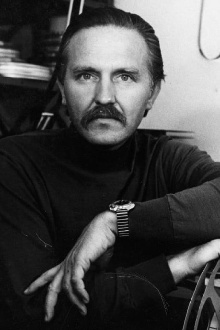
American experimental filmmaker Stan Vanderbeek began his career in the 1950’s after having studied art and architecture in New York and North Carolina.
His earliest period (1955-1965) is marked by his animated painting and collage films which the artist and critic Daryl Chin regarded as having an “enormous vitality, bounding inventiveness and incendiary wit which was shared by such other collagists as Robert Breer, Bruce Conner, Dick Preston.” Films such as Science Friction (1959, 10’), Breathdeath (1963, 15’), A la Mode (1959, 7’) and Achoo Mr. Kerrooschev (1960, 2’) are from this period.
In the 1960’s, in the context of his expanded cinema research, Vanderbeek started his audacious project of the “Movie Drome” theater, a space that allowed him to create an appropriate environment for his synesthetic works, which included film, performance and dance among other disciplines. The filmmaker spent about 10 years developing this project, which consisted of a huge dome that surrounded the audience and engulfed them in the images projected all around them.
From the mid-1960’s, Vanderbeek ‘s appetite for exploring new technologies increased and tools such as video played a major part in the filmmaker’s work. This can be seen in his computer-animated films from this period such as Symmetricks (1972, 6’) and the Poemfield series of 8 computer generated animations (1966-1971). His work with computers and experiments with holograms reflected his desire to use the most complex technology to get as close as possible to the functioning of the human nervous system.
In addition to his creative work in the fields of film and video art, Vanderbeek was a faculty member and artist-in-residence at a number of major universities. He died in 1984.

Most Popular Stan VanDerBeek Trailers
Total trailers found: 72
01 January 1959
A short surreal animation created with fashion magazine clippings and sound collages.
01 January 1985
Home movies shot on Super 8mm by W+B Hein over 10 years.
31 December 1959
This film uses stop motion animation of still photographs to convey images of politics and science in the nuclear era.
06 August 1997
Jonas Mekas assembles 160 portraits, appearances, and fleeting sketches of underground and independent filmmakers captured between 1955 and 1996.
18 September 1960
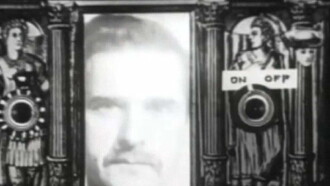
A cut-out of Soviet leader Nikita Khrushchev sails over newspaper articles as they take place. Combines live photography and collage animation in one film.
24 July 2011
Experimental filmmaker Pip Chodorov traces the course of experimental film in America, taking the very personal point of view of someone who grew up as part of the experimental film community.
28 December 1963
A surrealistic fantasy based on the 15th century woodcuts of the dance of the dead. A film experiment that deals with the photoreality and the surrealism of life.
14 April 1967
Optically-printed film and computer graphics synthesis. 16mm, color, silent, 4:40 min.
01 January 2000
Visual Velocity is a tribute to the pioneering work of Stan VanDerBeek. VanDerBeek was an experimental filmmaker, artist, animator, and media visionary.
01 January 1969
Iimura creates a short self-portrait as well as brief portraits of five of his peers: Brakhage, Vanderbeek, Smith, Mekas and Warhol.
06 August 1965
An artistic short film directed by Stan Vanderbeek.
31 December 1967
An experimental short in which a couple engaged in lovemaking is superimposed over ocean and beach scenes.
01 January 1958
"Dedicated to Detroit and subtitled 'America on wheels.' A fantasy-farce on the car of everyday life.
01 January 1961
"A Claes Oldenburg 'happening.' A black statement about the City in which two people represent the populace after a bomb raid.
01 January 1967
16mm film transferred to video, color, sound
10 June 1967
"Each film was constructed using Knowlton's BEFLIX computer language, which was based on FORTRAN. The films were programmed on a IBM 7094 computer.
31 December 1972
Against a black background and a pulsating beat matching white symmetrical geometric flashes around a central orb, white lines are drawn in mirror images vertical to each other.
01 January 1964
16mm color work by Stan Vanderbeek that takes his work away from the cutups and the commentary and lands him in the psychedelic and abstract.
06 August 1965
A Stan VanDerBeek short film from 1965.
01 January 1959
"An animated vision... a subliminal glance at man in light and space" S.V.
31 December 1967
To create his “Poemfields” (1965-71) series, VanDerBeek worked closely with computer scientist Ken Knowlton and the staff at Bell Labs.
01 January 1981
In After Laughter, VanDerBeek constructs a rapid-fire montage depicting the evolution of the human race and the haunting specter of its destruction.
19 September 1977
A study in analog imaging and the relation of sound to image, Color Fields Left merges moving bands of color with electronic sounds in an increasingly complex pattern.
01 January 1964
Dream matrix, history written in lightning image, memory and the TV syntax, images flowing and fused together to other images and electronic tapestry of images half seen, sought for, seeking man's dreams, movies as dreams, history as media.
19 March 1972
Stan VanDerBeek, experimental filmmaker at work with friend and computer expert Wade Shaw, at the sophisticated new (1972) computer at MIT Center for Advanced Visual Studies, and discussing the inevitable interaction of computers with artistic creativity.
01 January 1967
A dance filmed with Elaine Summers, in which the nude figure is placed against nature, in this case a particular and spherical sense of nature as produced by a special lens…(that takes in 195 degrees of sight on film).
01 January 1970
"A study in ocular illusions, pattern superimposition producing other patterns and illusions of three dimensionality.
14 June 1983
Self Poured Traits is a tongue-in-cheek self-examination set to the poetry of Kenneth Rexroth.
15 June 1968
”Assassination, falling down, animated drawings from the landscape of memory, mankind falling down, faces with faces, a haunting view of man drawn in brilliant animation graphics.
01 January 1966
16mm film transferred to video, black and white, silent
01 January 1980
A Kafka-inspired tale, Mirrored Reason tells the story of a woman who is haunted and eventually replaced by her double.
12 May 1977
In Vanishing Point Left, the "vanishing point" is an analogy for the metaphysics of watching the video screen, which assumes such forms as a mandala, flower or gyre.
31 March 1972
"The shapes of sound filmed from a computer system that reproduces analog patterns from sounds. This pioneer work in animated computer mandalas is a lyrical, abstract song with analog rhythms.
01 January 1960
Performance art collaboration between Jim Dine and Stan VanDerBeek.
01 January 1968
Similes of a slippery TV tube gesticulate break and supply – a long view of multiple images (Mr. Johnson's war, is it Howard Johnson's or President Johnson's war?) – a long curving view, breakfast with aspirin, good grief – or Goodbye.
07 July 1983
In Reeling in TV Time, VanDerBeek experiments with imaging capabilities and early computer graphics.
01 January 1964
Performance by Robert Morris and Carolee Schneemann.
01 January 1965
Experimental film that used handheld projectors to present film images and slide projections.
01 January 1980
A fantasy film of illusive geometry, changing and rebuilding itself by computer animation, unique visual magic done while artist-in-residence at NASA in Houston in conjunction with Richard Weinberg.
01 January 1977
Strobe Ode is an exercise in video feedback and analog imaging, in which a circular image-field is modified and abstracted by strobe flashes.
06 July 1983
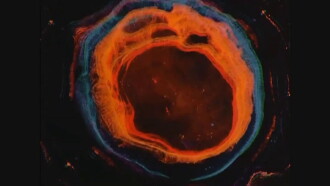
In Micro Cosmos, a series of four short computer-animated works, the image of an orb is transformed into a pulsating, energetic evocaton of life forces.
15 June 1957
An animated drawing done directly under the camera, combining painterly images and a drawn calligraphy, the works unfolds as you watch, permitting the viewer to see the process of the drawing.
01 January 1967
16mm film transferred to video, black and white, sound
01 January 1966
Influenced by Buckminster Fuller’s spheres, VanDerBeek had the idea for a spherical theater where people would lie down and experience movies all around them.
27 December 1963
World leaders at the crossroads.
02 June 1981
Face Concert is an ode to human expression in which VanDerBeek transforms the face into a visual canvas.
30 June 1967
"Words pulsate, then bleed into abstraction. Fields of color fragment into pixels or smear into mutating organisms.
07 July 1970
"A film of video light and color. Dancers move through computer-generated patterns and fields of soft color to the music of Ravel.
20 June 1983
In Sonia and Stan Paint a Portrait of Ronnie, VanDerBeek and artist Sonia Sheridan assemble a pastiche of images of Ronald Reagan, metamorphosed through digital computer graphics.
31 December 1957
An animated short film from Stan Vanderbeek.
01 January 1968
A hypnotic dance film of colours, dancers, forms, music, all sweeping through the TV tube eye, mixed together into a flow of female bodies and colours, a brilliant study of colour printing from black ad white.
06 August 1965
Camera animation over stills, “a portrait study of mankind, beginning with an infant and growing up to old age and death.
31 December 1962
A subversive experimental short against the ruling class.
06 June 1967
"Calligraphic computer animation of the enigmatic poem 'There is no way to peace- Peace is the way.' Black and white animation is colored by Brown/ Olvey.
01 January 1959
Vanderbeek photographs NYC, 1959. The 'meat' of the street: Doorways, debris, dilapidation. We meet a few youngsters and get a glimpse into a bygone era.
04 April 1959
Commissioned by the Pittsburgh Bicentennial Association to celebrate the city’s 200th anniversary, PITTSBURGH was created by a team of filmmakers that included Stan Brakhage (working under the pseudonym James Stanley), Weegee, Len Lye, and Stan Vanderbeek, and photographers W.
30 January 1967
First shown on January 30, 1967, FOR LIFE AGAINST THE WAR was an open-call, collective statement from American independent filmmakers disparate in style and sensibility but united by their opposition to the Vietnam War.