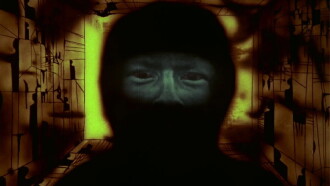
Iimura creates a short self-portrait as well as brief portraits of five of his peers: Brakhage, Vanderbeek, Smith, Mekas and Warhol. In each portrait, Iimura attempts to copy the styles and traits of each artist (Vanderbeek's constantly moving camera; Mekas' experiments with film speed; Warhol's use of flashes of white against a black background), while briefly commenting on the images being shown. The film serves effectively as an introduction to the film styles of these artists.
A farmer receives land from the king and discovers a buried golden mortar. He decides to give it to the king out of gratitude, but his clever daughter warns him that the king will surely want him to bring a corresponding pestle as well.
A student, tired of a too well-mannered fiancé, loses a virginity she considers very embarrassing in the arms of a forty-year-old man, before finding love with a repentant gigolo.
The landscape surveyed here might be the estranged interior of your typical East-European émigré animator’s skull; with its deranged narrative values, artfully disturbed graphic style, and aggressive "musique concrète" sonorities, Kamler's are among the most astounding works you'll ever see.
Paris 1900. Sharing a house in the Bohemian District are Roberto, a fledgling Musician, who is composing an Opera with his friend the poet Victor Duval; and the beautiful Cossette, daughter of a retired tenor, who goes up and down the stairs, taking advantage of Roberto's music to train her voice.
Dr. Roth, a respected veterinarian and head of a state-owned stud farm, had accepted papers from a man for safekeeping when he was 16 years old, toward the end of the war.
The drama revolves around the novelist Sami Al-Bagouri (Fuad Al-Mohandes), whose wife Mahasen (Zahra Al-Ola) is jealous of him so much that she is jealous of his deceased wife (Fekriya).