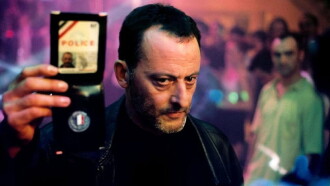
Hubert is a French policeman with very sharp methods. After being forced to take 2 months off by his boss, who doesn't share his view on working methods, he goes back to Japan, where he used to work 19 years ago, to settle the probate of his girlfriend who left him shortly after marriage without a trace.
Two penniless orphans, Black and White, struggle to survive on the mean streets of Treasure Town. When a megacorporation threatens to tear down the town to build an amusement park, Black and White engage in the fight of their life.
Murakawa, an aging Tokyo yakuza tiring of gangster life, is sent by his boss to Okinawa along with a few of his henchmen to help end a gang war, supposedly as mediators between two warring clans.
It is the third film in the Gokudo series. In this episode, set in 1937, the main character of the series gang leader Shimamura is drafted into the military and fight in China.
A dangerous mobster threatens the life of a businessman's mother in this thriller. As Ryuji oversees the building of a bridge in Japan, a powerful gangster plans to stop the project.
Ichiro Kataki, a violent Yakuza gang member travels to Melbourne, Australia after his beloved sister Yuko is brutally murdered by a group of criminals.
Three identical prints of a single 100 foot fixed-camera take are shown from beginning to end-roll light-flare, with a few feet of blackness preceding/bridging/following the rolls.
Centring on the legend of the four ancient Chinese heroines, the film was a novelty for audiences at the time, as the singing performance was in Cantonese and used huangmei operatic rhythms—a popular trend in the 1960s, yet it retained traditional flavours by using operatic luogu percussion in the battle scenes.
Two young boys, play hooky from school in order to explore an ultramodern world's fair. They take in the many marvelous scientific and industrial exhibits, obtain literature, eat food, and generally run amok.
"In my film I suggest that there is no greater mystery than that of the protagonists. War and Love are simply equated for what they are; the aftermath is inevitable, and a normal human condition, for which like the ancients one can only have pity and understanding.
Documentary by Juan Francisco de Lasa about a pioneer of Spanish cinema. Gelabert attended one of the first sessions of the Lumière's cinématographe in Barcelona.
Comments
Have you watched The Bandits yet? What did you think about it?