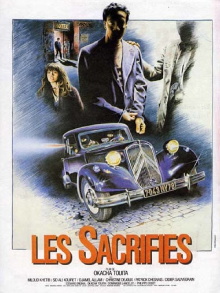
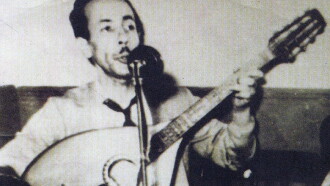
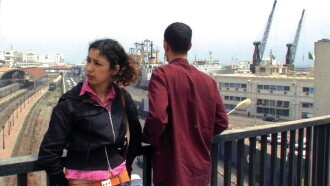
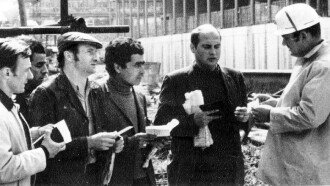
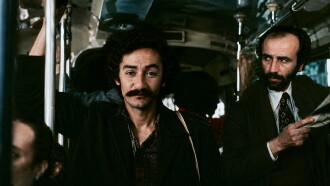
In 1955, a year after the birth of the National Liberation Front (FLN), Mahmoud was expelled from Algeria by the colonial authorities who feared his revolutionary speeches. At the age of 27, he arrived in the Algerian slum of Nanterre. Roughly questioned by FLN activists, in disagreement with the Algerian Nationalist Movement (MNA) who wanted to recognize theirs, he was then accepted as the local hairdresser and shoemaker. Subsequently, he became a driver during anti-MNA expeditions. Accepting increasingly dangerous missions, he is imprisoned by the French police and once again undergoes interrogations and special treatment by the police which will definitively undermine his sanity. One day, he no longer recognized his companions, and when joy broke out among the FLN militants, at the announcement of the signing of the Evian Accords, Mahmoud remained alone, frozen in an attitude of refusal, walled in his madness. Algeria has just won its independence.
In a working-class immigrant neighborhood slated for demolition, Jo, the son of Ali, known as the Rescuer from the Algerian war, lives idle and delinquent, committing small assaults to pay for his drugs.
Ali in Wonderland unveils the condition of immigrant workers in Paris in the 1970s. It is a cry of anger against exploitation and racism, uncompromisingly raising the role of the French state, the media, capitalism, and colonization in this system of domination that crushes those who suffer it.
Ahmed, an Algerian laborer and young father, leaves his country and arrives in France, hoping to find a job through Salah, a friend who has been living in the Paris suburbs for several years.
An unemployed Algerian worker leaves Paris by hitchhiking. He soon found himself in Brittany and, seduced by the beauty of wild gorse, eventually established himself as a gorse merchant.
High school student David Lightman has a talent for hacking. But while trying to hack into a computer system to play unreleased video games, he unwittingly taps into the Department of Defense's war computer and initiates a confrontation of global proportions.
James Bond returns as the secret agent 007 to battle the evil organization SPECTRE. Bond must defeat Largo, who has stolen two atomic warheads for nuclear blackmail.
A woman was raped in her school years and broke up with her lover because of it. Later, when she became a high school music teacher, she had forbidden liaisons with her colleagues and students at her apartment.