Hollis Frampton Trailers
Funtime at the Vasulkas TrailerAs I Was Moving Ahead Occasionally I Saw Brief Glimpses of Beauty TrailerHe Stands in a Desert Counting the Seconds of His Life Trailer
Hollis Frampton is known for the broad and restless intelligence he brought to the films he made, beginning in the early '60s, until his death in 1984. In addition to being an important experimental filmmaker, he was also an accomplished photographer and writer, and in the 1970s made significant contributions to the emerging field of computer science. He is considered one of the pioneers of what has come to be termed structuralism, an influential style of experimental filmmaking that uses the basic elements of cinematic language to create works that investigate film form at the expense of traditional narrative content. Along with Michael Snow and Stan Brakhage, he is one of the major figures to emerge from the New York avant-garde film community of the 1960s.
Most Popular Hollis Frampton Trailers
Total trailers found: 74
01 January 1985
Home movies shot on Super 8mm by W+B Hein over 10 years.
15 March 1979
Grand Opera marks a stock-taking of Benning's work and his life, presenting a personal and artistic autobiography woven together with a series of events dealing with the historical development of the number pi, Benning's travels, and homages to Michael Snow, Hollis Frampton, George Landow (Owen Land), and Yvonne Rainer.
13 February 1974
A pendulum swings by until it comes to a complete stop.
09 September 1972
Frampton on Apparatus Sum: "A brief lyric film of death, which brings to equilibrium a single reactive image from a roomful of cadavers.
05 November 2000
A compilation of over 30 years of private home movie footage shot by Lithuanian-American avant-garde director Jonas Mekas, assembled by Mekas "purely by chance", without concern for chronological order.
12 September 1968
"Homage to Michael Snow's environmental sculpture 'Blind.' The film proposes analogies, in imitation of three historic montage styles, for three perceptual modes mimed by that work.
13 February 1974
Clouds roll by in a static haze.
13 February 1974
Rain falls and reflects the light.
16 February 1972
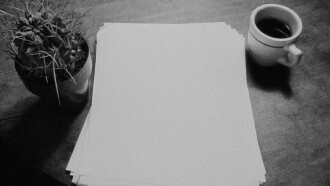
Poetic Justice presents the viewer with an ordinary domestic scene: a stack of papers, a cup of coffee, and a potted cactus on a table.
29 March 1974
Otherwise known as Magellan's Toys #1. Hollis Frampton's "Noctiluca" was a film designed to be shown on the second day of the Magellan cycle, the filmmaker's unfinished magnum opus work.
01 April 1970
Zorns Lemma is a 1970 American structural film by Hollis Frampton. It is named after Zorn's lemma (also known as the Kuratowski–Zorn lemma), a proposition of set theory formulated by mathematician Max Zorn in 1935.
09 September 1973
"Near the end of 1973, Frampton realized that he had not finished a single film over the course of a year.
05 March 1969
Upward shot from the ground perspective of a silo.
29 December 1967
In a Lower Manhattan industrial loft, a camera very slowly zooms into a photograph on a wall while various people occasionally enter and exit.
09 September 1966
Frampton on Information: "Hypothetical 'first film' for a synthetic tradition constructed from scratch on reasonable principles, given: 1) camera; 2) rawstock; 3) a single bare lightbulb.
13 February 1974
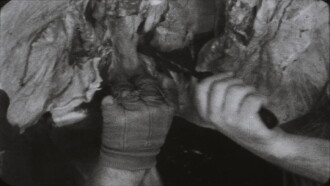
A butchered cow is decapitated in this short film by Hollis Frampton.
13 February 1974
A series of ghost-like vehicles drive by.
01 January 1977
Short film by Hollis Frampton
31 December 1969
Artificial Light repeats variations on a single filmic utterance twenty times. The same phrase is a series of portrait shots of a group of young New York artists talking, drinking wine, laughing, smoking, informally.
13 February 1974
A series of papers flutter in the wind.
30 November 1969
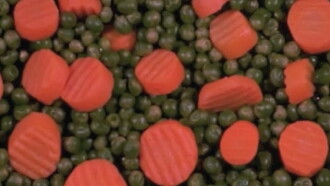
An experimental short film which compares and contrasts the colors of carrots and peas.
31 December 1977
Hollis Frampton alludes to origins and creation as he cuts between a garden featuring a bride and groom and an 1902 film entitled "A Little Piece of String.
13 February 1974
A little boy celebrates his frog catch.
13 February 1974
Filmed in a slaughterhouse in South St. Paul, MN… Frampton utilizes a shooting strategy that flattens and pictorializes a palpable space of action that includes not only cattle (now seen hanging from huge meathooks), but even on occasion, figures.
22 February 1986
A film collage tracing the story of the lives, loves, and deaths within the artistic community surrounding Jonas Mekas.
01 January 1984
Joyce Wieland: “Hollis and I came back to Toronto on holiday in the summer of '67. We were staying at a friend's house.
26 August 2026
Adapting an unpublished screenplay by Hollis Frampton, Charli explores and challenges the perceptions of trans women at their most intensely dysphoric.
01 January 1966
An experimental short film by Hollis Frampton of contrasting colours.
30 December 1974
"The operations that dislocate a film like Summer Solstice– I hope irreparably– from being a movie about the locomotion and eating habits of cows, a dairy farm document, or what have you, are finally of a whole lot less concern to me than the following things: how it looks, the sense that probably it was done deliberately, the pleasure or displeasure– the intrigue, possibly– of attempting to retrieve the manner in which it was done while one is watching.
01 January 1976
"In the final format for MAGELLAN, Frampton had planned to disassemble these two films into twenty-four 'encounters with death' that were to be shown in five-minute segments twice a month.
02 January 1972
“The frame itself, which divides what is present to consciousness from what is absolutely elsewhere, is tempered here by the breath, tremor, heartbeat of the perceiver.
01 January 1969
“For Black and White Film, Huot created his own photographic imagery for the first time. After a few moments of darkness, a young woman (Sheila Raj) lowers a covering of some kind, slowly revealing her naked body.
11 September 1979
A film of multiple superimpositions, utilizing the images of Solariumagelani (Summer Solstice, Autumnal Equinox, and Winter Solstice) (1974) overlaid with the hexagonal shapes that recur throughout Frampton's Magellan cycle.
31 December 1974
An experimental short by Hollis Frampton who films the female form during various activities.
31 December 1966
In this "fourteen-part drill for the camera," Frampton created a portrait gallery of his art-world friends engaging in a variety of ordinary activities.
01 January 1980
Short film by Hollis Frampton
31 December 1968
A film in three parts: a man talking while a telephone rings, a walking tour of New York, and a goldfish swimming.
12 September 1972
"A vision of a journey, during which the eye of the mind drives headlong through Salisbury Cloister (a monument to enclosure), Brooklyn Bridge (a monument to connection), Stonehenge (a monument to the intercourse between consciousness and LIGHT).
31 December 1968
Scottish physicist James Clerk Maxwell's classic theory about the behavior of gas molecules is represented on-screen by a man performing a series of Canadian air force exercises.
02 January 1972
“A ‘baroque’ summary of film’s historic internal conflicts, chiefly those between narrative and metric/plastic montage; and between illusionist and graphic space.
01 January 1972
"In PUBLIC DOMAIN...(Frampton) recapitulates cinema's infancy in a series of direct quotes from such notable primitive works as RECORD OF A SNEEZE (FRED OTT'S SNEEZE) and SANDOW FLEXING HIS MUSCLES, two 1894 Edison kinetoscopic shorts, as well as literal pieces of cinematic juvenilia (child wading at the beach, another throwing a tantrum at home, three women merrily blowing bubble pipes, and the finale, a melodramatic weighing of a newborn attended by an anxious father, doctor, and nurse)–all readily retrievable/quotable fragments from our finite federal version of the 'infinite film,' the paper print collection at the Library of Congress.
09 September 1969
"Two repetitive, banal rhythmic acts - as it were from the observe and reverse of a phenakistiscope disk - factored and expanded into a cinema filmstrip.
13 February 1974
The camera pans across a field of flowers at extreme speeds.
04 December 1971
“This film metaphors an entire human life: birth, sex, death – the framing device is the fingers and palm of the maker’s hand, wherein others only attempt to read the future.
01 January 1976
An experimental short film from the Gates of Death series by Hollis Frampton.
13 February 1974
A sampling of forty-nine fragments from Frampton's catalogue of 'actualities', the films from STRAITS OF MAGELLAN: "DRAFTS AND FRAGMENTS" are all silent and unedited.
01 January 1972
“A portrait of the filmmaker, Paul Sharits, in particular response to energies he generated one May afternoon in 1971.
13 June 1972
"After two years of massive didacticism in black-and-white [Hapax Legomena (1971-72)], I am surprised by Tiger Balm, lyrical, in color, a celebration of generative humors and principles, in homage to the green of England, the light of my dooryard… and consecutive matters.
06 June 1976
"Filmed in large part during H.F.'s lecture-screening tour in the bay area: visit(s) to the Musee Mechanique, Land's End, the Cliff House.
01 June 1969
By stripping the sound from a pre-existing instructional film, Frampton conjures, with an economy of means, the everyday movements then being explored by the Judson Dance Theater.
01 January 1976
“An exquisite homage to O’Keeffe’s ‘Radiator Building, Night’.” –Mark Webber
01 January 2006
A recording of a meeting in the studio where Jeffrey Schier and Woody show colleagues and teachers a new tool.
01 January 2012
An icon of the American avant-garde, Hollis Frampton made rigorous, audacious, brainy, and downright thrilling films, leaving behind a body of work that remains unparalleled.
05 June 1979
"...Frampton travels to the purported birthplace of the Eisensteinian model of cinema, the fairground, with its 'montage of attractions'.
06 July 1976
"Strategy and imagery combat and aid each other in pairs. QUATERNION...a spatial figure of monumental attractions.
09 September 1976
"This film is composed of different and relatively commonplace subjects, but each image is a super-imposition ('double exposure') of two similar shots of the same subject, almost in the same position.
20 October 1975
An analysis of film’s persistent relationship to sexuality, mediated by allusions to early cinema’s flicker, and other aggressive qualities of the cinematic apparatus.
09 September 1967
"No, not the United etc. but the conditions, forms in which things exist. Somewhat abstracted, a solid, a liquid and a gas: salt, milk and smoke: falling, pouring and rising are the stars of this classical film.