Józef Robakowski Trailers
Trying to Describe Oneself TrailerConversation With My Mother TrailerThe Energy Manifesto! Trailer


Trying to Describe Oneself TrailerConversation With My Mother TrailerThe Energy Manifesto! Trailer

Total trailers found: 48

04 November 2005
Trying to describe oneself is a movie about representation. How it is possible, through film, to describe oneself and describe others.
12 November 2002
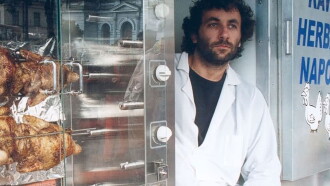
A young married couple and their everyday hardships. Unemployed Wojtek decides to sell grilled chicken from a street stall.
31 December 1999
In Impulsators, Robakowski rejects the narrative film form and the representational function in the spirit of his radical manifestations against the illusory character of traditional film in the 1970s, such as e.
21 April 1994
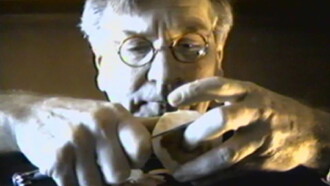
A short showing Robakowski peeling and eating an apple, which itself produces the sound.
18 February 1993
ince the 1970s, Robakowski has been experimenting with the category of the author, transferring the authorship of his works onto the film camera.
01 January 1982
Video: Józef Robakowski, music: Laibach Werkstatt, production: Exchange Gallery.
01 January 1982
"...We came to the conclusion that the event recorded on the film does not have to be logically interpreted or named, because its meaning or even nonsense is justified by the fact that this phenomenon took place in a state of war.
01 January 2004
A fictional telephone conversation between the filmmaker and his mother on her birthday. A performative reflection on the relationship between public and private spheres in which the maker turns his back to the camera, simultaneously shielding himself, and engages the viewer in the (im)possibility of bridging the gap between the man and his mother.
01 January 1985
The ritual transmission of a military parade from Moscow’s Red Square: On every anniversary of the October Revolution, this was loyally broadcast by all the television stations in the so-called people’s democracies.
01 January 1990
One of the three epitaphs that Robakowski created between 1966 and 1994, in an installation entitled Mr Deer (Self-Epitaph).
01 January 1994
Words and abstract shapes on a film strip, shot on video
03 July 1985
A swing imposes its rhythm, independent of the commentator; it forms the rhythmic score for the filmmaker's singing.
04 March 1992
The equation of organically generated soundtrack with the video image.
07 March 1990
A simple video performance mocking the so called "butchers of art", some Polish performers that used to devastate their bodies during the performances.
01 January 1970
From the heaps of rusted scrap metal, a metal, fully functional figure shapes up, trying to get out of there to reach the horizon.
01 January 1970
The film is an experimental documentary form, made using the stop-motion method. It is a single shot in total plan, showing an aerial view of the Balucki Market in Lodz.
01 January 1999
In 1978, Robakowski moved into a new flat in a newly-built high rise in the center of Łódź. That’s when he began filming the people and events he could see from his kitchen window.
02 June 2004
The film is dedicated to the memory of American surrealist Paul Sharits. Sharits sent Robakowski a film score with a proposal to use it in a film production, but the outbreak of martial law prevented the idea from being realised.
01 January 1985
This film belongs to a group of works that constitute manifestations of Robakowski’s engaged attitude towards social reality.
01 January 1985
Robakowski directs the camera to zoom back and forth.
04 February 2003
A highly expressive cry from the author of the manifesto, uttered while his head emerges from the water: "I should like to tell you all that art is energy!
01 January 1971
A classical organ composition by Johann Sebastian Bach “stretches” a red strip of film; An exploration of musical memory.
01 July 1985
The camera records the trajectory and dynamics of Robakowski's movement: he walks, turns and spins with his head up in the woods.
01 January 1992
Here, the line serves the purpose of manifesting the artists marked pursuit in the 1970s to “brighten various structures of discipline”.
01 January 1992
An autobiographical, auto-therapeutic take, laced with deadpan humor. Here we learn about another identity crisis as Robakowski speaks of his fear of putting on his late grandfather’s glasses.
01 January 1973
From 'The Workshop of the Film Form'. // In I'm Going Robakowski attempted an iconoclastic representation of the human body.
01 June 1990
A film with Robakowski's characteristic single-shot structure, filmed from the perspective of a character who struggles to walk along a forest path, constantly complaining of nagging pain in his leg.
01 January 1981
A film sketch for a portrait of Stanislaw Ignacy Witkiewicz by multimedia artist Jozef Robakowski.
01 January 1971
Abstract, geometric forms, became the basis for the most outstanding works of the avant-garde sculptor Katarzyna Kobro.
01 January 1989
A film consisting of two shots recorded by a camera mounted on a lorry driving through Brooklyn, New York.
01 January 2004
The expression of the fascination of a problem of the ANGLES existance as of its kind intuitive geometry.
01 January 1970
Experimental short film by Józef Robakowski & Ryszard Meissner.
01 January 1973
The protagonist climbs the steps of a tower, loudly counting each step. The end of his climb also marks the end of the film.
01 January 1989
The camera records the trajectory and dynamics of Robakowski's movement: he walks along the white line painted on the football pitch.
01 January 2005
A performance staged during the WRO 96 festival, entitled Monitor Polski. The artist presented a device in which his body was a conductor through which electricity flowed, with the voltage gradually increased at the artist's request and with the participation of the audience.
01 January 1989
In the sensual erotic piece, Robakowski revisits three experiences of homosexuality he encountered as a child, a teenager, and an adult.
01 January 1987
A resulted from Robakowski's re-editing the video Łódź Kaliska (1986) which he had shot together with Witold Krymarys.
01 January 1986
The violent text resonates with the harsh energy of the music videos—for instance Powietrza (More Air), 1986, in which the band frantically cries for oxygen in then politically oppressive Poland.
