Paolo Gioli Trailers
Paolo Gioli: Free Films Made Freely TrailerRitratto di Piero Bargellini TrailerThe Perforated Cameraman Trailer
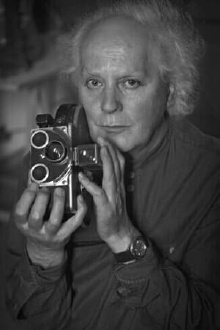
Paolo Gioli was born in Sarzano di Rovigo in 1942; he studied at the Fine Arts Academy in Venice and then in New York, where he came into contact with the New American Cinema, the New York School, and where he met Leo Castelli and Martha Jackson. In 1970 he settled in Rome where he frequented the authors of the Cooperativa Cinema Indipendente and the Filmstudio, and started to produce his own films. He moved to Milan in 1976 and focused his attention on photography: in this period he started using polaroid photos as a powerful means to broaden his research on instant photography, printing his work on different materials such as paper and canvas. Gioli is considered one of the most important photographers and film makers of his generation, and has held numerous solo exhibits in some of the most important museums such as the Centre Pompidou in Paris, the MoMA in New York and the Palazzo delle Esposizioni in Rome.

Most Popular Paolo Gioli Trailers
Total trailers found: 46
21 December 1973
Traumatografo is a film, the principal purpose of which is to comfort those who fear death by the gallows or scaffold.
10 September 1973
Self-shot: a film shot without a camera operator. Sole witness: the movie camera. Fixed, directed at a single expanse, obedient to the orders of wires that I manipulate: characters splitting in two through the asymmetrical filtration of the comings and goings of self-irony.
01 January 1992
Composed of still images from several photographs of the actress and pop icon Marilyn Monroe that have been manually transferred to film frame by frame, and animated through intermediate gradations within a series of successive, rapid fire montage visual "chapters", Gioli resurrects the vitality, captivating charm, and exuded sensuality of the voluptuous, iconic Hollywood superstar through the sequencing of the manipulated images - modulated object framing, subtle displacement, photographic blow-ups or visual recessions that simulate dimensionality and varying depths of focus - into a bold, risqué, and tantalizing "new" film starring the late actress.
12 January 1972
To split the visual realm in two: one is permeated with a schizo-imaginific detour, the second vibrates in a collateral contrast.
01 January 1989
It all started with the notorious Buñuelian sliced eyeball, that surprises us every time. The eye of an ox, but still it's the eye of a woman! The anxiety of the incision is transformed into a saccadic, uncontrolled anxiety precisely of the eye and of its pupil.
05 February 1970
A film that has chosen as its protagonist its own negative and will remain committed to that choice until the very end.
01 January 2012
A reflection on the material, on the filmic support. Strips of figures wander, fluxuate in the whirling kinetic rhythms imposed on them.
08 April 1972
The film relates the beliefs the author held for a certain time concerning water and diving into it.
01 January 2009
"Faces and figures found on reels of film by an unknown artist from the first few years of the 20th century.
11 March 2007
Feature-length retrospective interview with Italian avant-garde filmmaker Paolo Gioli.
05 February 2012
A reflection on the material, on the filmic support. Strips of figures wander, fluxuate in the whirling kinetic rhythms imposed on them.
10 May 2002
This digital video arose from the idea of trying to transfer to film all the photographic images I had created with the so-called “photo-finish” technique.
05 February 1984
Realized on the occasion of one of my photographic exhibitions of the same title dedicated to the Etruscans of Volterra.
05 February 1972
This film was shot a frame at the time using laborious extreme optical close-ups. Anonimatograph: the reanimated image of an unknown amateur at the beginning of the century who becomes middle class as he focuses on friends, movie camera in hand, indoors and outdoors surrounded by war and by his sisters.
01 January 2008
Made from fragments of a found porno film, where the frameline, which divides the images, becomes a mysterious plastic form, struggling in the center of the screen, vertically and horizontally.
01 January 1969
Executed and printed with two hands, that is to say, made using all possible means of imprinting the right and arm freshly applied ink, sand paper, stamps, etc.
01 January 1969
An artist's self-portrait problematizing the choice between tradition and the avant-garde, between being free or being disciplined.
01 January 2008
"I have always been interested in the sequencing of images in books, where the possibility exists of imposing movement onto still images.
05 February 1984
It is known that Muybridge was at the same time a great photographer and a killer, executioner of his wife’s lover and that into his own station physiologique (to use Marey’s term for his own working laboratory), it seems, not a single black man ever entered.
01 January 2013
Feminine undergarments placed over a wooden tablet around which a film, itself impure, has been wound.
04 June 1986
This extremely short film is dedicated to chronophotography, which—as is well known—is the prelude to cinema.
05 February 2008
This is not a short documentary on Rothko, but rather my reflection on his canvasses, that become so deeply assimilated with the screen, frames of film, the frame line.
01 January 1974
A film eroticized by prolonged baths in silver salts. Complete exposure of reclining bodies and their lascivious perambulations.
01 January 1969
Composed using three different formats, that have been made to co-exist: super-8, 16mm, and 35mm on a single 16mm support, clear leader.
01 January 1989
I have several English style windows and this and a tree in winter have caused me to think about Fox-Talbot’s window—his first image, perhaps.
06 May 1979
In L’operatore perforato (1979) that plump sprocket hole comes into its own. It multiplies like a virus, riding serenely on the surface, nearly obliterating the images trembling underneath it.
01 January 2009
Three persons wander on bridges and roads.
01 January 2009
"Extracted from rolls of 35mm film on which I had made exposures using the photofinish technique. That is, images intended as photography, and therefore as still images.
05 February 1973
A filmic homage to the German mime Helfrid Foron, a student of Etienne Decroux who worked with acrobats and tight-rope walkers.
26 December 2005
From Paolo Brunatto's series "Scheggie Di Utopia".
01 January 2002
An anthology of short films by Italian film director Paolo Gioli.
05 October 2013
A film made a single batch of 45 pin holes in a 50 cm hollow tube.
07 August 2014
Paolo Gioli's cinematic verification of Edwin H. Land's experiment in color perception.
01 January 1991
It is well known that the disposition of the images drawn by Escher are neither for animation nor for pre-animation; actually, quite the opposite.
03 October 2009
A film completely excavated by rephotographing rolls of 35mm negative containing images made with the photo-finish (slit scan) technique, the so-called foto-lunga which has no frame line and therefore no individual frames.
01 January 1978
I have a fixed idea about the screen that while it has no depth, we know that it is sprayed by 24 frames a second at the same point for an infinite amount of time.
01 January 1973
Pier Farri's Futurist Europe focuses on Futurism as the first avant-garde film movement in history.
01 January 2002
This digital video arose from the idea of trying to transfer to film all the photographic images I had created with the so-called “photo-finish” technique.
05 February 1993
Cinematic flicker: flicker is introduced into the flutter of butterflies shot from small books. My intention was, here as elsewhere, to animate what is inexorably locked up in the fixity of typographic ink in a book.
09 May 1970
Strains of Wagner's Das Rheingold and African tribal ululations collide with bi-/tri-sected television footage while negative-positive visuals smash heedlessly into their mirror images, an unbounded series of “meaningful” artistic fender-benders that amount to little of resonant substance.
11 July 1989
Film made with a tiny pinhole camera and 16mm film.
01 January 1986
This film was constructed using the so-called “photo-finish” technique employed in sporting events.
01 January 1994
"Duchamp is certainly as complex as Joyce and to do something about him, I tried to dedicate to him this small film poem, using only a few images of images of his work, taken always from books and catalogues (that are made of typographic ink).
05 February 1973
This film is an accumulation of semi-stroboscopic figures with features invisible to the eye, that remain in the human cerebral cortex located at the top of the brain.
05 February 1995
From old plates of an anonymous photographer who worked in the 50s, I extracted this impossible film (plates that had contributed to the composition of one of my little books with the title Sconosciuti [Persons Unknown] Frame by frame, plate by plate, with strips of reflected light and strips of tens of faces, I tried to bring them into a single cinematic stream, thinking about a solitary, single face emerging from the darkness.


